
四新赋能

Search documents
曾进泽:广东推动超5万家规上工业企业数字化转型
2 1 Shi Ji Jing Ji Bao Dao· 2026-02-24 08:47
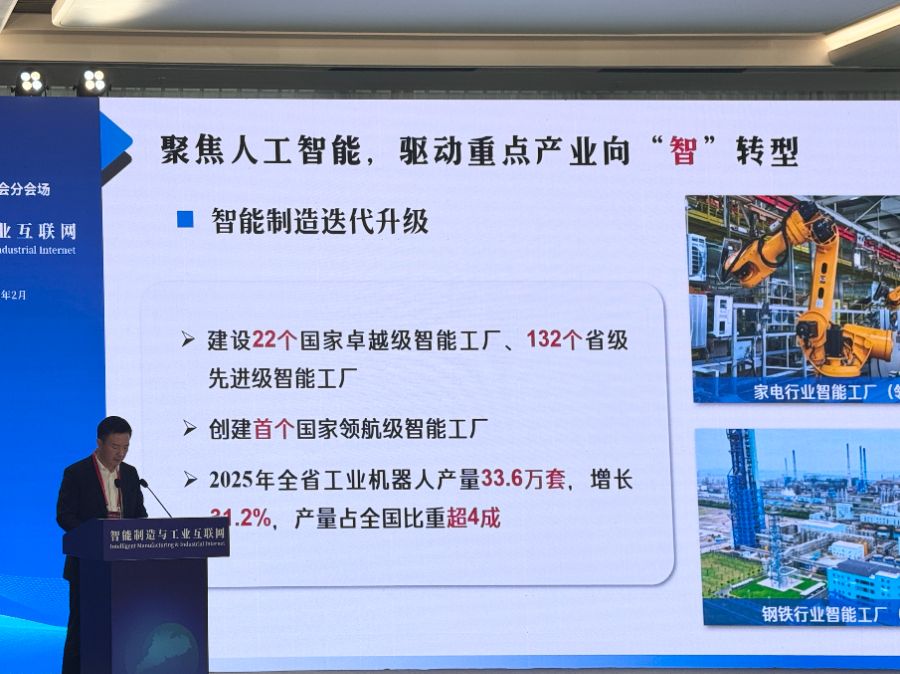
Core Viewpoint - Guangdong Province is making significant strides in digital transformation and smart manufacturing, aiming to exceed its "14th Five-Year Plan" goals by promoting over 50,000 industrial enterprises to undergo digital transformation by the end of 2025 [3][4]. Group 1: Digital Transformation Initiatives - Guangdong is focusing on the digital transformation of key industries, supporting leading enterprises in electronics, advanced equipment, and pharmaceuticals, with over 400 "lighthouse" projects, including more than 200 national model projects [4]. - The province has initiated pilot cities for small and medium-sized enterprises (SMEs) digital transformation, with over 4,000 SMEs undergoing digital upgrades across 38 key sectors [4][6]. - A long-term mechanism for digital transformation is established, including "diagnosis and assessment - implementation - sample promotion," with six cities recognized as national pilot cities [4][6]. Group 2: Artificial Intelligence Integration - By 2025, the core AI industry in Guangdong is expected to exceed 300 billion, accounting for about one-quarter of the national total [4]. - The province is developing industrial AI models and creating innovative platforms to enhance the integration of AI and manufacturing [5]. - The production of industrial robots is projected to reach 336,000 units by 2025, representing a growth of 31.2% and over 40% of the national share [5]. Group 3: Supply Chain and Industry Upgrades - Guangdong is promoting a "chain-based transformation" to enhance the supply chain, encouraging leading enterprises to build digital supply chains and improve efficiency [6]. - The province is leveraging industrial internet platforms to provide cost-effective digital solutions for upstream and downstream enterprises, fostering new business models [6]. - AI is being integrated into software development, with 50% of new code generated with AI assistance, reducing coding time by 40% and improving development efficiency by 20% [6]. Group 4: Investment and Technological Upgrades - Guangdong aims to drive technological upgrades in over 9,300 industrial enterprises by 2025, with a 12.6% year-on-year increase in investment for upgrading equipment [7]. - The province is facilitating deep cooperation between manufacturing and AI companies through targeted events, promoting the transformation of projects into actual investments [7]. - A comprehensive manufacturing empowerment system is being established, with the creation of national industrial internet platforms and partnerships to support digital transformation [7].

改造项目效率平均提升30%,广东力推传统产业“四新”赋能
Nan Fang Du Shi Bao· 2025-06-21 03:15
Core Viewpoint - Guangdong province is intensifying efforts to empower traditional industries through the application of new technologies, processes, materials, and equipment, which is crucial for the transformation and upgrading of the manufacturing sector [1][4]. Group 1: Traditional Industry Significance - Traditional industries in Guangdong account for over 70% of the added value of above-scale manufacturing, 65% of tax revenue, and 75% of employment, highlighting their critical role in the industrial economy [1]. - Upgrading traditional industries is essential for solidifying the manufacturing base and developing new productive forces [1]. Group 2: Financial Support and Collaboration - China Construction Bank's Guangdong branch introduced comprehensive financial solutions for enterprise technological transformation, providing specialized loans totaling 960 million yuan for equipment updates and technology improvements [2]. - Collaboration among research institutions, financial entities, and enterprises is emphasized to enhance the application of new technologies in traditional industries [1][2]. Group 3: Technological Pathways - The "Five Modernizations" approach proposed by South China University of Technology focuses on standardization, modularization, integration, systematization, and process optimization to facilitate AI integration in manufacturing [2][3]. - AI models can enhance production efficiency and provide management support in decision-making, compliance, marketing, and cultural heritage [3]. Group 4: Policy and Future Directions - The Guangdong provincial government plans to release a work plan for "Four New" empowerment in traditional industries, targeting sectors such as petrochemicals, steel, non-ferrous metals, construction materials, machinery, automotive, light industry, and textiles [4]. - Recent projects have shown an average production capacity increase of 10%, product qualification rate improvement of 6%, production cost reduction of 8%, and production efficiency enhancement of 30% post-transformation [3].