
链式改造

Search documents
曾进泽:广东推动超5万家规上工业企业数字化转型
2 1 Shi Ji Jing Ji Bao Dao· 2026-02-24 08:47
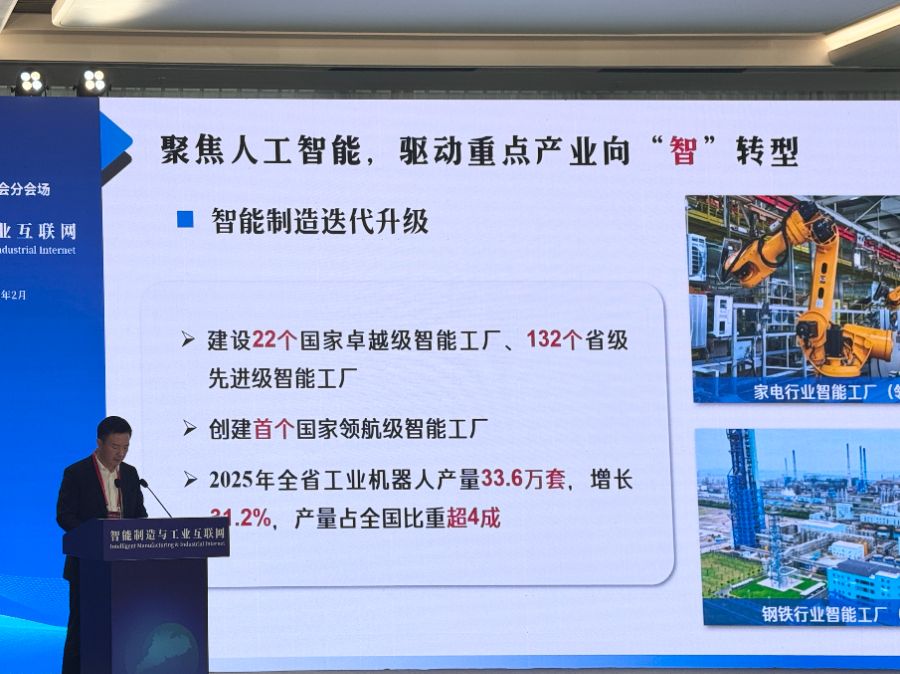
Core Viewpoint - Guangdong Province is making significant strides in digital transformation and smart manufacturing, aiming to exceed its "14th Five-Year Plan" goals by promoting over 50,000 industrial enterprises to undergo digital transformation by the end of 2025 [3][4]. Group 1: Digital Transformation Initiatives - Guangdong is focusing on the digital transformation of key industries, supporting leading enterprises in electronics, advanced equipment, and pharmaceuticals, with over 400 "lighthouse" projects, including more than 200 national model projects [4]. - The province has initiated pilot cities for small and medium-sized enterprises (SMEs) digital transformation, with over 4,000 SMEs undergoing digital upgrades across 38 key sectors [4][6]. - A long-term mechanism for digital transformation is established, including "diagnosis and assessment - implementation - sample promotion," with six cities recognized as national pilot cities [4][6]. Group 2: Artificial Intelligence Integration - By 2025, the core AI industry in Guangdong is expected to exceed 300 billion, accounting for about one-quarter of the national total [4]. - The province is developing industrial AI models and creating innovative platforms to enhance the integration of AI and manufacturing [5]. - The production of industrial robots is projected to reach 336,000 units by 2025, representing a growth of 31.2% and over 40% of the national share [5]. Group 3: Supply Chain and Industry Upgrades - Guangdong is promoting a "chain-based transformation" to enhance the supply chain, encouraging leading enterprises to build digital supply chains and improve efficiency [6]. - The province is leveraging industrial internet platforms to provide cost-effective digital solutions for upstream and downstream enterprises, fostering new business models [6]. - AI is being integrated into software development, with 50% of new code generated with AI assistance, reducing coding time by 40% and improving development efficiency by 20% [6]. Group 4: Investment and Technological Upgrades - Guangdong aims to drive technological upgrades in over 9,300 industrial enterprises by 2025, with a 12.6% year-on-year increase in investment for upgrading equipment [7]. - The province is facilitating deep cooperation between manufacturing and AI companies through targeted events, promoting the transformation of projects into actual investments [7]. - A comprehensive manufacturing empowerment system is being established, with the creation of national industrial internet platforms and partnerships to support digital transformation [7].

战鼓催征,广东“新春第一会”就这么策马开干!
2 1 Shi Ji Jing Ji Bao Dao· 2026-02-23 23:42
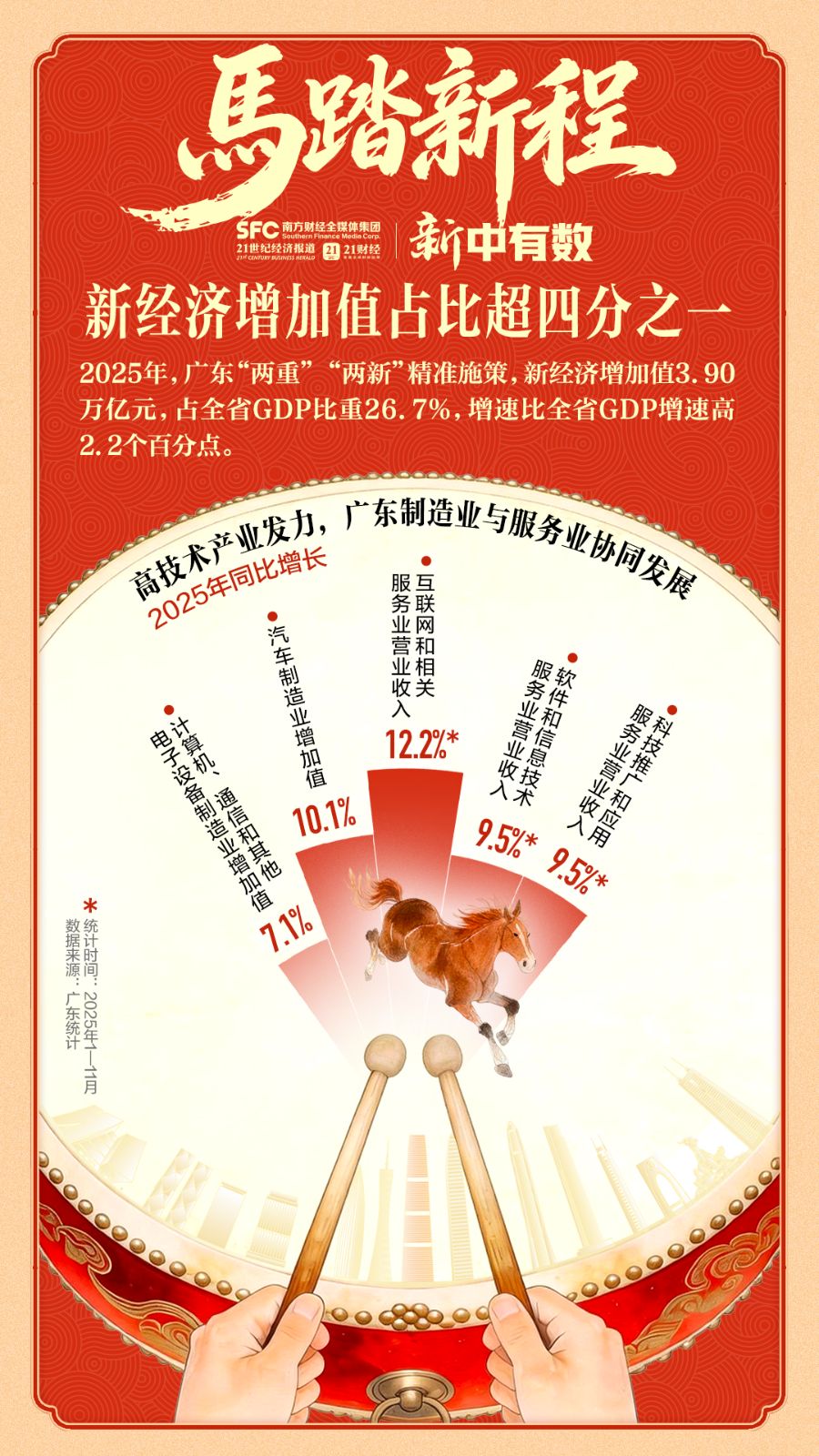
Group 1 - The core focus of the Guangdong "New Spring First Meeting" is on the collaborative development of manufacturing and service industries, aiming for high-quality growth [1] - Guangdong's industrial added value is projected to reach 4.89 trillion yuan by 2025, with over 77,000 high-tech enterprises, maintaining the top position in regional innovation capabilities for nine consecutive years [1] - The service sector's added value is expected to account for 58.3% of the provincial GDP by 2025, growing at a rate 0.8 percentage points faster than the overall GDP growth [1] Group 2 - By 2025, 20 industrial clusters in Guangdong will contribute 33.4% to the GDP, with ten trillion-level industrial clusters forming a multi-pillar, high-quality, modern industrial development pattern [4] - The electronic information industry is projected to exceed 1.08 trillion yuan in revenue by 2025, marking the first trillion-level industrial cluster in this field [5] Group 3 - Guangdong's regional innovation capability has ranked first in the nation for nine years, with the province holding the highest number of valid invention patents and high-value invention patents [6] - The "Shenzhen-Hong Kong-Guangzhou" innovation cluster has risen to the top of the global innovation cluster rankings [6] Group 4 - By 2025, the added value of high-tech manufacturing and equipment manufacturing in Guangdong is expected to account for 34.7% and 59.6% of the industrial output above designated size, respectively [8] - The new energy industry is rapidly developing and is becoming a new advantageous industry for Guangdong [8] Group 5 - The production of industrial robots in Guangdong has ranked first in the nation for six consecutive years, with the artificial intelligence core industry expected to reach 300 billion yuan by 2025, achieving over 40% growth [9] - The total output of industrial robots is projected to be 336,300 units by 2025, with service robots expected to reach 151,821 units [10] Group 6 - By the end of 2025, Guangdong's civil drone production is expected to exceed 6.9 million units, accounting for over 90% of the national total, while commercial aerospace-related enterprises will represent 11.5% of the national total [12] - The market share of consumer-grade drones in Guangdong is projected to be 95%, while industrial-grade drones will hold a 54% market share [12]
广东鼓励设“模型券” 降低算力使用成本
Nan Fang Du Shi Bao· 2025-10-22 23:08
Core Insights - The Guangdong Provincial Government has launched the "Action Plan for High-Quality Development of Manufacturing Empowered by Artificial Intelligence (2025-2027)" to enhance the integration of AI and manufacturing, aiming to create a globally influential demonstration zone for "AI + Manufacturing" [1] Group 1: Policy Measures - The action plan outlines 16 policy measures focusing on key supply reinforcement, application promotion, support system construction, and optimization of resource guarantees [1] - Specific industries targeted include consumer electronics, high-end equipment, automotive, petrochemicals, metal manufacturing, advanced materials, home furnishings, apparel, biomedicine, food, and toys [1] Group 2: Implementation Strategies - The plan emphasizes the innovation of AI applications in high-value scenarios such as R&D design, production, management, and supply chain management, with the goal of enhancing the efficiency of large and small AI models [2] - A selection process for provincial-level AI integration application benchmarks will be established, with funding support for qualifying projects to enhance demonstration and influence [2] Group 3: Support for SMEs - The government will leverage national and provincial policies to promote AI application among SMEs in over 30 pilot industries, providing financial support for eligible projects focused on AI integration [3] - Development of core software service platforms will be supported to enhance the AI capabilities of SMEs [3] Group 4: Financial Support and Investment - The action plan addresses the high costs associated with AI technology adoption in industrial enterprises, proposing the establishment of "model vouchers" and other financial tools to reduce costs [4] - A budget of 132 million yuan is allocated for AI technology projects by 2025, with a total of 2.196 billion yuan designated for foundational research and platform construction in AI [4] Group 5: Investment Goals - Guangdong aims to increase investment in AI to over 20 billion yuan by 2027, with a target of driving related industry scale to exceed 100 billion yuan [5] - The province has established a fund group for advanced manufacturing with a total subscribed scale of approximately 70 billion yuan, investing in 52 projects [5]
广东已推动4.4万家规上工业企业实现数字化转型
Zhong Guo Chan Ye Jing Ji Xin Xi Wang· 2025-06-01 22:52
Core Insights - Guangdong province is promoting a "chain transformation" for the digitalization of its manufacturing industry, with 44,000 large-scale industrial enterprises undergoing digital transformation and over 300 "lighthouse" projects cultivated, including more than 100 national pilot projects [1] - The digital transformation is shifting from "point breakthroughs" to "chain transformations," benefiting both leading enterprises and small and medium-sized enterprises (SMEs) [1] Group 1: Digital Transformation Initiatives - Guangdong has established a provincial digital transformation promotion center to address core issues such as "who to transform" and "how to transform," providing a one-stop service platform for digital transformation [2] - Guangzhou is leveraging its strengths by promoting low-cost and rapid transformation through a "one list, one platform" approach, with over 2,000 platform users and more than 500 product offerings [3] - Shenzhen Bao'an is accelerating resource aggregation to support deep collaboration within the industrial chain, with platforms like SugaNet and Cloud Factory gathering over 14,000 manufacturing enterprises [3] Group 2: Financial Support and Ecosystem Development - Dongguan Songshan Lake has created a digital service platform with over 100 quality digital service providers, offering more than 170 comprehensive solutions for over 7,000 micro-enterprises [4] - Zhongshan has innovated a "digital loan" policy to address funding challenges for SMEs, establishing a 500 million yuan risk compensation fund and facilitating 155 digital loan projects with a total loan demand of 1.6 billion yuan [4] Group 3: AI Integration in Manufacturing - Leading enterprises are acting as "chain leaders," with AI technology enhancing decision-making processes for SMEs, transitioning from traditional manual decisions to intelligent decisions [5][7] - Companies like Meiyun Zhishu are providing high-quality, low-cost, and easily deployable application solutions for SMEs through an industrial internet platform [6] - The "5G manufacturing brain" platform developed in collaboration with telecommunications has significantly improved production efficiency, saving over 600,000 yuan in storage costs annually [7]