
因子分域

Search documents
因子分域下的行业轮动框架——申万行业轮动框架介绍
申万宏源金工· 2025-12-18 08:01
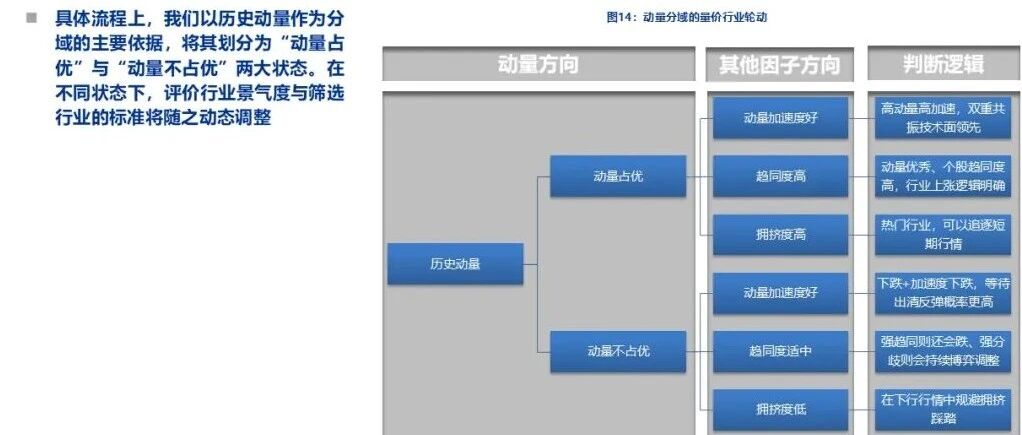
Group 1: Industry Rotation Framework - The rotation framework is introduced based on three dimensions: fundamentals, capital flow, and technical analysis [4][23]. - The fundamental aspect focuses on consensus expectations and financial reports, while the capital flow aspect examines investor money movements [4][23]. - The technical aspect is based on price and volume performance, which helps in understanding market trends [4][23]. Group 2: Performance Expectations - The change rate of consensus expectations is a better reflection of analyst views compared to individual earnings forecasts [5][6]. - The analysis shows that the consensus change in net profit for FY2 has a higher predictive capability, especially in top-performing portfolios [9][10]. - Growth indicators, such as quarterly net profit growth and gross margin growth, show better performance in screening effects compared to other metrics [11][12]. Group 3: Capital Flow Indicators - Institutional trading behavior is more rational compared to individual investors, making institutional funds a positive industry indicator [22][24]. - The analysis of capital flow shows that institutional funds have a higher rank IC of 5.09%, indicating a strong ability to select industries [30]. - In contrast, retail investor capital inflow demonstrates a negative relationship, with the highest performing group showing significant underperformance [30][27]. Group 4: Momentum Indicators - Traditional momentum indicators show varying effectiveness in industry selection, with longer-term momentum (24 months) having a statistically significant predictive effect [40][39]. - The concept of momentum acceleration is introduced to capture marginal changes in price trends, reflecting short-term investor sentiment [39][42]. - The analysis indicates that high momentum and high crowding industries can continue to perform well, suggesting that simple punitive measures against crowded trades may lead to missed opportunities [56][59]. Group 5: Multi-Factor Synthesis - A multi-factor synthesis approach is proposed to enhance industry rotation strategies, achieving a rank IC of 9.89% [54][52]. - The framework emphasizes the need to adapt to market conditions, suggesting that the effectiveness of factors can vary based on market states and industry attributes [58][59]. - The discussion highlights the importance of considering both momentum and crowding in a dynamic manner to optimize investment strategies [56][58].

申万行业轮动框架介绍:因子分域下的行业轮动框架
Shenwan Hongyuan Securities· 2025-12-14 14:42
Quantitative Models and Construction Methods Model Name: Momentum Acceleration - **Construction Idea**: The momentum acceleration factor is designed to measure the marginal change in price trends, reflecting short-term trading sentiment by excluding the impact of trading congestion[52] - **Construction Process**: - The factor is constructed by calculating the second derivative of the excess return curve to determine the rate of change in price trends - The formula used is not explicitly provided in the document, but it involves calculating the second derivative of the price trend to assess the acceleration or deceleration of price movements[52][53] - **Evaluation**: The momentum acceleration factor has shown to have a leading effect in industry selection, especially in long-term trends[53] Model Name: Composite Factor - **Construction Idea**: The composite factor integrates multiple dimensions to score industries, aiming to achieve sustained excess returns over the entire industry[63] - **Construction Process**: - The composite factor is constructed by combining various individual factors, including fundamental, technical, and sentiment indicators - The specific formula or method for combining these factors is not detailed in the document[63] - **Evaluation**: The composite factor has shown improved Rank_IC and sustained excess returns compared to the equal-weighted industry portfolio[63] Model Backtesting Results - **Momentum Acceleration**: - Rank_IC: 3.80% - IC_IR: 12.58% - IC>0 Ratio: 55.65% - Quintile 1 Annualized Return: -3.11% - Quintile 5 Annualized Return: 2.44%[56] - **Composite Factor**: - Rank_IC: 9.89% - IC_IR: 40.07% - IC>0 Ratio: 67.26% - Quintile 1 Annualized Return: -4.97% - Quintile 5 Annualized Return: 7.21%[61] Quantitative Factors and Construction Methods Factor Name: Analyst Consensus Change Rate - **Construction Idea**: The change rate of analyst consensus is used to reflect analysts' views more accurately[7] - **Construction Process**: - The factor is constructed using the change in consensus net profit forecasts over the past three months (FY1 and FY2) - The specific formula is not provided, but it involves calculating the percentage change in consensus forecasts[8] - **Evaluation**: The change rate of consensus net profit forecasts (FY2) has shown better predictive ability for excess returns compared to FY1[11] Factor Name: Cash Flow to Net Profit Ratio - **Construction Idea**: The cash flow to net profit ratio is used to reflect the quality of industry operations[22] - **Construction Process**: - The factor is constructed by calculating the ratio of operating cash flow to net profit - The specific formula is not provided, but it involves dividing operating cash flow by net profit[22] - **Evaluation**: The cash flow to net profit ratio has shown better performance in screening for high-quality industries, especially in identifying short positions[28] Factor Backtesting Results - **Analyst Consensus Change Rate (FY2)**: - Rank_IC: 6.17% - IC_IR: 25.22% - IC>0 Ratio: 63.03% - Quintile 1 Annualized Return: -4.44% - Quintile 5 Annualized Return: 2.77%[6] - **Cash Flow to Net Profit Ratio**: - Rank_IC: 4.90% - IC_IR: 25.01% - IC>0 Ratio: 58.78% - Quintile 1 Annualized Return: -2.17% - Quintile 5 Annualized Return: 3.88%[20]