国产大模型+算力+中国电力

Search documents
国产算力大涨,V4给英伟达新一轮DS冲击?
3 6 Ke· 2026-02-27 11:32
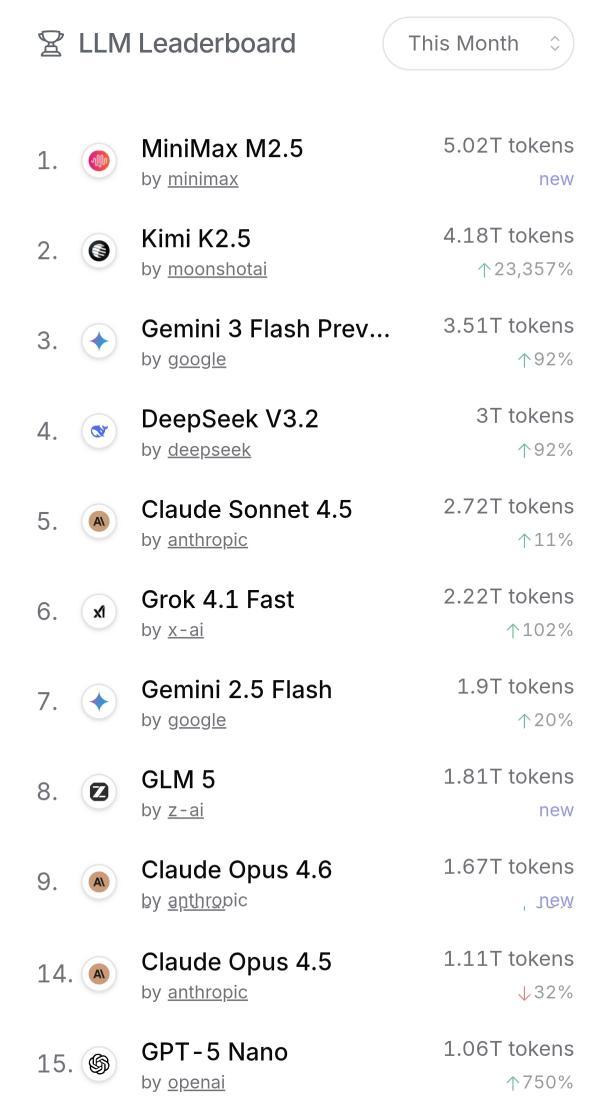
Group 1 - The core point of the article is that Chinese large models have surpassed American models in token usage, marking a significant milestone in the AI industry [1][2][13] - From February 9 to 15, 2023, the token call volume for Chinese models reached 41.2 trillion, surpassing the U.S. models at 29.4 trillion, and further increased to 51.6 trillion in the following week, a 127% rise [1] - The newly released MiniMax M2.5 achieved a token call volume of 45.5 trillion, becoming the monthly champion on OpenRouter [1][2] Group 2 - The rise of domestic computing power is breaking the monopoly of Nvidia, with significant investments in production capacity from local wafer manufacturers [3] - HW Ascend is accelerating its product launches, with the Ascend 950PR and 950DT expected in Q1 and Q4 of 2026, respectively, enhancing the capabilities of the Atlas 900 A3 SuperPoD [3] - The integration of domestic models, computing power, and China's electricity supply forms a competitive advantage that is difficult to replicate [3][4] Group 3 - The essence of AI is power consumption, which is fundamentally linked to chip computation and electricity supply [4] - China's leading position in power infrastructure and clean energy supports the growth of computing power, which in turn drives the iteration of large models [4] - The collaboration between HW Ascend and domestic manufacturers enhances the competitive edge of the domestic ecosystem [5] Group 4 - HW Ascend's public testing of the CodeArts AI development tool lowers the entry barrier for AI development, increasing participation in the ecosystem [7] - HW Ascend is actively defining global AI standards by joining the Linux Foundation's AAIF, positioning its chip architecture within global technology norms [7] - Nvidia's recent financial report showed strong revenue but resulted in a significant stock drop, attributed to market concerns over its growth sustainability and competition from emerging players [8][12] Group 5 - The "halo effect" in the AI industry is driven by strong demand for AI infrastructure and the rapid evolution of AI applications, impacting the software sector [10] - Key investment opportunities are identified in four areas: AIDC cloud services, domestic computing power, core segments of the global AI computing industry, and the "optical-electrical-material" triangle in AI infrastructure [10][12] - The "optical-electrical-material" triangle represents a high-demand segment, with increasing requirements for optical communication and power supply as AI computing needs grow [10][12] Group 6 - The overall trend indicates that the global AI industry landscape is being restructured, with China emerging as a significant player rather than merely a follower [13] - The era of domestic large models and computing power is just beginning, highlighting the importance of these developments in the global AI context [13]