国有资产法

Search documents
四大证券报头版头条内容精华摘要_2025年12月30日_财经新闻
Xin Lang Cai Jing· 2025-12-29 23:21
Group 1 - Ganfeng Lithium, a leading lithium mining company, has been indicted for insider trading and the case has been sent to the prosecution for review [1] - Wenkang Development announced a major asset restructuring plan involving the acquisition of stakes in Wenkang Mining and Luzhong Mining from its controlling shareholder [2] - Huali Co., a leader in decorative composite materials, has terminated its agreement to acquire a 51% stake in Zhongke Huilian Technology due to a lack of consensus on key transaction terms [3] Group 2 - Haizhi Technology has submitted its listing application to the Hong Kong Stock Exchange for the second time, following a previous application that expired; the company reported continuous losses from 2022 to 2025 [4] - SMIC announced a significant acquisition plan to purchase a 49% stake in SMIC North from five shareholders for a total of 406.01 billion yuan [5] - Several foreign investment institutions have expressed optimism about the Chinese market, citing abundant liquidity, stronger policy support, and attractive valuations as factors contributing to an "upward opportunity period" for Chinese assets in 2026 [6] Group 3 - Multiple companies in the lithium iron phosphate industry have announced production cuts, with reductions ranging from 35% to 50% scheduled for January 2026 [8][26] - Public funds in China have reached a record high of 37.02 trillion yuan, marking the first time the total scale has surpassed this threshold [11][29] - Various public fund institutions have held investment strategy meetings for 2026, with a consensus that technology will remain a core investment theme alongside opportunities in consumer recovery and overseas expansion [17][34] Group 4 - The recent increase in margin requirements for precious metals futures by the CME Group has led to a decline in international metal prices, with gold futures dropping below $4,500 per ounce [10][28] - The Chinese government is set to implement tax reforms aimed at addressing "tax revenue gaps" and standardizing tax incentives to foster a fair market environment [12][30] - A draft law on state-owned assets is open for public consultation, aiming to establish a comprehensive governance system for state assets to prevent loss and enhance management [13][31] Group 5 - 29 A-share companies have released their 2025 earnings forecasts, with 19 companies expecting profit increases, indicating a positive outlook for the upcoming fiscal year [14][32] - The Porsche dealership network in China is facing challenges, with reports of dealers disappearing and leaving showrooms empty, indicating potential issues within the distribution system [18][35]

立法守好国有资产,国有资产法草案提请全国人大常委会首次审议
Xin Jing Bao· 2025-12-25 11:07
Core Viewpoint - The proposed draft law on state-owned assets aims to establish a foundational and comprehensive legal framework to protect state-owned assets as a common wealth of the people, currently under review by the 19th meeting of the 14th National People's Congress Standing Committee [1] Group 1: Legal Framework and Structure - The draft consists of 62 articles divided into seven chapters, covering general principles, responsibilities of state-owned asset owners, management, reporting, supervision, legal responsibilities, and supplementary provisions [2] - It defines state-owned assets and categorizes them into natural resources, administrative and public service assets, enterprise assets, and other types, ensuring compatibility with existing management systems and allowing for new asset types like airspace and data [2] Group 2: Responsibilities and Management - The draft emphasizes the responsibilities of state-owned asset owners, including asserting ownership, planning, establishing regulations, approving major matters, and reporting and accepting supervision [3] - It includes specific management requirements for government bodies and enterprises that directly manage state-owned assets, highlighting the importance of planning, asset allocation, usage, revenue management, and prohibiting unauthorized actions to prevent asset loss [3] Group 3: Reporting and Supervision - The draft establishes a comprehensive reporting and supervision system for state-owned assets, extending responsibilities across all management stages to enhance the quality and reliability of asset management reports [3]
人大常委会 | 我国拟专门立法守好国有资产
Xin Hua She· 2025-12-22 16:12
Core Viewpoint - The draft of the State-Owned Assets Law was submitted for the first review at the 19th meeting of the 14th National People's Congress Standing Committee, aiming to establish a foundational and comprehensive legal framework for managing state-owned assets, which are considered a common wealth of the people [1][2]. Group 1: Legislative Framework - The draft consists of 62 articles divided into seven chapters, covering general principles, responsibilities of state-owned asset owners, management, reporting, supervision, legal responsibilities, and supplementary provisions [1]. - The law is positioned to be based on the Constitution, the Civil Code, and various specialized laws related to state-owned assets, guiding and constraining these specialized laws [1]. Group 2: Asset Management Principles - The draft defines and classifies state-owned assets, providing general provisions on the main categories and their characteristics, while establishing principles for ownership, management, and supervision [2]. - It emphasizes a system where state ownership is unified at the national level, combined with a tiered and classified approach to fulfilling ownership responsibilities [2]. Group 3: Governance and Effectiveness - The draft aims to enhance the regulation and supervision of state-owned assets, promote the comprehensive release of their value, and improve governance effectiveness, ensuring the proper management of the valuable wealth of the people [2].
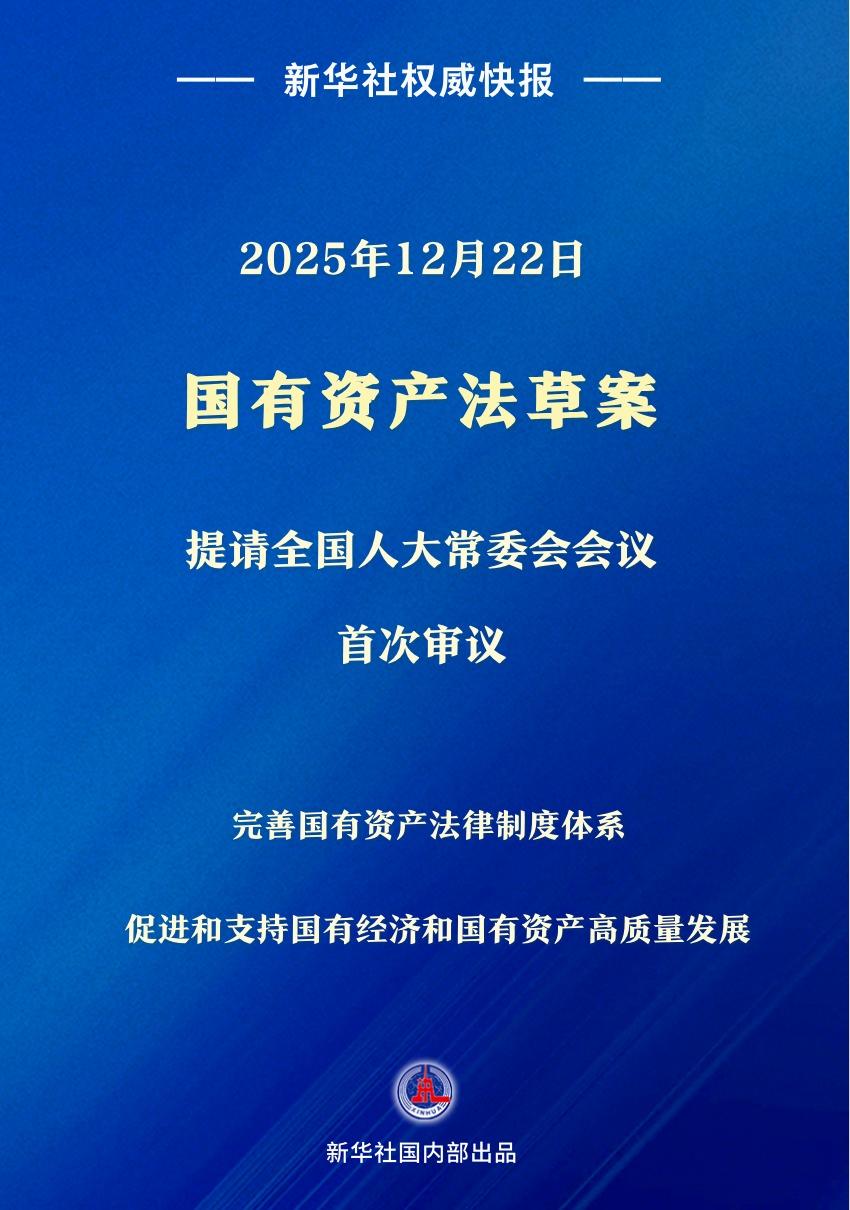
国有资产法草案12月22日提请审议
Jin Rong Jie· 2025-12-22 07:27
Core Viewpoint - The draft of the State-Owned Assets Law was submitted for the first review at the 19th meeting of the 14th National People's Congress Standing Committee on December 22, highlighting the importance of establishing a foundational and comprehensive legal framework for state-owned assets management [1] Group 1: Legislative Framework - The draft consists of 62 articles divided into seven chapters, covering general principles, responsibilities of state-owned asset owners, management of state-owned assets, reporting, supervision, legal responsibilities, and supplementary provisions [1] - The legislation aims to enhance the governance efficiency of state-owned assets within a legal framework, emphasizing the need for a robust legal system [1] Group 2: Governance and Oversight - The draft reinforces the comprehensive leadership of the Party in the management and supervision of state-owned assets, ensuring that governance aligns with party directives [1] - It adopts a problem-oriented approach to standardize and strengthen the management and supervision of state-owned assets, aiming for effective protection and utilization [1] Group 3: Economic Development - The law is designed to promote and support the high-quality development of the state economy and state-owned assets, indicating a strategic focus on enhancing economic performance through improved asset management [1]
我国拟制定基础性综合性国有资产法
Xin Lang Cai Jing· 2025-12-22 03:54
Core Points - The draft of the State-Owned Assets Law was submitted for the first review by the 14th National People's Congress Standing Committee, aiming to enhance the governance efficiency of state-owned assets within a legal framework [1][2] - The draft consists of 7 chapters and 62 articles, covering general principles, responsibilities of state-owned asset owners, management, reporting, supervision, legal responsibilities, and supplementary provisions [1] Group 1: Definition and Classification - The draft defines state-owned assets as properties and rights that are clearly owned by the state according to the constitution and laws, or acquired through purchase, investment, expropriation, or donations [1] - State-owned assets are categorized into natural resource assets, administrative and public service assets, enterprise state-owned assets, and other state-owned assets [1] Group 2: Management Regulations - A dedicated chapter on the management of state-owned assets focuses on key aspects related to the responsibilities of asset owners throughout the entire lifecycle of the assets [1] - Specific management requirements are outlined for government departments, state agencies, and state-funded enterprises, including regulations on the management of state capital equity and the safety of state-owned assets [1] Group 3: Reporting and Supervision - The draft establishes a reporting and supervision system for state-owned assets, addressing issues related to the quality and foundation of management reports [2] - Responsibilities for reporting are extended to all management stages, reinforcing the accountability of asset owners and users [2] - It also clarifies the supervisory roles of various entities, including the National People's Congress, government, and auditing bodies, to create a coordinated supervision system for state-owned assets [2]
我国拟制定基础性综合性的国有资产法
Xin Hua She· 2025-12-22 02:00
Core Viewpoint - The draft of the State-Owned Assets Law is submitted for the first review by the Standing Committee of the National People's Congress, aiming to improve the legal system for state-owned assets and promote high-quality development of state-owned economy and assets [3]. Group 1: Legislative Framework - The draft consists of 62 articles divided into seven chapters, including general principles, responsibilities of state-owned asset owners, management of state-owned assets, reporting, supervision, legal responsibilities, and supplementary provisions [3]. - The legislation emphasizes the comprehensive leadership of the Party in the management and supervision of state-owned assets, aiming to standardize and enhance the management and supervision processes [3]. Group 2: Objectives and Implications - The law aims to enhance the governance effectiveness of state-owned assets within a legal framework, ensuring the protection and effective utilization of these assets [3]. - The draft is designed to address existing issues in the management of state-owned assets, thereby supporting the high-quality development of the state-owned economy [3].