
国有资产治理

Search documents
每日债市速递 | 12月LPR报价持稳
Wind万得· 2025-12-22 22:37
Open Market Operations - The central bank conducted a 7-day reverse repurchase operation on December 22, with a fixed rate and quantity tendering, amounting to 67.3 billion yuan at an interest rate of 1.40%, with the same amount being the bid and awarded [1] - On the same day, 130.9 billion yuan of reverse repos matured, resulting in a net withdrawal of 63.6 billion yuan [1] Funding Conditions - The interbank market remains in a loose funding condition, with the weighted average interest rate of DR001 slightly decreasing to around 1.27% [3] - Overnight rates on the anonymous click (X-repo) system remained stable at 1.25%, indicating ample supply [3] - Non-bank institutions quoted 14-day funding rates around 1.7%, with both borrowing and lending parties showing a relaxed attitude [3] - The latest overnight financing rate in the U.S. is 3.66% [3] Interbank Certificates of Deposit - The latest transaction for one-year interbank certificates of deposit among major banks is around 1.64%, showing a slight increase from the previous day [7] Government Bond Futures - The closing prices for government bond futures on December 22 showed declines: 30-year main contract down 0.28%, 10-year down 0.09%, 5-year down 0.06%, and 2-year down 0.02% [12] Loan Market Rate - The Loan Prime Rate (LPR) remained stable on December 22, with the one-year LPR at 3.0% and the five-year LPR at 3.5%, unchanged from the previous rates [13] Central Bank Bills - The central bank issued 40 billion yuan of 6-month central bank bills in Hong Kong, with a winning rate of 1.67% [14] Bond Market Activity - In November, institutions increased their bond allocations amid market volatility, with banks adding over 600 billion yuan in various bonds, and large banks purchasing over 300 billion yuan in short-term government bonds in December [14]


我国拟制定基础性综合性国有资产法
Xin Lang Cai Jing· 2025-12-22 03:54
Core Points - The draft of the State-Owned Assets Law was submitted for the first review by the 14th National People's Congress Standing Committee, aiming to enhance the governance efficiency of state-owned assets within a legal framework [1][2] - The draft consists of 7 chapters and 62 articles, covering general principles, responsibilities of state-owned asset owners, management, reporting, supervision, legal responsibilities, and supplementary provisions [1] Group 1: Definition and Classification - The draft defines state-owned assets as properties and rights that are clearly owned by the state according to the constitution and laws, or acquired through purchase, investment, expropriation, or donations [1] - State-owned assets are categorized into natural resource assets, administrative and public service assets, enterprise state-owned assets, and other state-owned assets [1] Group 2: Management Regulations - A dedicated chapter on the management of state-owned assets focuses on key aspects related to the responsibilities of asset owners throughout the entire lifecycle of the assets [1] - Specific management requirements are outlined for government departments, state agencies, and state-funded enterprises, including regulations on the management of state capital equity and the safety of state-owned assets [1] Group 3: Reporting and Supervision - The draft establishes a reporting and supervision system for state-owned assets, addressing issues related to the quality and foundation of management reports [2] - Responsibilities for reporting are extended to all management stages, reinforcing the accountability of asset owners and users [2] - It also clarifies the supervisory roles of various entities, including the National People's Congress, government, and auditing bodies, to create a coordinated supervision system for state-owned assets [2]
我国拟制定基础性综合性的国有资产法
Xin Hua She· 2025-12-22 02:00
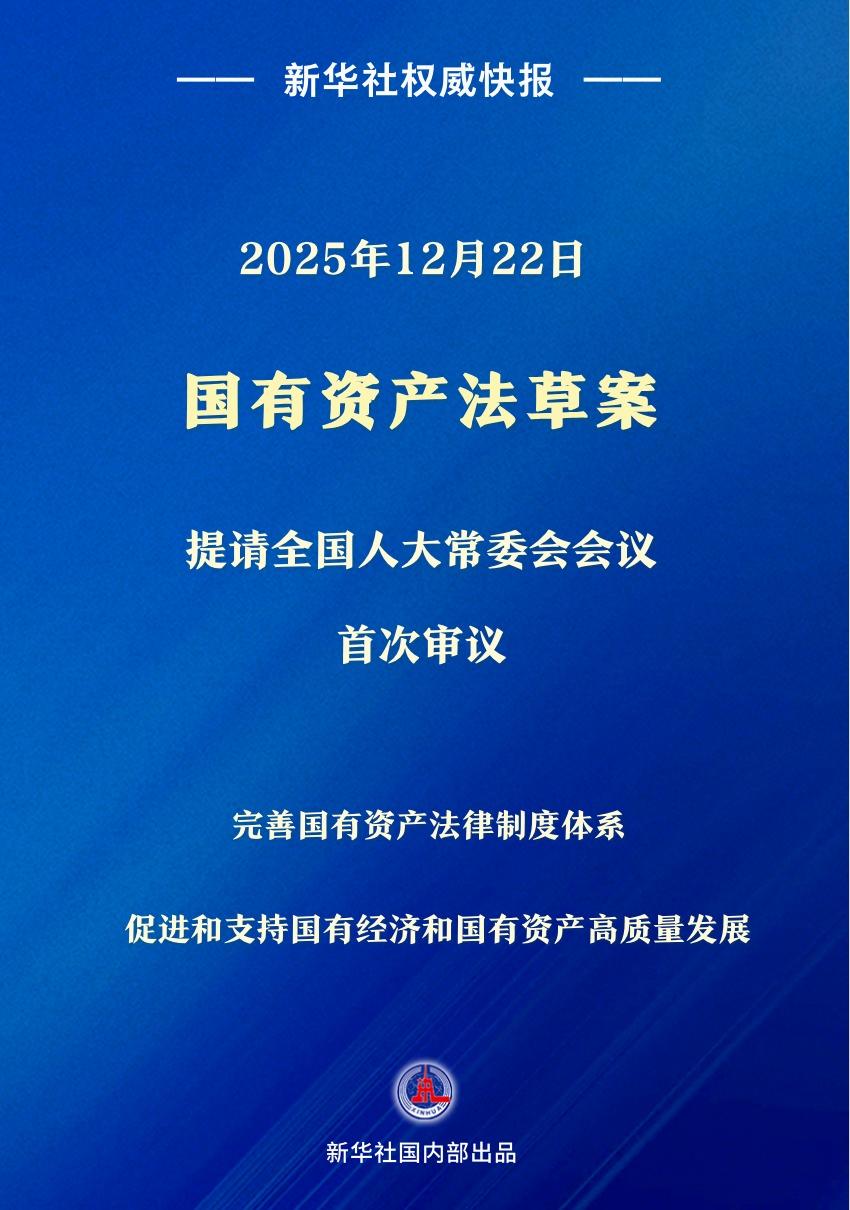
Core Viewpoint - The draft of the State-Owned Assets Law is submitted for the first review by the Standing Committee of the National People's Congress, aiming to improve the legal system for state-owned assets and promote high-quality development of state-owned economy and assets [3]. Group 1: Legislative Framework - The draft consists of 62 articles divided into seven chapters, including general principles, responsibilities of state-owned asset owners, management of state-owned assets, reporting, supervision, legal responsibilities, and supplementary provisions [3]. - The legislation emphasizes the comprehensive leadership of the Party in the management and supervision of state-owned assets, aiming to standardize and enhance the management and supervision processes [3]. Group 2: Objectives and Implications - The law aims to enhance the governance effectiveness of state-owned assets within a legal framework, ensuring the protection and effective utilization of these assets [3]. - The draft is designed to address existing issues in the management of state-owned assets, thereby supporting the high-quality development of the state-owned economy [3].
一财社论:推进社会经济发展,国资责无旁贷
Di Yi Cai Jing· 2025-10-27 13:13
Group 1 - The core viewpoint emphasizes that state-owned assets are a common wealth of the people and must be managed and utilized effectively [1][2][7] - The comprehensive report highlights the need to fully understand the state-owned asset base, revitalize existing resource assets, and enhance management efficiency [2][4] - State-owned enterprises are expected to take on more social responsibilities and focus on developing new productive forces and strategic emerging industries [3][6] Group 2 - The total amount of administrative and institutional state-owned assets is reported to be 68.2 trillion yuan, with net assets of 55.4 trillion yuan, indicating a need to activate underutilized assets [4][5] - There is a clear directive to strengthen the management of natural resource assets and maintain resource security as a foundation for national security [5][6] - The discussion around "three assets" (state-owned assets, resources, and funds) and "three transformations" (assetization, securitization, and leveraging) aims to enhance the functionality of state-owned assets in various sectors [7]