国际性综合交通枢纽城市

Search documents
规划27条过江通道 形成7个机场航空总体布局
Nan Jing Ri Bao· 2025-10-11 02:41
Core Points - The Nanjing Municipal Planning and Natural Resources Bureau has publicly solicited opinions on the draft of the "Nanjing Comprehensive Transportation Planning (2021-2035)" [1] - The plan proposes a "27+1" river crossing channel framework, aiming to establish Nanjing as an international comprehensive transportation hub city by 2035 [1][3] Group 1: River Crossing Channels - The "27+1" plan includes 27 existing, under-construction, and future river crossing channels, with one being a long-term control channel [2] - Currently, there are 14 river crossing channels, with five under construction, including the Xinxin River Bridge and the Metro Line 4 Phase II [2] - Future planned channels include several rail and road crossings, with the long-term channel located in the eastern part of Qixia District [2] Group 2: Airport and Port Planning - The plan outlines the establishment of seven airports, including one main airport and five general airports, with a target of 80 million passengers and 140,000 tons of cargo annually by 2035 [4] - The strategy aims to enhance Nanjing's position as a regional shipping logistics center and develop a national logistics hub [4] Group 3: Railway Network - The railway layout will consist of "two rings and eighteen lines," with new high-speed railways planned, including the Ninghua and Hu-Yu-Rong railways [5] - The plan includes three main and seven auxiliary passenger stations, along with two classification stations and four logistics bases [5] Group 4: Transportation Accessibility - Nanjing aims to create a "123" transportation access circle, allowing one-hour access to urban centers, two hours to major cities in the Yangtze River Delta, and three hours to major cities nationwide [6] - The city plans to achieve a "4155" spatial goal, ensuring accessibility to major roads and public transport within 15 minutes [6]
杭州加速迈向国际性综合交通枢纽城市
Hang Zhou Ri Bao· 2025-05-28 03:00
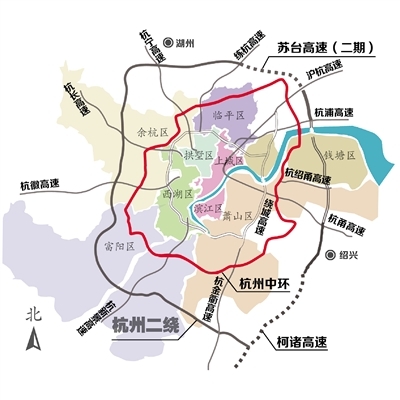
Core Points - The construction of the Kezhu Expressway and the Su-Tai Expressway (Phase II) is progressing rapidly, with both projects expected to be completed and operational by 2025, thereby closing the last two gaps in the Hangzhou Second Ring Road [2][4] - The Hangzhou Second Ring Road, once completed, will significantly enhance traffic flow and economic connectivity within the Hangzhou metropolitan area, benefiting various local industries [5][6] Group 1: Project Progress - The main construction of the Kezhu Expressway includes 23 bridges and 7 tunnels, with asphalt paving currently underway [2] - The Su-Tai Expressway (Phase II) has also reached a critical stage, with the completion of the main line and the commencement of construction for the service area [2][4] Group 2: Economic and Traffic Impact - The completion of the Hangzhou Second Ring Road will alleviate congestion on the existing Hangzhou Ring Expressway, which has been experiencing high traffic volumes and frequent bottlenecks [5] - The new ring road will connect key urban nodes, enhancing economic ties and facilitating quicker access to major industrial areas, such as the pearl industry in Zhuji and the textile industry in Keqiao [5][6] Group 3: Future Developments - The Hangzhou Central Ring Road is also under construction, with plans for completion by 2027, further improving regional connectivity and supporting the city's goal of becoming an international transportation hub [6][7] - The overall transportation plan aims to achieve one-hour commuting within the Hangzhou metropolitan area and two-hour access to major cities in the Yangtze River Delta by 2027 [7]