国际核不扩散体系

Search documents
美俄唯一军控条约今天失效
财联社· 2026-02-05 04:40
Core Viewpoint - The expiration of the New START treaty between the US and Russia signifies the potential collapse of the nuclear arms control framework established during the Cold War, leading to an escalation in the arms race and increased risks of conflict [1][2]. Group 1: Implications of Treaty Expiration - The failure to extend or replace the New START treaty means there will be no legally binding limits on the number of nuclear weapons held by the US and Russia, which could intensify the arms race [1]. - The expiration of the treaty may disrupt verification, data exchange, and notification mechanisms, leaving both parties unaware of each other's nuclear capabilities, thus increasing the risk of misinterpretation during military exercises and deployments [2]. Group 2: Impact on Global Security - The global security environment is likely to deteriorate, with the international nuclear non-proliferation regime facing significant challenges. If both the US and Russia refuse to impose limitations, other nations may feel justified in expanding their arsenals, potentially leading to nuclear proliferation [5]. - Nuclear-armed states may feel compelled to respond to the perceived threats, while non-nuclear states could question the fairness of the Non-Proliferation Treaty, prompting countries like Japan and South Korea to consider nuclear sharing or independent development of nuclear weapons, which poses systemic risks to global strategic stability [5].


日本右翼日益膨胀的核野心 对世界和平稳定构成严重威胁
Xin Lang Cai Jing· 2026-01-09 04:13
Core Viewpoint - The report titled "Japan's Right-Wing Nuclear Ambitions: A Serious Threat to World Peace" highlights the growing nuclear ambitions of Japan's right-wing factions, which are seen as a dangerous signal of the resurgence of Japanese militarism, posing a significant threat to global peace and stability [1][2]. Group 1 - The report reveals Japan's secret development of nuclear weapons, the accumulation of sensitive nuclear materials, and the potential for nuclear weapon development, analyzing the negative impact of right-wing rhetoric on international peace and security [2]. - The spokesperson emphasized that Japan's right-wing nuclear ambitions challenge the international non-proliferation regime and the post-war international order, provoking strong opposition from both the international community and various sectors within Japan [1][2]. - The spokesperson called for Japan to clarify its stance on nuclear weapons, adhere to its obligations under the Treaty on the Non-Proliferation of Nuclear Weapons, and uphold the "Three Non-Nuclear Principles" [2]. Group 2 - The international community is urged to remain vigilant regarding Japan's nuclear ambitions and to exercise caution in nuclear cooperation with Japan, while continuing discussions on curbing Japan's nuclear aspirations and enhancing oversight [2]. - The report advocates for measures to counter Japan's nuclear ambitions and calls for the maintenance of international law and the non-proliferation regime to prevent any challenges posed by Japan's actions [2].
日本右翼日益膨胀的核野心对世界和平稳定构成严重威胁
Xin Lang Cai Jing· 2026-01-08 19:02
Core Viewpoint - The report titled "Japan's Right-Wing Nuclear Ambitions: A Serious Threat to World Peace" highlights the growing nuclear ambitions of Japan's right-wing factions, signaling a dangerous resurgence of militarism that poses a significant threat to global peace and stability [1][2] Group 1: Japan's Nuclear Ambitions - The report indicates that Japan's right-wing factions are increasingly revealing their nuclear ambitions since the new government took office, with officials advocating for the revision of the "Three Non-Nuclear Principles" and suggesting the introduction of nuclear submarines [1] - The report cites Japan's secret development of nuclear weapons, accumulation of sensitive nuclear materials, and potential for nuclear weapon development as alarming facts [2] Group 2: International Response - The Chinese government urges Japan to clarify its stance on nuclear weapons and adhere to its obligations under the Treaty on the Non-Proliferation of Nuclear Weapons and the "Three Non-Nuclear Principles" [2] - There is a call for the international community to remain vigilant regarding Japan's nuclear ambitions and to cautiously engage in nuclear cooperation with Japan, while continuing discussions on monitoring and restricting Japan's nuclear aspirations [2]
外交部:促日停止在拥核问题上试探国际正义的底线红线
中国能源报· 2026-01-08 08:21
Core Viewpoint - The article discusses the rising nuclear ambitions of Japan's right-wing factions and their implications for global peace, emphasizing the need for international vigilance and cooperation to prevent nuclear proliferation [1]. Group 1 - The Chinese Ministry of Foreign Affairs expressed concerns over Japan's nuclear ambitions, highlighting the potential threat to world peace posed by these developments [1]. - The report released by Chinese academic institutions calls for immediate clarification from Japanese Prime Minister Fumio Kishida regarding Japan's stance on nuclear weapons [1]. - The article urges the international community to be cautious in engaging in nuclear cooperation with Japan and to continue discussions on monitoring and controlling Japan's nuclear ambitions through bilateral and multilateral platforms [1].

外交部:促日停止在拥核问题上试探国际正义的底线红线
Jing Ji Guan Cha Wang· 2026-01-08 07:56
Core Viewpoint - The report released by the China Arms Control and Disarmament Association highlights Japan's expanding nuclear ambitions as a serious threat to global peace, urging Japan's Prime Minister to clarify the country's stance on nuclear weapons [1] Group 1: Japan's Nuclear Ambitions - The report indicates that Japan's right-wing factions are increasingly pushing for nuclear capabilities, which poses a significant risk to international stability [1] - There is a call for heightened vigilance from the international community regarding Japan's nuclear intentions, emphasizing the need for cautious nuclear cooperation with Japan [1] Group 2: International Response - The Chinese government advocates for continued discussions on curbing Japan's nuclear ambitions through both bilateral and multilateral platforms [1] - The importance of ensuring that international law and the nuclear non-proliferation regime remain intact is stressed, with a push for Japan to refrain from testing the limits of international justice regarding nuclear issues [1]
人民日报:对战后国际安排极为不满的日本右翼势力,正急于突破束缚,重走军事扩张的老路和邪路
Xin Lang Cai Jing· 2025-12-28 02:55
Core Viewpoint - The article emphasizes the urgent need for international justice forces to jointly counter Japan's nuclear ambitions, which threaten regional security and contradict Japan's historical commitment to peace [1]. Group 1: Japan's Nuclear Ambitions - Recent statements from Japanese officials advocating for nuclear weapons have sparked significant international concern, indicating a potential shift in Japan's defense policy [3]. - The remarks from high-ranking officials, including the Prime Minister's close aides, suggest a willingness to modify Japan's "Three Non-Nuclear Principles," which could destabilize the post-war international order [4][5]. Group 2: Historical Context and Policy Implications - Japan's "Three Non-Nuclear Principles," established in 1971, are critical for assessing its commitment to peaceful development and nuclear non-proliferation [4]. - The current government, under Prime Minister Kishida, has shown a clear inclination towards nuclear armament, undermining Japan's historical stance as a peace-oriented nation [4][5]. Group 3: International Law and Security Concerns - Japan's nuclear rhetoric is viewed as a blatant disregard for international legal obligations, including the Cairo Declaration and the Potsdam Proclamation, which mandate Japan to remain disarmed [5]. - The shift in Japan's security policy, including the expansion of its Self-Defense Forces and potential nuclear capabilities, raises alarms about a resurgence of militarism in Japan [5][6]. Group 4: Domestic and International Reactions - Prominent figures in Japan, including former Prime Ministers, have publicly opposed the push for nuclear weapons, advocating for adherence to the "Three Non-Nuclear Principles" [6]. - The international community, particularly China, expresses strong vigilance against Japan's nuclear developments, emphasizing the importance of maintaining the nuclear non-proliferation regime [6].
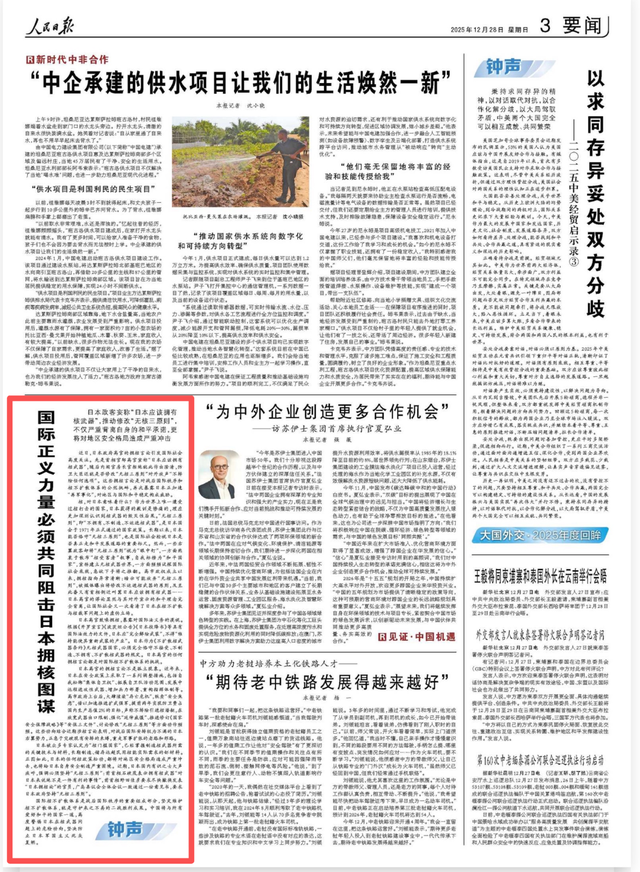
国际正义力量必须共同阻击日本拥核图谋
Xin Lang Cai Jing· 2025-12-27 23:52
Core Viewpoint - Recent statements by Japanese officials advocating for nuclear armament have raised significant concerns regarding Japan's commitment to its post-war peace promises and the potential destabilization of regional security dynamics [1][2][3]. Group 1: Nuclear Policy and International Obligations - Japan's "Three Non-Nuclear Principles" (not possessing, not producing, and not allowing the introduction of nuclear weapons) have been a cornerstone of its national policy since 1971, serving as a benchmark for its peaceful development [2][3]. - Any advocacy for nuclear armament by Japanese officials is seen as a direct challenge to international nuclear non-proliferation frameworks, including Japan's obligations under the Treaty on the Non-Proliferation of Nuclear Weapons [3][4]. Group 2: Military Expansion and Security Policy - The current Japanese administration has been actively pursuing military expansion, including the potential modification of the "Three Non-Nuclear Principles," increasing defense spending to 2% of GDP ahead of schedule, and enhancing the capabilities of the Self-Defense Forces [3][4]. - There is a growing sentiment among Japanese right-wing factions to break free from post-war military constraints, which could lead to a resurgence of militarism in Japan [3][4]. Group 3: Regional and International Reactions - Experts have classified Japan as a "nuclear threshold state," possessing the necessary technology and materials for nuclear weapon production, which raises alarms about the implications of any shift in its nuclear policy for regional security [4]. - Prominent figures in Japan, including former Prime Ministers, have publicly called for adherence to the "Three Non-Nuclear Principles," emphasizing the risks associated with nuclear armament for Japan's own security [4].
人民日报:作为世界上唯一遭受过核打击的国家,日本获得的教训是惨痛的,理应更加深刻认识到核武器的毁灭性后果
Xin Lang Cai Jing· 2025-12-27 23:51
Core Viewpoint - The article emphasizes the international community's concern over Japan's recent pro-nuclear statements by government officials, which are seen as a challenge to post-war international order and nuclear non-proliferation efforts [1][2]. Group 1: Japan's Nuclear Policy - Japan's "Three Non-Nuclear Principles" (not possessing, not producing, and not allowing nuclear weapons) are crucial for its identity as a peace-oriented nation, and any deviation from these principles raises alarms internationally [2][3]. - The current Japanese administration has shown a clear inclination towards nuclear armament, with officials suggesting potential modifications to the "Three Non-Nuclear Principles" and openly discussing the need for Japan to possess nuclear weapons [2][3]. Group 2: International Legal Obligations - Japan's pro-nuclear rhetoric is viewed as a disregard for its international legal obligations, including documents like the Cairo Declaration and the Potsdam Proclamation, which mandate Japan to remain disarmed [3]. - As a non-nuclear weapon state under the Treaty on the Non-Proliferation of Nuclear Weapons (NPT), Japan is expected to adhere strictly to its commitments regarding nuclear weapons [3]. Group 3: Regional Security Implications - Japan is recognized as a "nuclear threshold state," possessing the technology and materials necessary for nuclear weapon production, which poses significant risks to regional security if its nuclear policy shifts [4]. - Experts and former officials within Japan are advocating for the strict adherence to the "Three Non-Nuclear Principles," highlighting the potential dangers of nuclear armament for Japan's own security and regional stability [4]. Group 4: Response from the International Community - The article calls for vigilance from peace-loving nations to counter Japan's dangerous nuclear ambitions, emphasizing the importance of maintaining the nuclear non-proliferation regime as a key component of post-war international order [4].
外交部:再次敦促日方深刻反省,不得插手中国内政
证券时报· 2025-12-22 10:10
Group 1 - The Chinese Foreign Ministry urges Japan to deeply reflect on its actions regarding Taiwan and to refrain from interfering in China's internal affairs, emphasizing that Taiwan is an inseparable part of China [1] - The Ministry expresses strong opposition to Japanese officials visiting Taiwan and meeting with local leaders, stating that such actions violate the one-China principle and Japan's own commitments [1] - The Ministry warns the Democratic Progressive Party in Taiwan against pursuing pro-Japan independence, labeling it a misguided and doomed path [1] Group 2 - The Chinese Foreign Ministry expresses shock at comments from a senior official in the Japanese Prime Minister's office advocating for Japan to possess nuclear weapons, viewing it as a serious threat to regional and international peace [2] - The Ministry highlights that such statements are a blatant provocation against the post-war international order and the nuclear non-proliferation regime, and they must be taken seriously by the international community [2] - The Ministry asserts that the remarks reflect Japan's right-wing ambitions for re-militarization and pose a risk to global security if allowed to progress [2]

日本高官公然宣称日本应拥核,中方:感到震惊!
券商中国· 2025-12-22 09:54
Core Viewpoint - The article expresses strong opposition to recent statements by Japanese officials advocating for Japan to possess nuclear weapons, viewing these remarks as a serious threat to international peace and stability, and a violation of Japan's international legal obligations [1][2][4]. Group 1: International Legal Obligations - The statements made by Japanese officials contradict Japan's obligations under international law, including the Cairo Declaration and the Potsdam Proclamation, which mandate Japan to be completely disarmed and not maintain any military capabilities [2]. - As a non-nuclear weapon state under the Treaty on the Non-Proliferation of Nuclear Weapons (NPT), Japan is required to adhere strictly to the principles of not accepting, manufacturing, or possessing nuclear weapons [2]. Group 2: Threat to Regional Stability - The push for nuclear armament by Japan undermines the authority and effectiveness of the international non-proliferation regime, posing a significant challenge to the hard-won peace and prosperity established post-World War II [2]. - There is widespread condemnation from various sectors within Japan, including political leaders and civil society, against the notion of Japan acquiring nuclear weapons, emphasizing the need to uphold the "Three Non-Nuclear Principles" [2]. Group 3: Rising Militarism in Japan - The ambitions of Japan's right-wing factions to pursue re-militarization are becoming increasingly evident, with past officials claiming Japan has the capability to develop nuclear weapons [3]. - Japan's significant stockpiling of plutonium beyond its civilian energy needs indicates its potential to produce weapon-grade plutonium, raising concerns about its intentions [3]. - The current government's rhetoric and actions suggest a deliberate move towards militarization, with previous statements by Prime Minister Kishida indicating a shift in Japan's defense posture [3]. Group 4: Historical Context and Warnings - The article highlights the historical context of Japan's militarism during World War II and warns against the resurgence of militaristic tendencies, which could lead to catastrophic consequences [4]. - There is a call for vigilance from China and other peace-loving nations to oppose Japan's dangerous inclinations regarding nuclear weapons and to adhere to international law and its own constitution [4].