
城市发展潜力

Search documents
中国十大最具发展潜力城市
泽平宏观· 2026-02-20 16:05
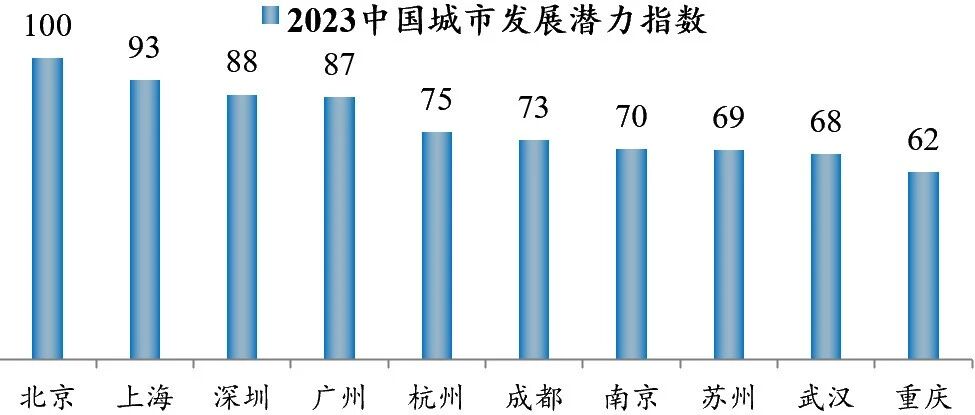
Core Viewpoint - The article discusses the competitive landscape of Chinese cities, highlighting the rapid urbanization and the emergence of new economic centers, while ranking the development potential of 337 cities in China, with Beijing, Shanghai, Shenzhen, and others leading the list [2]. Group 1: Beijing - Beijing is positioned as the political, cultural, international exchange, and technological innovation center of China, with a GDP exceeding 4.1 trillion yuan in 2022, making it the second-largest city after Shanghai [9][10]. - The service sector accounts for 84% of Beijing's economy, with finance, headquarters economy, and technological innovation as key pillars [10]. - Future plans include transforming Beijing into a world-class harmonious city while optimizing population distribution to enhance urban vitality [11][13]. Group 2: Shanghai - Shanghai has established itself as an international economic center, with a GDP of approximately 4.5 trillion yuan in 2022, and aims to rival New York in global economic influence [16][24]. - The city’s industrial structure is supported by the automotive, electronics, and financial sectors, with finance contributing 19.3% to the GDP [17][19]. - Shanghai plans to continue its open policies and develop into a globally competitive city, enhancing the Yangtze River Delta region [24]. Group 3: Shenzhen - Shenzhen's GDP surpassed 3.2 trillion yuan in 2022, marking it as the third-largest city in China, with a significant annual population increase of around 600,000 [25][26]. - The city is recognized as a leading innovation hub, with strategic emerging industries accounting for over 41% of its GDP [26]. - Future initiatives focus on enhancing collaboration within the Guangdong-Hong Kong-Macau Greater Bay Area to solidify its status as a global innovation city [29]. Group 4: Guangzhou - Guangzhou's GDP reached approximately 2.9 trillion yuan in 2022, ranking fifth nationally, with a strong manufacturing base in automotive and electronics [30][31]. - The city faces challenges in innovation capacity and financial sector development, with financial services contributing only 9.2% to the GDP [33]. - Future goals include enhancing its role as a national center city and participating in global economic cooperation [34]. Group 5: Hangzhou - Hangzhou's economy has shown robust growth, with a GDP of around 1.9 trillion yuan in 2022, driven by a vibrant private and digital economy [36][37]. - The city is recognized for its strong digital economy, with core digital industries contributing 27.1% to the GDP [37]. - Plans for the future include improving transportation infrastructure and fostering a more open and innovative business environment [41][42]. Group 6: Chengdu - Chengdu's GDP exceeded 2 trillion yuan in 2022, accounting for 36.7% of Sichuan province's economy, and it is recognized as a key economic hub in Western China [43][44]. - The electronics sector is a major contributor, with a significant portion of the industrial output [44]. - Future strategies involve enhancing its role as a national center city and collaborating with Chongqing to develop the Western economic highland [49]. Group 7: Nanjing - Nanjing's GDP approached 1.7 trillion yuan in 2022, with a per capita GDP of 179,000 yuan, ranking fifth among major cities [50][51]. - The city is focusing on developing its automotive, steel, electronics, and petrochemical industries while nurturing emerging sectors [51]. - Future aspirations include becoming an "innovation city" and enhancing its influence in the Yangtze River Delta region [54]. Group 8: Suzhou - Suzhou's GDP reached nearly 2.4 trillion yuan in 2022, making it the top city among prefecture-level cities in China [56]. - The city is recognized as a global industrial powerhouse, with significant contributions from electronics and manufacturing sectors [56]. - Future plans emphasize its role in the Yangtze River Delta urban cluster and advancing towards a high-tech manufacturing base [59].

中国十大最具发展潜力城市
泽平宏观· 2024-12-18 14:24
按照人随产业走、产业决定城市兴衰等基本逻辑, 我们在《中国城市发展潜力排名: 2023》研究报告中对全国除港澳台外的337个地级及以上城市的发展潜力进行客观排名, 北 京、上海、深圳、广州、杭州、成都、南京、苏州、武汉、重庆 位居前10名。 从排名变动来看,南京超越苏州位居第七,南京近年来通过加大高技术投入力度、不断招 才引智、积极开放交流等,一定程度上推动了城市发展,而苏州的发展韧性仍较强。 摘要 NO1.北京:政治、文化、国际交往和科技创新中心。 1)北京集政治中心、创新中心、金融 中心、国际交流中心、文化中心等优势于一身,未来将聚焦于发展首都核心功能。2)北京三 产比重达到84%,金融、总部经济和科技创新成为三大名片。3)北京严控人口规模抬升生活 成本、影响城市活力,但引导人口布局优化也有助于城市高质量发展;区域发展不平衡问题 仍存。4)未来,北京将建设成为国际一流的和谐宜居之都,引领京津冀协同发展。作为全国 第一个减量发展城市,北京将从粗旷型扩张到精细化调整转型。 NO2.上海:全球化的大上海,未来媲美纽约。 1)上海已基本建成国际经济中心,随着中国 经济的腾飞,未来有望媲美纽约,成为主要的全球经济金 ...