外卖业务增长

Search documents
低价、外卖、外部压力环绕下,百胜中国真找准了“最佳平衡点”?
Hua Er Jie Jian Wen· 2026-02-05 07:19
Core Viewpoint - Yum China continues to demonstrate synchronized growth in scale, same-store sales, and profitability, despite increasing pressure from delivery services and competition in the food delivery market [1][2]. Financial Performance - In Q4 2025, Yum China's system sales increased by 7% year-on-year, while same-store sales grew by 3%, marking the third consecutive quarter of positive growth [1]. - The company added 1,706 new stores in 2025, bringing the total to 18,101 stores across over 2,500 towns [1]. - The operating profit margin reached 10.9% for the year, an increase of 60 basis points year-on-year, achieving the highest level since the company's listing in the U.S. after excluding special items [1]. Delivery and Market Trends - Delivery sales grew by 25% year-on-year in 2025, accounting for 48% of restaurant revenue, up 9 percentage points from the previous year [2]. - In Q4, delivery sales for KFC and Pizza Hut reached 53% and 54%, respectively, indicating a consistent upward trend throughout the year [2]. Pricing Strategy - KFC raised delivery product prices by approximately 0.8 yuan starting January 26 to offset rising delivery costs associated with increased delivery sales [3]. - The CEO noted that the growth of delivery services is expected to continue into 2026, and larger brands benefit from the competitive landscape of delivery platform subsidies [3]. Operational Efficiency - Yum China is implementing operational efficiency measures, including product innovation and the use of AI tools to optimize staffing and inventory management [4]. - In Q4 2025, KFC and Pizza Hut's restaurant profit margins increased by 70 and 60 basis points, respectively, due to these efficiency initiatives [4]. Expansion Strategy - The "Shoulder-to-Shoulder" model has proven effective in enhancing store efficiency and growth, with KFC's sub-brand K-Coffee expanding from 700 to 2,200 stores in 2025 [5]. - KPRO (KFC's healthy food brand) surpassed 200 stores and contributed double-digit sales growth to parent stores [7]. - Yum China plans to double KPRO's store count to over 400 in 2026, focusing on high-tier cities [8]. Future Goals - Yum China aims to reach a total of 30,000 stores by 2030, expanding its presence from approximately 2,500 cities to 4,500 [11]. - The company is adjusting its expansion strategy by increasing the proportion of franchise stores, which rose from 25% to 36% of new store openings in 2025, with plans to reach 40%-50% in 2026 [13]. - The company is confident in achieving its goal of 20,000 stores by 2026, with total capital expenditures expected to remain between $600 million and $700 million [18].
五家餐饮企业自述:如何在2025年获得增长?
经济观察报· 2026-01-26 02:36
Core Insights - The article discusses the challenges and strategies of various restaurant brands in achieving growth in 2025 amidst a difficult economic environment for the food and beverage industry [2][3]. Group 1: Industry Overview - In 2025, the total revenue of the restaurant industry reached 57,982 billion yuan, with a year-on-year growth of 3.2%, surpassing the growth rates of retail sales and social consumer goods [2]. - Approximately two-thirds of surveyed restaurant companies reported a decline in revenue for 2025, primarily due to reduced customer traffic and lower average spending per customer [2]. - The closure rate of small restaurant chains increased significantly, with a 34% closure rate within a year for single-unit restaurants [2]. Group 2: Successful Strategies - Some restaurant brands managed to achieve growth by innovating store formats, expanding service scenarios, and avoiding blind expansion [3]. - Xiao Diao Li Tang increased its revenue by 12.5% through the introduction of "satellite stores" designed for delivery, which are smaller and require lower investment [4][5]. - Nanchengxiang reduced its store count from over 200 to 191 but doubled its net profit, emphasizing a strategy of closing unprofitable locations and focusing on quality customers [9][10]. Group 3: Brand-Specific Strategies - Xiao Diao Li Tang's satellite stores focus on a simplified menu and efficient delivery, achieving a stable average spending of 30-35 yuan per customer [6]. - Nanchengxiang's strategy involved closing low-performing stores and implementing a "back-to-back" model to reduce internal competition while enhancing profitability [9][10]. - Wild Man Mr. Ice Cream emphasizes the emotional value of its products, creating unique customer experiences that resonate with consumers' emotional needs [11][12]. Group 4: Future Plans - Xiao Diao Li Tang plans to open 10-15 more satellite stores in 2026, exploring a hybrid model of small dining and delivery [6]. - Nanchengxiang intends to invest 100 million yuan in store renovations and product development rather than aggressive expansion [10]. - Red Star Forward aims to expand its cake business, which has shown significant growth, by opening smaller stores closer to communities [18][19].


“初代网红餐厅”靠外卖回血?
3 6 Ke· 2025-08-28 10:07
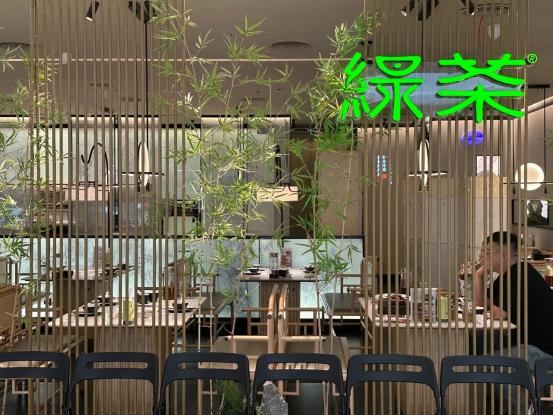
Core Viewpoint - The Green Tea Group reported a strong performance in the first half of 2025, with revenue and profit growth driven by an increase in takeout business and store expansion [2][4]. Financial Performance - Green Tea's revenue for the first half of 2025 reached 2.29 billion RMB, a year-on-year increase of 23.1% [2][6]. - The adjusted net profit was 251 million RMB, reflecting a 40.4% increase compared to the previous year [2][6]. - Takeout revenue amounted to 524 million RMB, a significant increase of 74.2% from 300 million RMB in the same period last year, contributing to 22.9% of total revenue [4][6]. Operational Challenges - Despite revenue growth, the company faced challenges such as declining same-store sales and slower-than-expected expansion [4][8]. - Same-store average daily sales decreased from 23,100 RMB in June 2024 to 20,000 RMB in June 2025, with the largest decline in North China at 15.9% [8][9]. - The overall average consumer spending dropped from 61.8 RMB in 2023 to 55.5 RMB in 2025 [9]. Expansion Strategy - Green Tea plans to continue its expansion strategy, aiming to open 150, 200, and 213 new restaurants in 2025, 2026, and 2027 respectively, targeting a total of over 1,000 stores by 2027 [10][11]. - The company has focused on smaller restaurant formats, which have shown higher turnover rates and lower operating costs, with the number of small restaurants increasing from 100 in 2022 to 284 in 2024 [7][10]. Store Count and Market Presence - As of June 30, 2025, Green Tea operated 502 stores nationwide, with over half located in first-tier and new first-tier cities [6][7]. - The company only added 37 new stores in the first half of 2025, achieving only 24.7% of its annual target, indicating a slower expansion pace than anticipated [11][12].
DoorDash(DASH.US)二季度扭亏为盈超预期 上调三季度订单指引至242亿-247亿美元
智通财经网· 2025-08-07 00:11
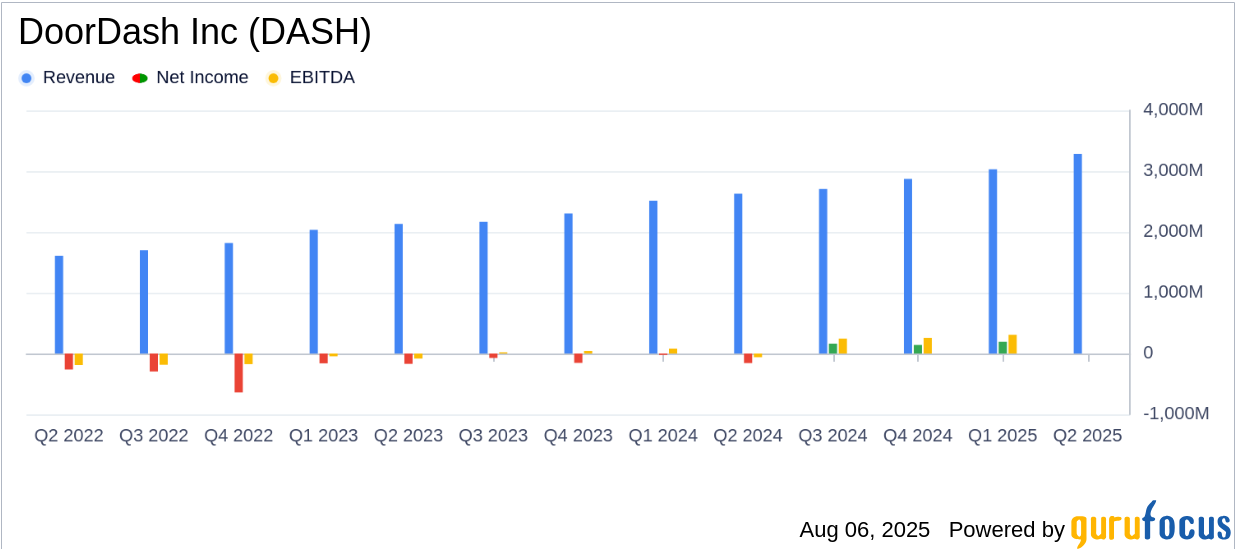
Core Insights - DoorDash reported strong Q2 earnings, achieving a net profit of $285 million, translating to earnings per share of $0.65, a significant turnaround from a loss of $157 million (EPS loss of $0.38) in the same period last year, and exceeding analyst expectations of $0.44 per share [1][3] - Revenue for the quarter grew from $2.63 billion to $3.28 billion year-over-year, also surpassing market forecasts [1][3] Financial Performance - The Gross Order Value (GOV) increased by 23% year-over-year to $24.24 billion, exceeding analyst expectations of $23.63 billion [3] - Adjusted EBITDA for Q2 reached $655 million, surpassing market expectations [3] Future Outlook - For Q3, DoorDash anticipates total orders to be between $24.2 billion and $24.7 billion, with a median exceeding the Bloomberg analyst average of $23.8 billion [3] - The expected adjusted EBITDA range for the same period is $680 million to $780 million, with a midpoint of $730 million, higher than the consensus estimate of $718.9 million [3] User Engagement and Market Position - The company attributes its performance to an increase in active user base and user engagement, highlighting the high retention rates of long-term users and growth in orders from non-restaurant categories [3][4] - The number of paid subscribers for the DashPass service has increased, contributing to a record order volume of 761 million [3][4] Competitive Landscape - DoorDash's Q2 order total of $24.2 billion not only surpassed Uber Eats' performance but also exceeded its own previous quarter's results [4] - The company is actively enhancing its business through acquisitions, including the pending acquisition of UK-based Deliveroo and completed acquisitions of SevenRooms and Symbiosys, aimed at strengthening its service capabilities [4]