多资产组合配置

Search documents
“买股票怕追高,放存款又觉得赚得太少?”专家:年终奖理财正转向配置导向
Di Yi Cai Jing Zi Xun· 2026-01-28 15:27
Core Insights - The article discusses the challenges faced by individual investors in allocating their year-end bonuses amidst rising stock and gold prices, while traditional financial products offer less attractive returns [2] - Banks are responding to this situation by launching specialized financial products and activities aimed at year-end bonuses, expanding beyond traditional offerings to include deposits, funds, insurance, and customer incentives [2] Group 1: Product Offerings - Major state-owned banks have introduced year-end bonus financial products characterized by R2 stable risk levels, short to medium terms, and low minimum investments [3] - Bank of Communications launched a themed year-end bonus product with a near 3-month annualized return exceeding 4%, providing options for short-term allocation of year-end funds [3] - Postal Savings Bank offers various products catering to different risk appetites, including low-risk options with daily liquidity and medium-risk products for stable growth [4] - Industrial and Commercial Bank of China promotes a series of salary management products with low minimum investments and diverse strategies, with one product offering an annualized return of about 3% [4] - China Construction Bank emphasizes asset allocation guidance, suggesting a diversified approach to managing year-end bonuses across various financial products [4] Group 2: Marketing Strategies - Banks are enhancing the retention of year-end bonus funds through incentive mechanisms, such as cash rewards for increasing average monthly assets [5] - Shanghai Pudong Development Bank combines deposit and investment products in a structured manner to attract year-end bonus funds [5] - City commercial banks have launched specialized net value financial products for year-end bonuses, with varying investment terms and performance benchmarks [5] Group 3: Market Trends - The marketing of year-end bonus financial products has shifted towards a configuration-oriented approach, focusing on low minimum investments and flexible terms [6] - The trend reflects a response to a low-interest-rate environment, where banks aim to attract low-cost funds and quality customer assets [6] - The overall financial market is seeing increased interest in wealth management products, with the total scale of the wealth management market reaching 33.29 trillion yuan by the end of 2025, a growth of over 3 trillion yuan from the beginning of the year [7] - Various asset classes have shown strong performance, influencing investor expectations and leading them to prefer stable and predictable product combinations for their year-end bonuses [7]

黄金ETF基金(159937)盘中飘红,成交1.39亿元,机构:黄金维持标配或适度超配状态仍可能为最优选择
Sou Hu Cai Jing· 2025-06-26 03:49
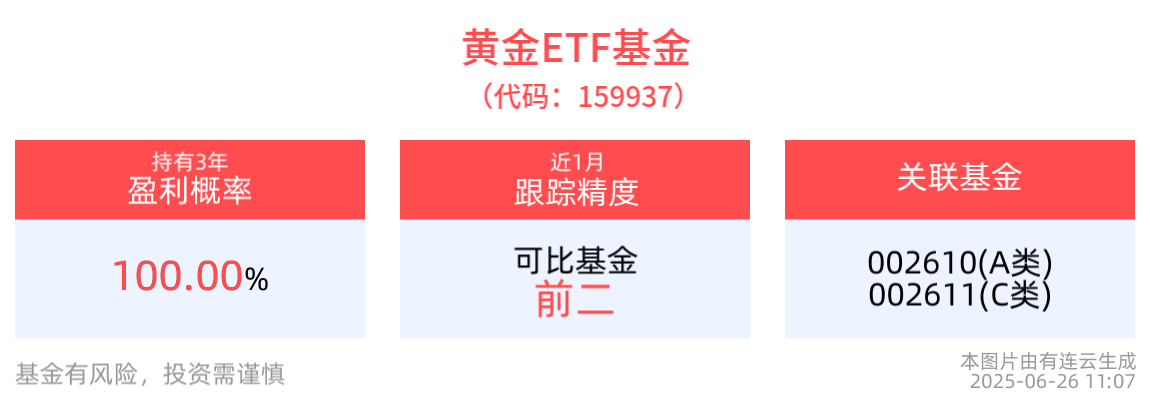
Core Viewpoint - The demand for gold as a safe-haven asset is being driven by geopolitical risks, leading to significant contributions to multi-asset strategy returns in 2023 [2] Group 1: Gold ETF Performance - As of June 25, the Gold ETF fund has seen a net value increase of 88.93% over the past five years, ranking it among the top two comparable funds [3] - The fund's highest single-month return since inception was 10.62%, with the longest consecutive monthly gains lasting six months and a maximum increase of 16.53% [3] - The fund has a historical three-year holding profitability rate of 100% and an average monthly return of 3.27% during up months [3] Group 2: Risk and Return Metrics - The Gold ETF fund has a Sharpe ratio of 2.59 over the past year, indicating strong risk-adjusted returns [3] - Year-to-date, the fund has experienced a relative drawdown of 0.38% compared to its benchmark [3] - The management fee for the Gold ETF fund is 0.50%, and the custody fee is 0.10% [3] Group 3: Market Activity - Leveraged funds are increasingly positioning themselves in the gold market, with the latest financing buy-in amounting to 18.17 million yuan and a financing balance of 3.686 billion yuan [2]