大学生生活费

Search documents
2025年大学生月均生活费1744元,九年间增长超四成
Sou Hu Cai Jing· 2025-10-29 23:06
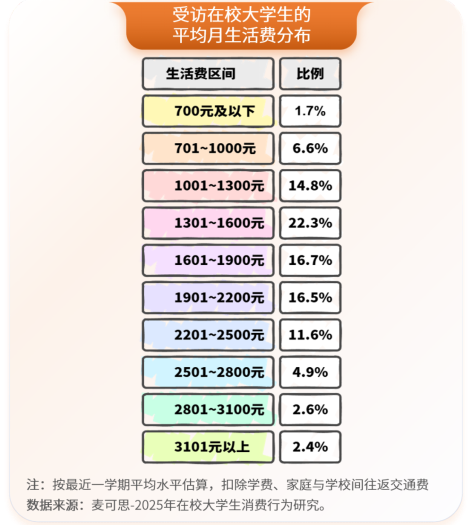
Core Insights - The report by McKinsey reveals significant changes in the consumption patterns of contemporary college students, with an average monthly living expense of 1,744 yuan in 2025, marking a 43.9% increase from 1,212 yuan nine years ago [1] Group 1: Living Expenses - The distribution of living expenses shows that 22.3% of students have monthly expenses between 1,301 and 1,600 yuan, while 16.7%, 16.5%, and 14.8% fall into the 1,601-1,900 yuan, 1,901-2,200 yuan, and 1,001-1,300 yuan categories respectively [3] - Nearly 10% of students (9.9%) have monthly living expenses exceeding 2,501 yuan, indicating a higher consumption capacity among this group [3] - Regional disparities are notable, with average living expenses in Beijing and Shanghai reaching 2,860 yuan and 2,780 yuan respectively, while students in less developed regions like Gansu and Qinghai maintain expenses around 1,000 yuan [4] Group 2: Spending Habits - Over 40% (40.1%) of students allocate their monthly expenses to educational costs, including tuition, books, and learning tools, highlighting the importance of academic investment [6] - Personal entertainment (39.7%), social activities (31.7%), and image management (25.2%) also represent significant portions of student spending, indicating a balance between self-improvement and social engagement [6] Group 3: Consumption Behavior - The student demographic exhibits a strong inclination towards online shopping, with 98.5% having engaged in e-commerce in the past six months and an average shopping frequency exceeding seven times per month [8] - A majority (71.7%) of students feel their living expenses meet or slightly exceed their daily needs, with 43.8% stating their expenses are just sufficient and 27.9% reporting a slight surplus [8] - The data suggests that 1,500 yuan serves as a critical threshold for maintaining a balanced lifestyle, with implications for financial planning based on local economic conditions [8]


研究报告:2025年大学生月均生活费1744元,相比2016年(1212元)增长了532元,涨幅约为43.9%
Ge Long Hui· 2025-10-29 07:19
Core Insights - The research conducted by "Mackenzie - 2025 College Student Consumption Behavior Study" surveyed 2,783 college students, revealing that the average monthly living expense for students in 2025 is 1,744 yuan, an increase of 532 yuan or approximately 43.9% compared to 1,212 yuan in 2016 [1] Spending Behavior - The highest proportion of surveyed students (22.3%) reported average monthly living expenses in the range of 1,301 to 1,600 yuan, followed by 16.7% in the 1,601 to 1,900 yuan range, 16.5% in the 1,901 to 2,200 yuan range, and 14.8% in the 1,001 to 1,300 yuan range [1] - Over 40% (40.1%) of college students allocate monthly spending towards educational expenses, while 39.7% invest in personal entertainment, indicating a balance between self-improvement and leisure [1] - Additionally, 31.7% of students spend on social activities, and 25.2% on image management, highlighting these as significant components of their daily consumption [1]
2025年大学生月均生活费1744元,你那时多少?
第一财经· 2025-10-29 04:09
Core Insights - The average monthly living expense for college students in 2025 is 1,744 yuan, which represents an increase of 532 yuan or approximately 43.9% compared to 1,212 yuan in 2016 [3][5]. Spending Behavior - 71.7% of surveyed college students report that their monthly living expenses meet or slightly exceed their daily needs, with 43.8% stating it "just meets" their needs and 27.9% indicating they have a "slight surplus" [5]. - 24.9% of students occasionally find their living expenses insufficient, while 3.4% frequently struggle with insufficient funds [5]. Consumption Patterns - Over 40% (40.1%) of students allocate part of their monthly expenses to educational purposes, while 39.7% spend on personal entertainment, indicating a balance between self-improvement and leisure [6]. - 31.7% of students spend on social activities, and 25.2% on image management, highlighting diverse spending categories in their daily lives [6]. Online Shopping Behavior - College students exhibit active online shopping habits, with an average monthly frequency exceeding 7 times. 98.5% have shopped online in the past six months, with the highest proportion (43.8%) shopping 6-10 times per month [6]. - Additionally, 18.1% of students shop online more than 10 times each month, indicating a strong inclination towards e-commerce [6].

2025年大学生月均生活费1744元,你那时多少?
Di Yi Cai Jing· 2025-10-29 03:56
Core Insights - The average monthly living expenses for college students in 2025 is projected to be 1,744 yuan, an increase of 532 yuan or approximately 43.9% compared to 2016 [1] - A significant portion of students (71.7%) report that their monthly living expenses meet or slightly exceed their daily needs, with 43.8% stating it "just meets" their needs and 27.9% indicating a "slight surplus" [3] - Over 40% of students allocate their expenses towards educational purposes, while nearly 40% spend on personal entertainment, indicating a balance between self-improvement and leisure [4] Spending Behavior - The majority of college students (98.5%) have engaged in online shopping in the past six months, with an average frequency of over 7 times per month [4][5] - The highest proportion of students shop online 6-10 times a month (43.8%), followed by 1-5 times (36.7%), and 18.1% shop more than 10 times monthly [5]
父母说1500够,学生说4500活不了:大学生需要多少生活费?
36氪· 2025-06-03 13:06
Core Viewpoint - The article discusses the rising cost of living for university students in China, highlighting the disparity between different generations' perceptions of adequate living expenses and the increasing financial pressures faced by students today [3][4][11]. Group 1: Living Expenses Overview - The average monthly living expenses for university students have increased significantly from around 200 RMB in 1994 to nearly 2000 RMB in 2020, outpacing the national Consumer Price Index (CPI) growth of approximately 100% during the same period [11]. - A survey by iMedia Consulting in 2024 indicates that over 70% of university students have monthly incomes and expenditures between 1000-2000 RMB, with many experiencing a deficit [11]. - The average living expenses vary by city, with students in Beijing averaging 2400 RMB per month, while cities like Zhengzhou and Xi'an have averages above 1500 RMB [14]. Group 2: Spending Breakdown - The structure of student spending has shifted dramatically, with food expenses dropping from 89.4% of total spending in 1994 to less than 50% in recent years. In 2024, students spend 500-800 RMB on food and daily necessities, constituting about 50% of their overall expenses [25][26]. - Additional expenses include utilities, transportation, personal care, and social activities, which contribute to the perception of insufficient funds among students [28][30]. - A detailed breakdown of a typical university student's monthly expenses shows that basic needs alone can exceed 3000 RMB, indicating that living on 1000-2000 RMB is often insufficient [29]. Group 3: Generational Perspectives - There is a notable generational divide in perceptions of adequate living expenses, with older generations often believing that 1500 RMB is sufficient, while students argue that this amount does not cover their needs [41][42]. - The increase in students working part-time jobs has risen from 30% in 2016 to 56% in 2019, reflecting the financial pressures they face [42]. - The article highlights the social implications of financial disparities, where students unable to participate in social activities due to budget constraints may feel isolated or marginalized [34][36].