
大气污染

Search documents
伊朗储油设施爆炸产生有毒污染物,致德黑兰居民出现呼吸困难
中国能源报· 2026-03-09 09:59
Group 1 - The Iranian Red Crescent Society reported a rare "black rain" phenomenon near the oil storage facilities that were attacked, causing respiratory difficulties among Tehran residents [1] - The explosion of the oil storage facilities is expected to release large amounts of toxic substances into the atmosphere, potentially leading to acid rain that can cause skin burns and lung damage [1] - The Iranian Foreign Ministry spokesperson stated that the attack on the oil facilities has released dangerous and toxic substances into the air, posing a significant threat to civilian life and the environment [1] Group 2 - The Iranian Environmental Protection Organization warned that pollutants have entered Tehran due to recent attacks, advising citizens to avoid unnecessary outdoor activities [2] - The attacks on five oil facilities resulted in four fatalities [2]


四川盆地开年第一波污染为啥这么“凶”
Xin Lang Cai Jing· 2026-01-12 18:00
Core Viewpoint - The first significant PM2.5 pollution event of the year in the Sichuan Basin is attributed to unfavorable meteorological conditions, biomass burning, and the impact of gaseous pollutants, leading to prolonged and widespread pollution from January 8 onwards [1][3]. Meteorological Conditions - From January 8, a warm and humid airflow moved north, causing adverse meteorological conditions that worsened air quality. The transition to high-pressure systems resulted in stable weather, enhancing temperature inversions and allowing pollutants to accumulate [1][2]. - Ground-level meteorological factors showed a continuous drop in pressure with no significant cold air influence, leading to a gradual increase in temperature and a decrease in wind speed, which contributed to pollutant concentration accumulation [2]. Pollution Transformation and Contribution - The pollution event is characterized by a combination of primary emissions and secondary transformation, with biomass burning and gaseous pollutants significantly contributing to PM2.5 levels. In the Chengdu Plain, nitrogen oxides are the primary contributors, while in northeastern and southern Sichuan, both primary emissions and secondary transformations play a role [3]. - Secondary inorganic ions account for 40%-60% of PM2.5, with nitrate ions being a major component, indicating that the secondary transformation of nitrogen oxides is a key factor in increasing PM2.5 concentrations [3]. Forecast and Prediction - The pollution is expected to persist until around January 19, with temporary improvements due to weak cold air on January 12. However, unfavorable meteorological conditions will continue to lead to pollutant accumulation [4][5]. - From January 13 to 15, light to moderate pollution is anticipated, with some areas facing severe pollution risks. A significant improvement in air quality is expected after January 19 due to the influence of weak cold air and precipitation [5].
北京生态环境部门解读:为啥秋冬季污染总爱“找上门”?
Xin Hua Wang· 2025-12-19 01:30
Group 1 - The air pollution yellow alert was activated in Beijing from December 18 to 19, marking the third significant pollution event in the Beijing-Tianjin-Hebei region this autumn and winter [1][2] - The increase in pollution levels is attributed to the total emissions of pollutants exceeding environmental capacity, exacerbated by specific meteorological conditions during the autumn and winter seasons [1][2] - The stable atmospheric conditions during autumn and winter, such as temperature inversions and high humidity, hinder the dispersion of pollutants, leading to their accumulation in localized areas [1][2] Group 2 - The onset of the heating season in northern China has led to increased emissions from coal-fired power plants and heating boilers, contributing to higher pollution levels [2][5] - The operational levels of the thermal power heating industry in the Beijing-Tianjin-Hebei region have increased by approximately 20 percentage points compared to pre-heating season levels [2] - The geographical features of the Beijing area, surrounded by mountains, create a "bowl-shaped" terrain that facilitates the accumulation of pollutants, especially under the influence of southerly winds [5]
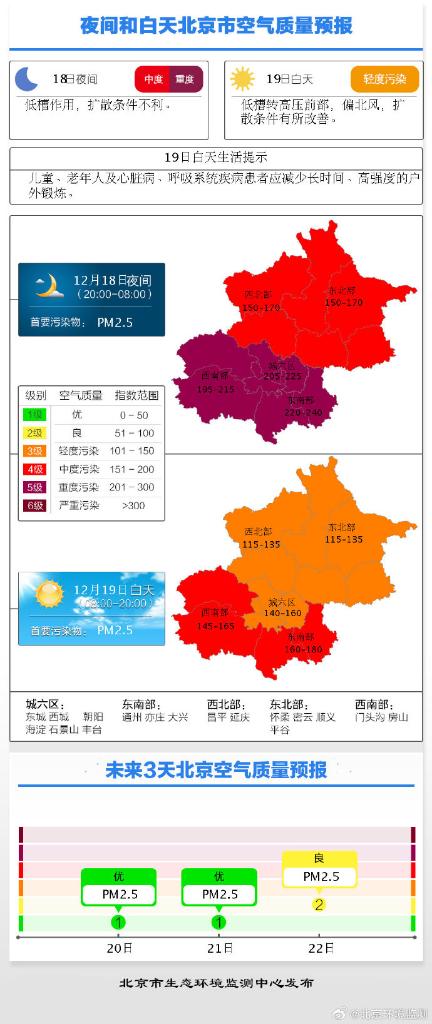
北京生态环境部门解读:为啥秋冬季污染爱“找上门”?
Xin Hua Wang· 2025-12-18 22:59
Group 1 - The air pollution yellow alert was activated in Beijing from December 18 to 19, marking the third significant pollution event in the Beijing-Tianjin-Hebei region this autumn and winter [1] - The increase in pollution levels is attributed to the total emissions exceeding environmental capacity, exacerbated by specific meteorological conditions during the autumn and winter seasons [1][2] - The stable atmospheric conditions during autumn and winter, including temperature inversions and high humidity, hinder the dispersion of pollutants, leading to local accumulation [1][2] Group 2 - The onset of the heating season in northern China has led to increased emissions from coal-fired power plants and heating boilers, contributing to higher pollution levels [2] - The operational levels of the thermal power heating industry in the Beijing-Tianjin-Hebei region have increased by approximately 20 percentage points compared to pre-heating season levels [2] - The transportation and construction activities have quickly resumed after snowfall, further contributing to pollution sources [2] Group 3 - The geographical features of the Beijing area, surrounded by mountains on three sides, create a "bowl-shaped" terrain that facilitates the accumulation of pollutants, especially under southerly winds [5] - The pollution transport dynamics in the region are influenced by the prevailing winds, which can carry pollutants from upstream areas into Beijing [5] - Forecast models indicate that improved dispersion conditions will not occur until the arrival of cold air on the afternoon of December 19 [5]
“OBD作弊器”竟能篡改检测数据!警方捣毁制售团伙
Yang Guang Wang· 2025-11-18 05:13
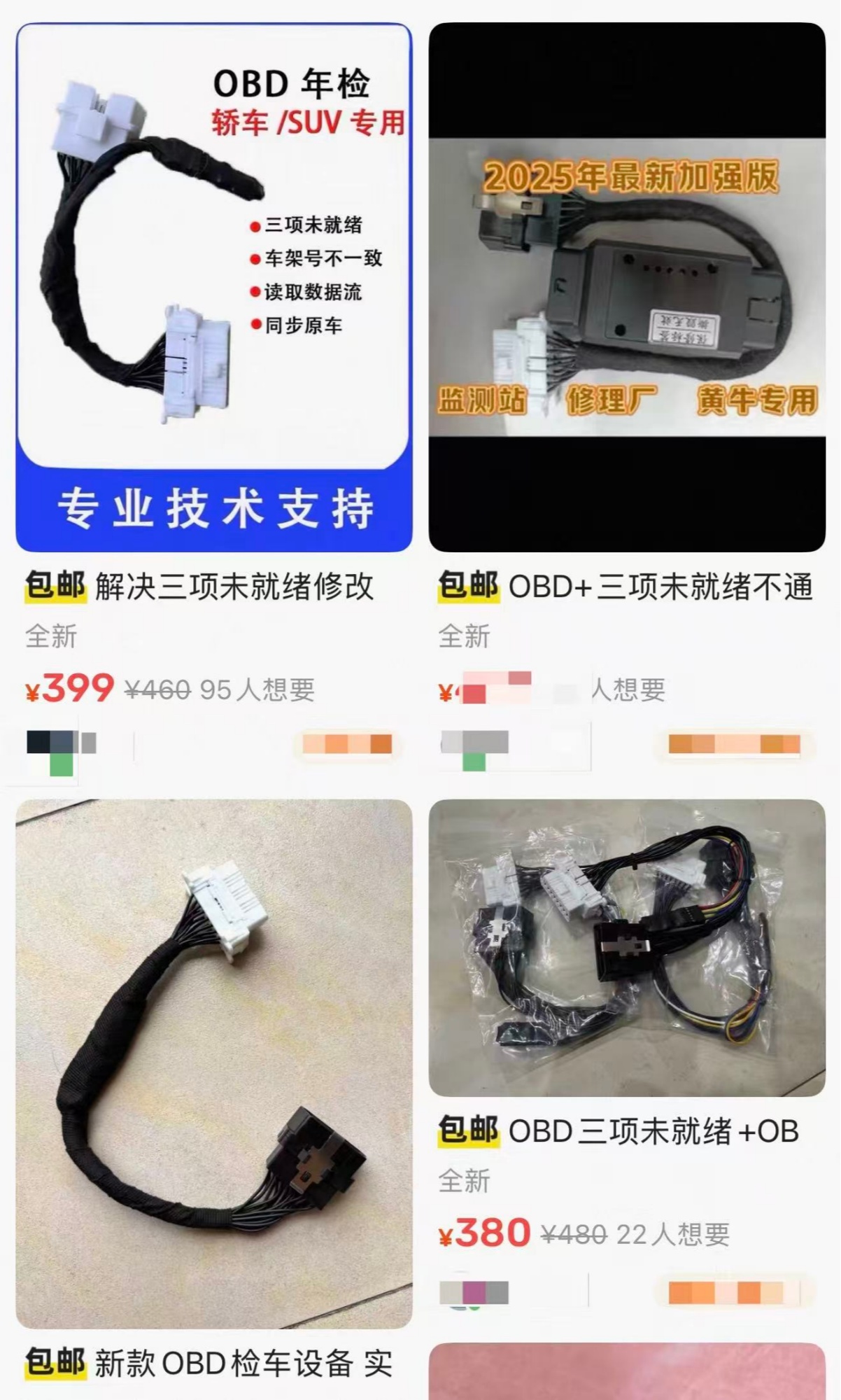
Core Viewpoint - The article highlights the illegal sale and use of OBD (On-Board Diagnostics) devices that allow vehicles to bypass emissions testing, posing risks to environmental safety and road security [1][11]. Group 1: OBD System Overview - OBD systems monitor vehicle engine performance and emissions, alerting users when emissions exceed legal limits [1]. - If certain diagnostic checks are incomplete, vehicles may fail annual inspections, particularly if more than two checks are not ready [1]. Group 2: Illegal OBD Devices - Online platforms are selling OBD devices that can manipulate vehicle data, enabling "problem cars" to pass inspections unlawfully [1][6]. - These devices act as deceptive programs, altering the data sent to inspection systems to show compliant results regardless of the vehicle's actual condition [6][9]. Group 3: Criminal Activities and Law Enforcement - A criminal gang involved in the production and sale of these OBD cheating devices was recently dismantled by Shanghai police, revealing a black market for such products [11]. - The gang leader, identified as Zhong, operated multiple online stores and utilized social media to evade detection while selling these illegal devices [9][11]. - The police have taken legal action against the suspects for environmental pollution and providing illegal tools for manipulating computer information systems [11][13]. Group 4: Regulatory Response - In response to the issue, the Ministry of Ecology and Environment, along with other departments, is working to enhance OBD system functionalities to prevent tampering and improve vehicle inspection processes [13]. - Authorities are urging the public to avoid purchasing these illegal devices and report any suspicious activities related to OBD cheating [13].
区域污染排放量处于高位,昨夜北京空气连续13个小时达重污染
Xin Jing Bao· 2025-11-06 03:43
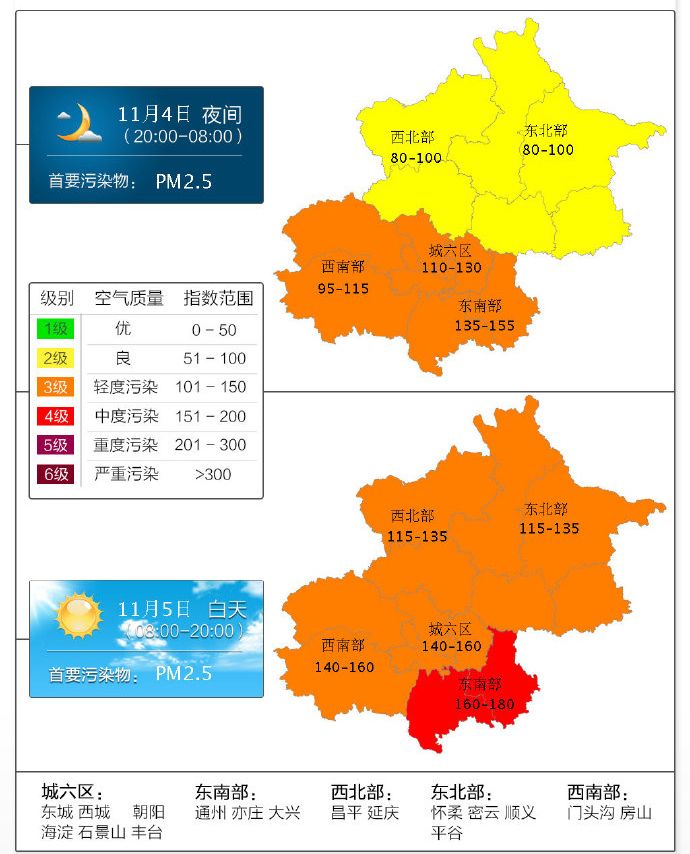
Core Insights - The air pollution event in the Beijing-Tianjin-Hebei region began on November 3, with PM2.5 concentrations significantly increasing due to regional transmission, peaking at 162 micrograms per cubic meter on November 5 [1][2] Group 1: Pollution Causes - The high pollution emission levels in the region before the heating season are identified as the fundamental cause of the pollution event [3] - The operational rates of industries such as brick, tile, and ceramics increased by 3 percentage points year-on-year, and heavy truck traffic rose by 7% during this period [3] - The region is experiencing unfavorable atmospheric diffusion conditions due to the transition from autumn to winter, leading to the accumulation of pollutants [3] Group 2: Impact on Beijing - During the pollution event, nearly 70% of Beijing's pollution was attributed to regional transmission, with local contributions accounting for 34% [4] - The average PM2.5 concentration in Beijing rose rapidly, with a peak increase of 17 micrograms per cubic meter within one hour [4] - Forecast models indicate that from November 6 to 8, diffusion conditions will improve, leading to a potential reduction in pollution levels, with expectations of reaching a good air quality level by November 7 [4]
京津冀及周边出现中至重度污染,专家分析污染成因有三个
Xin Jing Bao· 2025-11-06 02:32
Core Viewpoint - The PM2.5 pollution in the Beijing-Tianjin-Hebei region has intensified, reaching moderate to heavy pollution levels, primarily due to adverse meteorological conditions, high regional pollutant emissions, and the transport of pollution from northern Anhui [1][2][3]. Group 1: Current Air Quality Status - On November 5, PM2.5 levels in Beijing reached short-term heavy pollution levels, with a peak hourly concentration of 163 micrograms per cubic meter [2]. - On November 4, 15 cities in the region experienced light pollution, with a daily average peak concentration of 108 micrograms per cubic meter in Luoyang [2]. - The overall PM2.5 concentration in the central region of Beijing-Tianjin-Hebei was classified as moderate to heavy pollution during this period [2]. Group 2: Causes of Pollution - The pollution event was attributed to several factors: weak southeast winds, ground inversion, high humidity, and fog, which created poor atmospheric diffusion conditions [3]. - The relative humidity exceeded 90%, facilitating the chemical transformation of pollutants, particularly nitrogen oxides under high humidity conditions [3]. - The region also faced significant emissions from ongoing heating activities and high levels of vehicle and machinery operations, contributing to increased nitrogen oxides emissions [3]. - Pollution transport from northern Anhui, where there were numerous straw burning incidents, further exacerbated the situation, with some areas experiencing over 80% organic matter in pollution during peak times [3]. Group 3: Response Measures and Effectiveness - As of November 5, 24 cities in the region activated heavy pollution weather alerts, implementing differentiated control measures based on performance grading [4]. - Cities such as Tianjin and Shijiazhuang initiated orange alerts, while others like Zhengzhou and Kaifeng issued yellow alerts [4]. - Following the alert activation, there was a notable reduction in regional pollutant emissions, with a 10% decrease in operational rates for industries like cement and ceramics, and over a 20% reduction in emissions from key enterprises [4]. Group 4: Future Air Quality Outlook - Air quality is expected to improve significantly by November 6-7, with the northern region experiencing slight relief from pollution [5][6]. - The forecast indicates that from November 8-12, the region will benefit from multiple cold air fronts, leading to better dispersion conditions and overall improved air quality [5][6]. - Specifically, by November 9, it is anticipated that Beijing's air quality will reach excellent levels, following a period of light to moderate pollution [6].
北京5日至8日迎污染过程,相关部门解读背后原因
Xin Hua Wang· 2025-11-05 00:23
Core Viewpoint - Beijing is expected to experience a period of light pollution from November 5 to 8, primarily due to unfavorable meteorological conditions and local emissions, with air quality predicted to reach level 3 (light pollution) and potentially level 4 (moderate pollution) during certain periods [1][3]. Summary by Relevant Sections Pollution Forecast - The air quality in Beijing is forecasted to be at level 3 (light pollution) from November 5 to 6, with some areas possibly reaching level 4 (moderate pollution) [1][3]. - On November 7, conditions are expected to improve to level 2 (good) due to the influence of a northeastern high-pressure system and potential precipitation [1][3]. - On November 8, pollution is expected to return, with air quality ranging from level 2 (good) to level 3 (light pollution) [1][3]. Causes of Pollution - The increase in pollution is attributed to a combination of reduced atmospheric capacity and increased regional emissions as autumn and winter set in [1][3]. - Adverse meteorological conditions, including weak pressure systems and significant temperature inversions, are causing pollutants to accumulate near the ground [1][3]. - High relative humidity levels are contributing to the secondary formation of particulate matter, while regional southerly winds are exacerbating the situation by transporting pollutants into the area [1][3]. Duration and Future Outlook - The pollution event is expected to last for four days, with a shift to favorable dispersion conditions anticipated from November 9 due to incoming cold air [1][3].
生态环境部:6月下半月京津冀及周边地区中南部和汾渭平原可能出现轻至中度污染
news flash· 2025-06-16 14:28
Core Viewpoint - The article discusses the air quality forecast for the second half of June, indicating that while most regions will have good air quality, the Beijing-Tianjin-Hebei region and the Fenwei Plain may experience light to moderate pollution due to high temperatures and dust storms [1]. Group 1 - The National Environmental Monitoring Station, in collaboration with various meteorological and environmental agencies, conducted a nationwide air quality forecast for the latter half of June [1]. - Overall, the atmospheric diffusion and wet removal conditions across the country are expected to be favorable, leading to predominantly good air quality in most areas [1]. - However, high temperatures may lead to light to moderate pollution in the central and southern parts of the Beijing-Tianjin-Hebei region and the Fenwei Plain [1]. Group 2 - Dust storm conditions may cause moderate or higher levels of pollution in parts of eastern and southern Xinjiang during certain periods [1].
减污和降碳 找到“连接点” 清华SIGS团队最新发现登上《自然》
Shen Zhen Shang Bao· 2025-06-14 16:54
Core Insights - The research led by Tsinghua University's SIGS proposes a novel integration of pollution reduction and carbon reduction, providing new insights for climate and environmental policy research [1] Group 1: Methane and Air Pollution - Methane is the second-largest greenhouse gas contributing to climate change, and understanding its concentration changes is crucial for climate warming research [2] - The study identifies two dimensions driving methane concentration changes: emissions and losses, with the latter being significantly influenced by the presence of hydroxyl (OH) radicals, which act as a "cleanser" for methane in the atmosphere [2] Group 2: Interaction Between Air Pollution and Methane Loss - The research reveals a new connection between air pollution and methane loss, indicating that certain air pollutants can accelerate methane loss, while efforts to reduce these pollutants without considering their impact on methane loss may inadvertently increase atmospheric methane concentrations [3] - This finding emphasizes the need for policymakers to consider the synergistic effects of pollution reduction and carbon reduction in their strategies [3] Group 3: Ongoing Research and Future Directions - The current research builds on previous findings regarding the impact of wildfires on global warming, highlighting the importance of addressing forest fire phenomena in climate policy [4] - The team plans to expand their research to assess the comprehensive factors affecting OH radicals over a longer time scale, aiming to explore the interactions between various atmospheric active components and methane loss [5] - The study underscores the complex interplay between air pollution and methane source-sink dynamics, advocating for a systematic evaluation of the impacts of air pollutant reductions on global methane budgets to achieve both air quality improvement and climate goals [5]