
头部集中效应

Search documents
国泰海通|非银:财富管理需求旺盛,头部集中趋势明显——关于2025年下年销售机构公募基金保有量点评
国泰海通证券研究· 2026-03-17 14:08
Core Insights - The total non-cash fund holdings of the top 100 institutions increased by 14.7% to 11.7 trillion yuan, primarily driven by the growth in equity mutual funds [1] - The preference for fixed income plus products is rising, with banks losing market share to brokerages and third-party channels, indicating strong wealth management demand [1] Group 1: Fund Holdings Growth - The non-cash fund holdings of the top 100 sales institutions reached 11.7 trillion yuan in H2 2025, marking a 14.7% increase from H1 2025 [1] - Excluding equity funds, the holdings of other funds (mainly bond funds) amounted to 5.7 trillion yuan, reflecting a 12.67% increase and contributing 43% to the overall growth [1] - Equity fund holdings reached 6.0 trillion yuan, contributing 57% to the increase in non-cash fund holdings, indicating that equity funds are the main growth driver [1] Group 2: Equity Fund Performance - The equity fund holdings of the top 100 institutions grew by 17% to 6 trillion yuan in H2 2025, with index funds accounting for 54% of this growth [2] - The third-party channel showed the largest contribution, increasing by 22% to 1.8 trillion yuan, contributing 38% to the overall growth, with Ant Fund, Tiantian Fund, and Teng'an Fund being the main contributors [2] - The strong market performance in H2 2025, with the Shanghai Composite Index rising by 14.78%, led to increased trading activity, with an average daily transaction volume of 24.57 billion yuan in equity funds [2] Group 3: Market Concentration Trends - The market share of the top 100 wealth management institutions for equity and non-cash funds increased by 0.61% and 1.00% respectively from mid-2025 to the end of 2025, indicating a more pronounced head concentration effect [3] - The market share of banks in equity and non-cash funds decreased by 0.73% and 0.32%, respectively, as wealth management demand shifts towards brokerages and third-party institutions [3] - Fixed income plus products are increasingly favored, suggesting that banks with diverse fixed income products may see their market share decline [3] Group 4: Investment Recommendations - There is an increasing certainty that residents will enhance their allocation to equity assets, suggesting a focus on retail business share growth and potential investments in leading public funds or profitable brokerage firms [4]


关于 2025 年下年销售机构公募基金保有量点评:财富管理需求旺盛,头部集中趋势明显
GUOTAI HAITONG SECURITIES· 2026-03-17 07:40
Investment Rating - The industry investment rating is "Increase" for companies like 招商证券 and 兴业证券, indicating a positive outlook relative to the market index [12]. Core Insights - The demand for wealth management is strong, with a notable trend of concentration among leading institutions. The top 100 institutions saw a 14.7% quarter-on-quarter increase in non-monetary fund holdings, reaching 11.7 trillion yuan, primarily driven by the growth of equity funds [2][4]. - The preference for fixed income plus products is increasing, with banks losing market share to brokerages and third-party channels. This shift is attributed to the growing wealth management demand [2][4]. - The increase in equity fund holdings is mainly from third-party channels, with a 17% quarter-on-quarter growth, where index funds contributed 54% to the total growth of equity funds [4][5]. Summary by Sections Fund Holdings - The top 100 institutions' non-monetary fund holdings reached 11.7 trillion yuan in 2025H2, with equity funds contributing 57% to the growth. The equity fund holdings increased to 6 trillion yuan, while fixed income funds reached 5.7 trillion yuan [4][5]. - The market share of the top 100 wealth management institutions increased by 0.61% for equity funds and 1.00% for non-monetary funds from mid-2025 to the end of 2025 [4]. Company Recommendations - The report recommends关注零售业务份额有望提升, particularly for companies like 兴业证券 and 招商证券, which are expected to benefit from the increasing allocation of equity assets by residents [4][6].






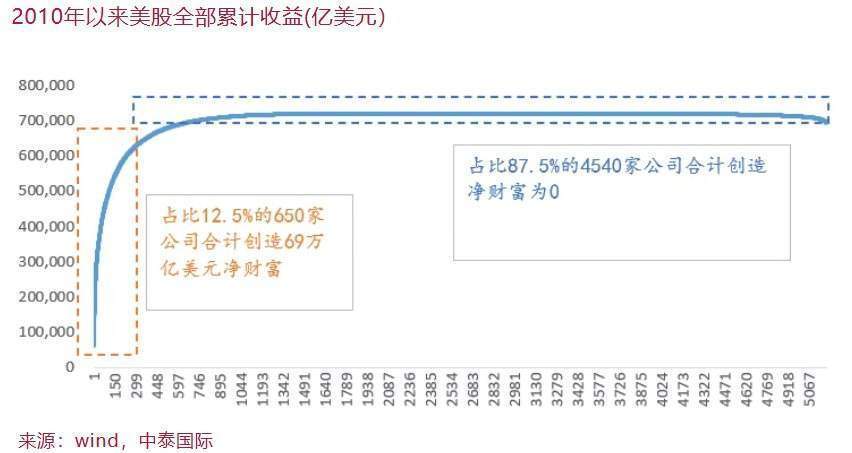
李迅雷:2010年至今,头部12.5%美股上市公司贡献了几乎美股总市值净增长,剩余87.5%上市公司的市值没有变化
Sou Hu Cai Jing· 2025-09-15 06:58
Group 1 - The current A-share market has transitioned from a slow bull market driven by valuation increases to a structural bull market driven by high growth expectations [1] - The concentration effect in the US stock market is significant, with the top 12.5% of listed companies contributing nearly all net growth in market capitalization since 2010, while the remaining 87.5% have seen no change [1] - Major US tech giants like Apple, Microsoft, and Nvidia benefit from stable cash flows and industry dominance, allowing them to maintain higher valuations than the market average [3] Group 2 - The "seven giants" of the US stock market contributed nearly half of the market's gains last year, highlighting the impact of leading companies on overall market performance [3]



机构:动力电池行业头部集中效应显著
Zheng Quan Shi Bao Wang· 2025-08-12 00:33
Group 1: Industry Overview - In July, China's total production of power and other batteries reached 133.8 GWh, with a month-on-month increase of 3.6% and a year-on-year increase of 44.3% [1] - From January to July, the cumulative production of power and other batteries in China was 831.1 GWh, reflecting a year-on-year growth of 57.5% [1] - In July, the sales volume of power and other batteries in China was 127.2 GWh, showing a year-on-year increase of 47.8% [1] - The cumulative sales from January to July amounted to 786.2 GWh, with a year-on-year growth of 60.6% [1] Group 2: Market Dynamics - The power battery industry is experiencing significant head concentration effects, with inefficient tail-end capacities needing orderly elimination [1] - The industry has a long-standing market structure characterized by head concentration due to its technology-intensive and complex manufacturing processes [1] - The demand for power battery installations remains high due to the rapid growth of the new energy vehicle sector, leading to competitive pricing pressures [1] Group 3: Future Outlook - China's lithium battery companies have a clear advantage in global scale production capacity and high-end technology, indicating a trend of long-term stable growth [1] - The domestic new energy vehicle market demand is substantial, supported by a well-established supply chain, which facilitates participation in global competition [1] - Since 2024, capital expenditures across the battery industry chain have noticeably slowed, with improvements in supply-demand conditions and signs of price recovery in some segments [2] - Leading enterprises in various segments are expected to recover profitability and escape the impacts of supply surplus first [2]