孔子学院

Search documents
裴淳华一家的中文咋这么好(学中文)
Ren Min Ri Bao Hai Wai Ban· 2026-02-26 23:11
Core Insights - The article highlights the growing interest in learning Chinese globally, particularly among children, and the cultural significance of the language as a bridge to understanding Chinese culture [2][6][8]. Group 1: Chinese Language Education Initiatives - Ghana plans to introduce Chinese language courses in primary and secondary schools nationwide by 2026, reflecting a broader trend of integrating Chinese into national education systems [2]. - The "Chinese Bridge" competition series has attracted over 1.8 million young participants globally, showcasing the appeal of Chinese language learning and its cultural connections [7]. Group 2: Cultural Exchange and Personal Development - The article emphasizes the personal stories of individuals like Rosamund Pike and her children, who have embraced Chinese language and culture, illustrating the language's role in fostering deeper cultural understanding [3][4]. - Learning Chinese is increasingly seen as a valuable asset for personal and professional development, with many young people incorporating it into their career plans, particularly in regions where Chinese language skills are in demand [8][10]. Group 3: Global Reach and Impact - Chinese language programs are now present in over 190 countries, with 90 countries including Chinese in their national education systems, indicating the language's expanding global footprint [6]. - The success stories of individuals like Ruth and Caroline, who have benefited from learning Chinese, highlight the tangible career opportunities that arise from language proficiency [9][10].

中非人文交流涌现“青春浪潮”
Xin Hua She· 2026-01-06 00:28
Core Viewpoint - The article emphasizes the growing role of youth in fostering connections between China and Africa through various forms of engagement, including sports, culture, and education, thereby creating vibrant new pathways for cooperation [1]. Sports as a Bridge - Chinese marathon runner He Jie has been training in Kenya, known as the "home of long-distance running," where he is inspired by the local athletes' determination to improve their lives through sports [2]. - He Jie's achievements include running a time of 2 hours 6 minutes and 57 seconds in the 2024 Wuxi Marathon, marking a significant milestone for Chinese men's marathon running [2]. - The exchange between Chinese and African athletes is deepening, with mutual learning and inspiration evident in their interactions [2]. Cultural Exchange - The 2026 Youth Olympic Games will be held in Dakar, Senegal, with martial arts included as an official event, showcasing the growing cultural ties [3]. - The "Belt and Road" initiative is facilitating cultural exchanges, as evidenced by nearly 500 youth from 66 countries participating in a sports exchange week in Jiangyin, China [3]. - A design competition between Kenyan and Chinese students highlights the collaborative spirit and cultural appreciation between the two nations [4]. Language and Education - South Africa has the highest number of Confucius Institutes in Africa, offering a variety of courses that promote cultural exchange and understanding [5]. - The Confucius Institute at the University of the Western Cape has developed a "Chinese + Traditional Chinese Medicine" training model, sending students to China for further education [5]. Skills Development - The article discusses the importance of diverse cultural exchanges in bridging the gap between Chinese and African youth, paving the way for mutual growth [6]. - Kenyan youth Jamleck Kariuki pursued engineering studies in China, later returning to work on a significant railway project, exemplifying the impact of educational exchanges [6]. - The 10th African Vocational Skills Challenge in 2025 involved 142 teams from 12 countries, benefiting over 1,300 African youths and promoting industrialization [7].
蒙古国国立教育大学孔子学院成立15周年庆典在乌兰巴托举行
Xin Hua She· 2025-11-03 14:04
Core Viewpoint - The 15th anniversary celebration of the Confucius Institute at the National University of Mongolia highlights its achievements in promoting educational cooperation and cultural exchange between China and Mongolia [1][2]. Group 1: Achievements and Contributions - The Confucius Institute has trained over 8,800 students and organized 119 cultural events, reaching nearly 8,000 participants in its 15 years of operation [1]. - The institute serves as a platform for enhancing educational collaboration and fostering mutual understanding between the two countries [1]. Group 2: Institutional Background - The Confucius Institute is the second of its kind in Mongolia, established in December 2010 as a Confucius Classroom, and upgraded to a Confucius Institute in September 2014 [2]. - It operates in collaboration with Northeast Normal University and the National University of Mongolia, with four teaching points under its administration [2].
“我的一半属于罗马尼亚,一半属于中国”(孔院之光)
Ren Min Ri Bao Hai Wai Ban· 2025-07-03 22:46
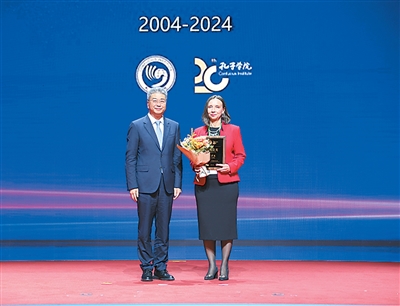
Core Points - The article highlights the significant contributions of Bai Luomi, the Romanian director of the Confucius Institute at Bucharest University, in promoting Chinese language and culture in Romania [7][12][15] - Bai Luomi was awarded the "Light of Confucius Institute" plaque during the 2024 World Chinese Conference for her efforts in enhancing the quality of education and cultural exchange between China and Romania [6][16] Group 1: Contributions to Education and Culture - Bai Luomi has played a pivotal role in the establishment and development of the Confucius Institute in Romania, witnessing the number of students grow from a few dozen to nearly 8,000 [12] - The institute has expanded its resources from handwritten materials to a wealth of electronic resources, catering to a diverse age group of learners [12] - Bai Luomi emphasizes the importance of Chinese literature as a means for Romanians to better understand contemporary China, focusing on translating works by modern Chinese authors [14] Group 2: Personal Journey and Achievements - Bai Luomi's fascination with Chinese culture began in childhood, leading her to pursue a lifelong passion for the language and its literature [9][11] - She has translated significant Chinese philosophical texts, including "Zhuangzi" and "Xunzi," which have deepened her understanding of Chinese thought [13][14] - Bai Luomi received the "Friendship Award" from the Chinese government in September 2019, recognizing her dedication to cultural and educational exchanges between China and Romania [15]