存储芯片产能转移

Search documents
近一个月翻倍!“电子茅台”价格暴涨快过黄金,行业大佬:全面缺货涨价,是30多年来第一次
Mei Ri Jing Ji Xin Wen· 2025-10-29 16:30
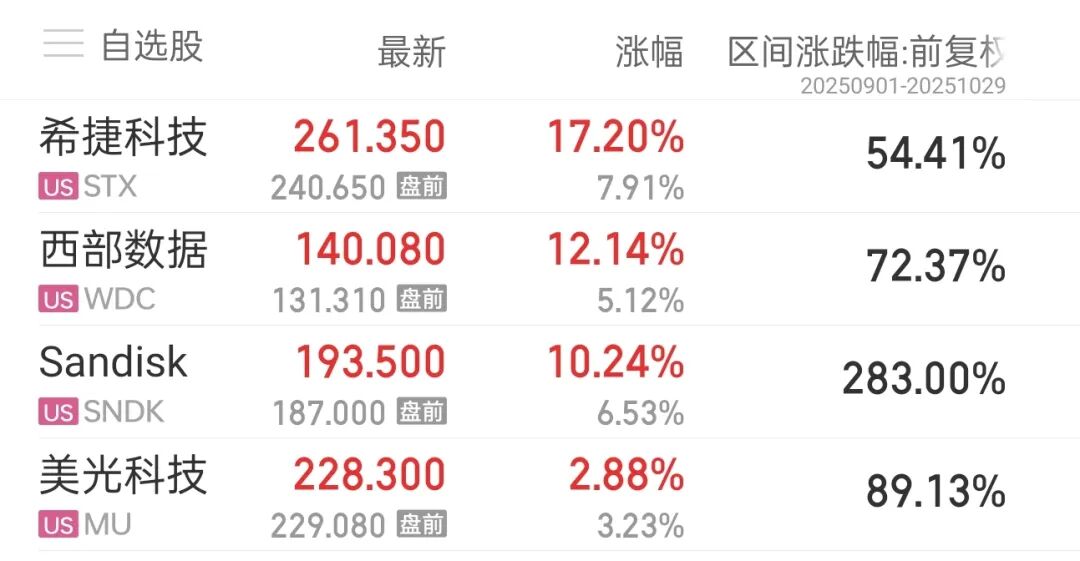
Core Viewpoint - The storage sector in the U.S. stock market has experienced significant gains, with companies like Seagate Technology, Western Digital, SanDisk, and Micron Technology seeing substantial increases in their stock prices over the past two months, driven by a dramatic rise in memory prices [1][2][3]. Group 1: Stock Performance - Seagate Technology's stock rose by 17.2%, with a cumulative increase of 54.41% over the past two months [1][2]. - Western Digital's stock increased by over 12%, with a cumulative rise of 72.37% [1][2]. - SanDisk's stock surged by over 10%, with an impressive cumulative increase of 283% [1][2]. - Micron Technology's stock rose nearly 3%, with a cumulative increase of 89.13% [1][2]. Group 2: Price Trends - Memory prices have seen a dramatic increase, with reports indicating that memory module prices in Hangzhou, Zhejiang, have doubled within a month [2][3]. - TrendForce data shows that DRAM prices surged by 171.8% year-over-year in Q3 2025, while gold prices increased by only 115% during the same period [3][4]. - Specific DRAM products, such as DDR5 and DDR4, saw price increases of 20.59% and 11.11% respectively in mid-October, with month-over-month increases of 58.73% and 43% [3][4]. Group 3: Supply and Demand Dynamics - The surge in prices is attributed to a structural imbalance in supply caused by the shift in production capacity towards high-bandwidth memory (HBM) chips due to the AI boom [4][5]. - Major manufacturers are reallocating production from standard DRAM to HBM, which is expected to dominate the market, with HBM revenue projected to nearly double by 2025 [4][5]. - The competition in the low-end DRAM market has prompted leading manufacturers like Samsung and SK Hynix to pivot towards higher-margin products, further constraining the supply of DDR4 memory [4][5]. Group 4: Market Reactions - Many distributors began stockpiling memory products earlier in the year, leading to reduced market supply and exacerbating price increases [5][6]. - The rising costs of memory chips are putting pressure on consumer electronics and server manufacturers, who are starting to pass these costs onto consumers [6][7]. - Companies like Raspberry Pi and Xiaomi have publicly acknowledged the impact of rising memory costs on their pricing strategies [6][7].