学术通胀

Search documents
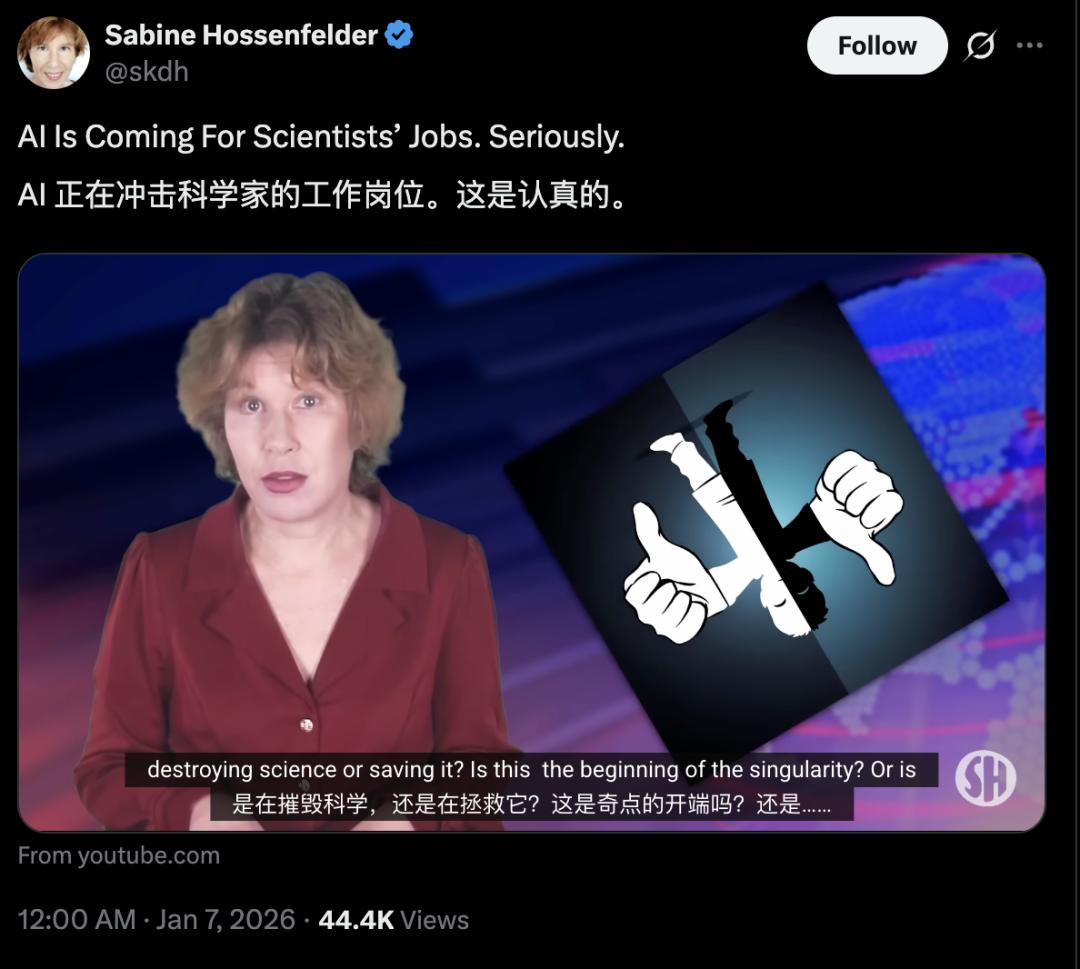
思考已成白菜价?黄仁勋一语成谶,物理学家:人类科研只剩3年
3 6 Ke· 2026-01-16 08:44
Core Viewpoint - The rapid advancement of AI is threatening the traditional roles of scientists, potentially leading to the obsolescence of familiar scientific research practices within three years [2][5][20]. Group 1: Impact of AI on Scientific Research - AI is expected to replace tasks traditionally performed by students and postdocs, significantly reducing costs and time associated with scientific research [3][7]. - The efficiency of research output is projected to increase by an average of 40%, with non-native English speakers seeing improvements of up to 80% [11]. - The adoption of AI tools in research is anticipated to approach nearly 100%, leading to a surge in the number of published papers and overwhelming the peer review process [11][22]. Group 2: Changes in Academic Landscape - The integration of AI in research is reshaping the academic environment, with institutions like MIT and Oxford beginning to adopt AI-based services [8][19]. - The reliance on AI tools is not limited to junior researchers; even top scientists like Terence Tao are utilizing AI for various aspects of their work [12]. - The U.S. government's "Genesis Mission" aims to leverage AI to accelerate scientific discoveries, indicating a strategic push at the national level [14][15][18]. Group 3: Future of Scientific Roles - The traditional roles of researchers, particularly in theoretical physics and mathematics, are at risk as AI can perform complex calculations and analyses more efficiently [6][8]. - The shift towards AI-driven research may lead to a breakdown in the traditional academic hierarchy, making entry-level positions more challenging to attain [25]. - Future scientists will need to evolve from being mere "knowledge carriers" to "wisdom commanders," focusing on problem formulation and interdisciplinary connections rather than rote knowledge [25][26].