安全统筹

Search documents
众安财险全面围剿“李鬼”!禁令之后统筹乱象仍需“堵疏结合”
Xin Lang Cai Jing· 2026-01-27 05:51
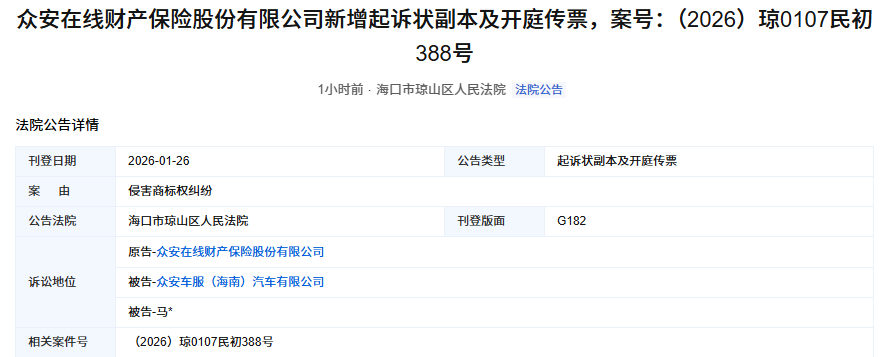
Core Viewpoint - ZhongAn Online has initiated a trademark infringement lawsuit against ZhongAn Chefu (Hainan) Automobile Co., Ltd. and an individual, marking a significant legal action in response to ongoing trademark violations and unfair competition in the insurance market [1][11]. Group 1: Lawsuit Details - The lawsuit has been accepted by the Haikou City Qiongshan District Court, with the case number (2026) Qiong0107 Minchu 388 [1][11]. - ZhongAn Online's five main demands include: immediate cessation of the use of "ZhongAn" or similar identifiers by the defendants, stopping misleading advertising related to "ZhongAn" and "insurance," changing the company name to remove "ZhongAn," publishing a public apology for thirty days, and compensating a total of 300,000 yuan for economic losses and legal fees [3][13]. Group 2: Industry Context - A nationwide "anti-counterfeiting" campaign began in early 2025, revealing numerous companies with names similar to "ZhongAn Chefu" across various provinces, indicating a widespread legal battle [4][14]. - These companies often sell "pseudo-insurance" products under names like "Motor Vehicle Safety Coordination" or "Safety Guarantee," deliberately avoiding the term "insurance" and using vague terms like "guarantee fund" and "mutual aid fund" [6][16]. Group 3: Regulatory Response - In July 2025, multiple regulatory bodies issued a notice to clarify that "traffic safety coordination" should only be an internal mutual aid mechanism for transportation companies, prohibiting commercial activities targeting unspecified vehicles [7][17]. - The notice aims to eliminate confusion in business registration and prevent new counterfeit entities from emerging, while the ongoing legal battles highlight the need for effective enforcement against trademark infringement [8][18]. Group 4: Market Implications - The rise of these "safety coordination" schemes, which operate outside strict insurance regulations, poses significant risks to consumers, especially if large claims arise or if the operators face financial difficulties [6][16]. - The market for these schemes has expanded rapidly, with over 2,000 such companies at their peak, exploiting the vulnerabilities of vehicle owners facing high insurance costs [6][16].


实施更加积极的财政政策 筑牢经济运行信心根基
Xin Lang Cai Jing· 2025-12-21 21:43
Core Viewpoint - The article emphasizes the importance of implementing a more proactive fiscal policy to stabilize economic growth and enhance confidence amid external uncertainties and domestic demand weaknesses [3][4][5]. Group 1: Importance of Proactive Fiscal Policy - A more proactive fiscal policy is crucial for shaping economic growth paths and driving high-quality development, especially in the context of external environmental changes and domestic supply-demand imbalances [4]. - The shift from "active" to "more active" fiscal policy has led to historic breakthroughs in deficit rates and significant expansions in debt instruments, which will continue to enhance confidence in stable economic growth [4][5]. Group 2: Counter-Cyclical Regulation and Economic Confidence - The proactive fiscal policy serves as a core tool for counter-cyclical regulation, addressing multiple pressures such as demand shortages and supply shocks [5]. - By providing financial support to various micro-entities, the policy aims to alleviate cash flow issues and stimulate consumption and investment, thus countering risks from international economic fluctuations [5]. Group 3: Long-term Growth and Structural Adjustment - The fiscal policy aims to achieve both short-term stability and long-term structural adjustments, addressing investment gaps in high-risk and positive externality sectors [6]. - It focuses on reducing early risks in strategic emerging industries and compensating for underinvestment in areas like basic research and infrastructure, which are essential for innovation and economic resilience [6]. Group 4: Social Welfare and Security - The proactive fiscal policy prioritizes social welfare, enhancing public services in education, healthcare, and social security, which in turn boosts consumer confidence and spending [7][11]. - It also aims to mitigate risks in key areas, ensuring sustainable fiscal health while supporting economic development and social stability [7][12]. Group 5: Key Measures for Implementation - The article outlines that maintaining necessary fiscal deficits and enhancing market confidence in demand recovery are essential for economic stability [9]. - It emphasizes the need for optimizing fiscal expenditure structures to support both social welfare and innovation, ensuring effective resource allocation [10][11]. Group 6: Risk Management and Sustainable Development - Effective risk management is highlighted as a prerequisite for stabilizing confidence, with a focus on maintaining sustainable fiscal practices [12]. - The proactive fiscal policy aims to stabilize the real estate market and manage local government debt risks through targeted financial strategies [12]. Group 7: Fiscal and Tax System Reform - The article discusses the need for fiscal and tax system reforms to promote fair competition and long-term development capabilities [13]. - It emphasizes the importance of standardizing tax incentives and fiscal subsidies to support public welfare, technological innovation, and green transformation [13].