家庭资产规划

Search documents
30年后高层住宅还值钱吗?答案藏在这四大核心逻辑里
Sou Hu Cai Jing· 2026-02-16 17:29
Core Viewpoint - The long-term value of high-rise residential properties is not predetermined to decline after 30 years, as it is influenced by building quality, location, maintenance, and property selection [1][8] Group 1: Building Quality and Standards - Concerns about high-rise buildings becoming unsafe over time lack industry knowledge, as there are strict national standards for residential quality in China [3] - The design lifespan for civil buildings is set at 50 years, and high-rise residential buildings adhere to this standard, with some developers enhancing quality during construction [3] - Proper maintenance can ensure that even after 30 years, the structural integrity and living functions of high-rise buildings remain satisfactory [3][4] Group 2: Location and Amenities - The value of real estate is closely tied to urban resources, with prime locations being crucial for maintaining property value over time [4] - High-quality locations provide irreplaceable amenities and sustained population demand, which can enhance living experiences despite aging buildings [4] - Properties in core urban areas tend to retain their value better than new developments in suburban areas, as they are more resilient during market fluctuations [4] Group 3: Maintenance and Urban Renewal - Property maintenance is essential for preserving the living experience and asset value of high-rise buildings over time [5][6] - Quality property management ensures regular inspections and upgrades, which are vital for maintaining a good living environment [6] - Urban renewal initiatives play a significant role in enhancing the value of aging high-rise buildings through comprehensive renovation and improvement measures [6][5] Group 4: Property Selection and Planning - The long-term value of high-rise residential properties is determined at the time of purchase, emphasizing the importance of selecting properties in prime locations from reputable developers [7][8] - Rational family asset planning is crucial, allowing for flexibility in housing choices as family needs evolve over time [7] - High-rise residential properties can serve as transitional housing or long-term investments, depending on family circumstances and market conditions [7][8]

“A股好岳父”!转让2.8亿股票给女婿,多年前“卖壳”大赚56亿
Mei Ri Jing Ji Xin Wen· 2025-09-23 22:33
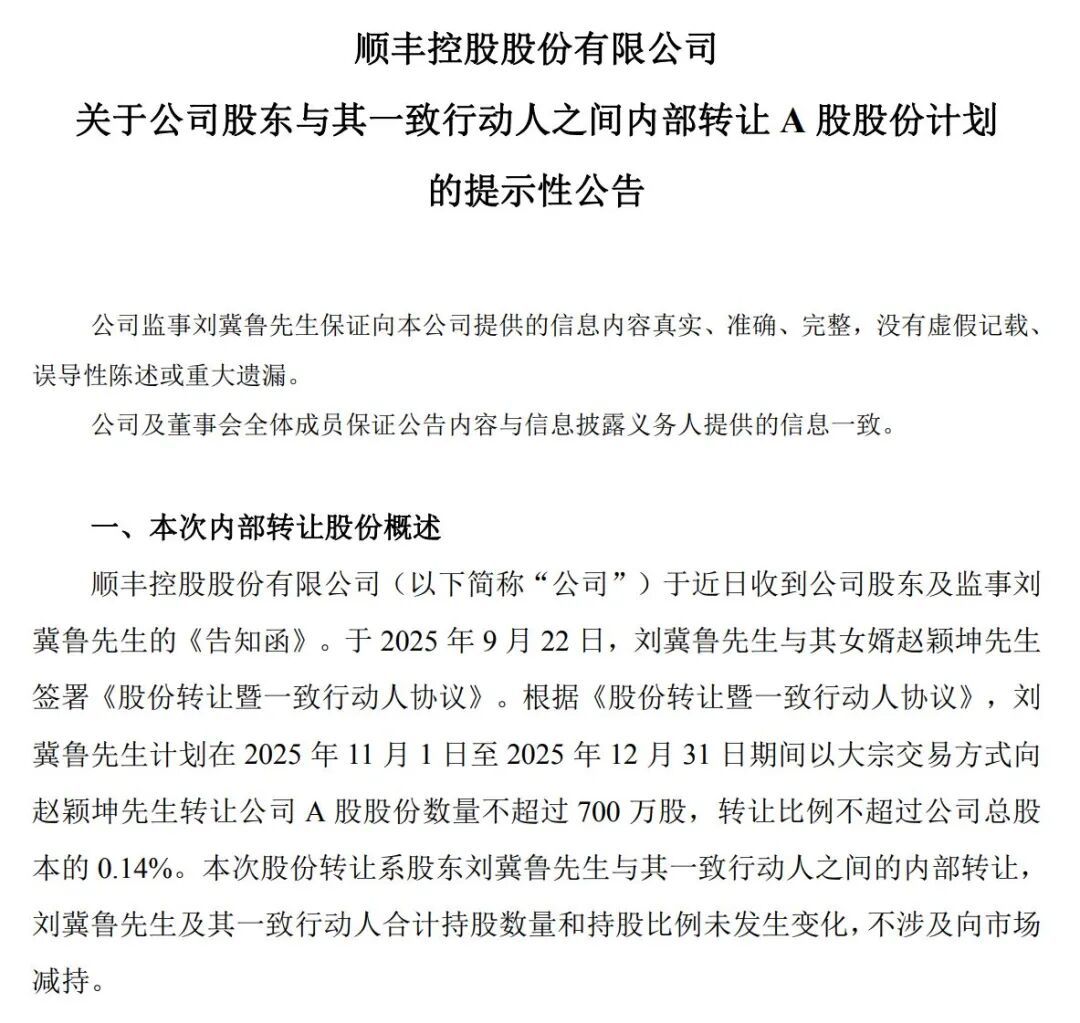
Core Viewpoint - SF Holding announced a share transfer agreement between shareholder Liu Jilu and his son-in-law Zhao Yingkun, planning to transfer up to 7 million A-shares from November 1 to December 31, 2025, representing 0.14% of the company's total share capital [1][5]. Group 1: Share Transfer Details - The reason for the share transfer is stated as "family asset planning needs" [5]. - Based on the closing price of 40.06 yuan per share on September 23, the total market value of the 7 million shares to be transferred is approximately 280 million yuan [5]. - The announcement emphasizes that the share transfer occurs between concerted parties, optimizing internal shareholding structure, and will not impact the total share capital or stability of the company's equity [5]. Group 2: Background of Liu Jilu - Liu Jilu, born in 1947, has a background in economic management from Anhui University and has a career spanning both industry and capital markets [5]. - He gained prominence during the reverse merger of SF Holding in 2017, where his holdings significantly increased in value, leading to a net gain of 5.6 billion yuan from the transaction [6]. - Liu Jilu has appeared multiple times on the Hurun Rich List, ranking 560th in 2020 with a wealth of 10.5 billion yuan, exemplifying a successful transition from industry to capital operations [6]. Group 3: Financial Performance - According to the 2025 mid-year financial report, SF Holding achieved operating revenue of 146.858 billion yuan, a year-on-year increase of 9.26%, and a net profit attributable to shareholders of 5.738 billion yuan, up 19.37% year-on-year [6]. - Post-transfer, Liu Jilu's shareholding will decrease from 0.71% to 0.57%, while Zhao Yingkun will hold 0.14% of the shares, with no change in company control or significant impact on daily operations or governance structure [6][7].