对外量化宽松

Search documents
瑞士央行狂买美股:持仓量近该国GDP五分之一,科技七巨头达516亿美元
Sou Hu Cai Jing· 2025-09-17 08:47
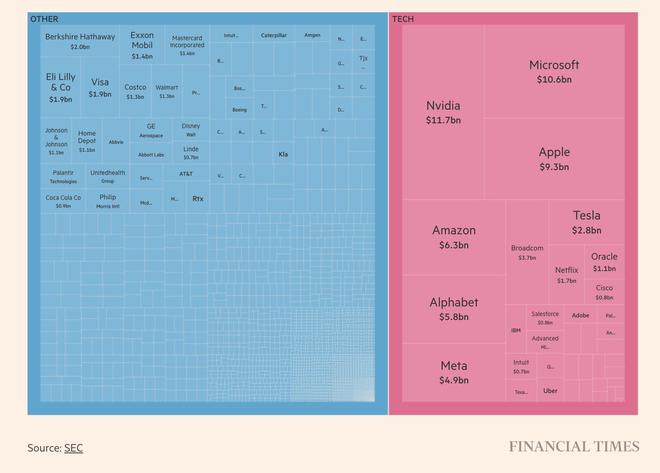
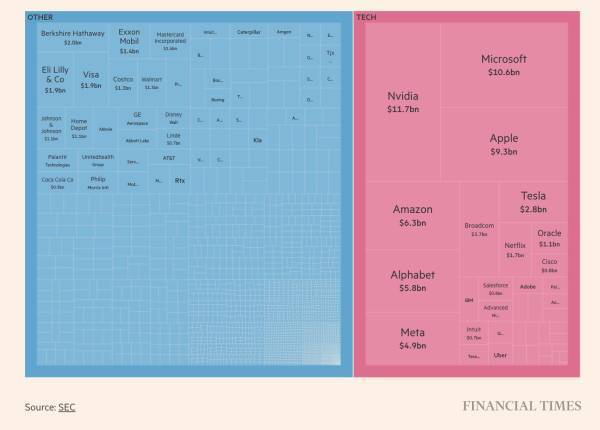
Core Insights - The Swiss National Bank (SNB) has become a significant player in the tech stock market, with a U.S. equity portfolio valued at $167 billion, nearly one-fifth of Switzerland's GDP, covering over 2,300 listed companies [1] - The seven major tech companies, including Apple, Microsoft, Amazon, Meta, Nvidia, Alphabet, and Tesla, account for $51.6 billion of SNB's investments, with Nvidia alone exceeding $11 billion [1][4] - SNB's balance sheet has expanded to $855 billion, positioning it alongside sovereign wealth funds from countries like Singapore and Qatar [1] Currency Management Strategy - The Swiss franc is viewed as a global safe-haven currency, leading to appreciation pressures during global turmoil, which can harm export competitiveness and potentially trigger deflation [2] - To counteract excessive currency strength, SNB employs a strategy of regularly selling francs and buying foreign currencies [2] Investment Approach - Approximately 87% of SNB's assets are in foreign currencies, including two-thirds in government bonds, 10% in corporate bonds, and 25% in stocks [5] - SNB's investment strategy is primarily passive, yet it demonstrates flexibility in adjusting its portfolio in response to market trends [5] Performance and Risks - SNB's holdings in Nvidia have seen a sixfold increase in quantity over two years, with a value surge of over 175% from March 2023 to March 2025, attributed to both active increases and stock price appreciation [7] - Despite high returns, SNB has faced significant losses due to asset price corrections and currency fluctuations, with a reported loss of 15.3 billion Swiss francs (approximately $19.5 billion) in the first half of the year [8] - Discussions around SNB's investment strategy have emerged, with some suggesting outsourcing asset management for higher returns, though many economists argue that the current system maintains advantages in liquidity and policy implementation [8]






瑞士央行狂买美股,持仓量近该国GDP五分之一
Guan Cha Zhe Wang· 2025-09-17 06:35
Core Viewpoint - The Swiss National Bank (SNB) has become a significant player in the tech stock market, with a U.S. equity portfolio valued at $167 billion, nearly one-fifth of Switzerland's GDP, covering over 2,300 listed companies [1] Group 1: Investment Strategy - The SNB's investment in major tech companies, including Apple, Microsoft, Amazon, Meta, Nvidia, Alphabet, and Tesla, accounts for $51.6 billion of its portfolio, with Nvidia alone exceeding $11 billion [1] - The SNB's balance sheet has expanded to $855 billion, positioning it alongside sovereign wealth funds from countries like Singapore and Qatar [1] - The SNB employs a unique strategy of regularly selling Swiss francs and buying foreign currencies to manage the appreciation of the Swiss franc, which is often seen as a safe-haven currency [2][4] Group 2: Market Position and Flexibility - Approximately 87% of the SNB's assets are in foreign currencies, including two-thirds in government bonds, 10% in corporate bonds, and 25% in stocks [6] - The SNB has shown flexibility in its investment approach, having established a position of over $2 billion in Berkshire Hathaway by 2025, despite not holding any shares in 2023 [6] - The SNB significantly increased its holdings in Nvidia, with the number of shares growing over sixfold in two years, leading to a 175% increase in value from March 2023 to March 2025 [8] Group 3: Risks and Challenges - The SNB has faced substantial losses due to asset price corrections and currency fluctuations, with a reported loss of 15.3 billion Swiss francs (approximately $19.5 billion) in the first half of the year due to a weakening dollar [9] - Discussions have arisen regarding the potential outsourcing of some assets to professional management for higher returns, although many economists believe the current system remains advantageous [9] - The SNB's ability to quickly mobilize foreign currency assets to manage inflation pressures post-COVID-19 highlights the importance of maintaining liquidity and flexibility in its investment strategy [9]