小央行+小财政

Search documents
【招银研究|宏观专题】回归“小央行”:美联储“沃什时代”前瞻
2 1 Shi Ji Jing Ji Bao Dao· 2026-02-14 03:09
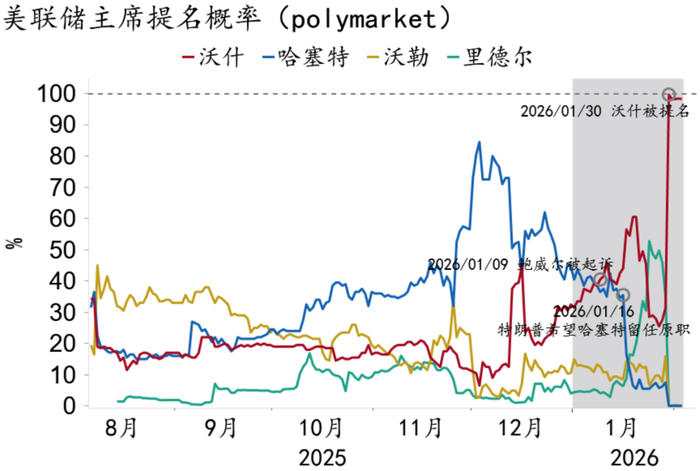
Core Viewpoint - Kevin Warsh has been nominated by Trump as the next Federal Reserve Chairman, aiming to balance various interests and potentially replace Jerome Powell on May 16, 2026 [1][3]. Group 1: Nomination Process - Warsh was chosen over other candidates due to his ability to unify different factions within the Republican Party and his strong connections with CEOs, financial giants, and politicians [1][7]. - Other candidates included Kevin Hassett, Rick Rieder, and Christopher Waller, each facing significant disadvantages compared to Warsh [4][8]. Group 2: Policy Philosophy - Warsh emphasizes that controlling inflation is the core mission of the Federal Reserve, advocating for balance sheet reduction and normalization of monetary policy [1][10]. - He believes that AI will drive the U.S. economy towards a "Goldilocks" scenario of high growth and low inflation, creating room for interest rate cuts [1][18]. - Warsh supports deregulation of U.S. commercial banks and aims to collaborate with regulatory vice-chair Bowman to advance this agenda [1][27]. Group 3: Long-term Policy Goals - Warsh's long-term strategy focuses on reviving monetarism, with deregulation and balance sheet reduction as core components [2][32]. - He may work with Treasury Secretary Bessent to implement "small central bank + small fiscal" reforms, aiming to achieve "growth with balance sheet reduction" [2][42]. Group 4: Market Implications - The global market may experience increased volatility, with U.S. stocks expected to trend upward but face a bumpy path [2][47]. - The U.S. Treasury yield is anticipated to decline moderately, with recommendations to focus on 2-5 year maturity bonds [2][56]. - The dollar is expected to initially weaken before strengthening, while the yuan is projected to appreciate moderately [2][62]. Group 5: Short-term Outlook - The Federal Reserve is likely to continue its interest rate cuts, with expectations of 2-3 cuts of 25 basis points each, potentially lowering the policy rate to 2.75-3.0% [1][36]. - Warsh's influence on short-term policy may be limited, but the dovish stance is expected to prevail [32][34].

【招银研究|宏观专题】回归“小央行”:美联储“沃什时代”前瞻
招商银行研究· 2026-02-12 11:13
Core Viewpoint - Kevin Warsh has been nominated by Trump as the next Federal Reserve Chairman, aiming to balance various interests and embody a consensus on monetary policy [2][12]. Group 1: Warsh's Policy Stance - Warsh emphasizes that controlling inflation is the core mission of the Federal Reserve, advocating for balance sheet reduction and normalization of monetary policy [3][16]. - He supports a reduction in the Fed's balance sheet and a focus on stabilizing inflation, while also calling for deregulation of U.S. commercial banks [3][30]. - Warsh's long-term goal is to revive monetarism, with deregulation and balance sheet reduction as key strategies [3][44]. Group 2: Economic Outlook and Interest Rates - The Fed is expected to continue a rate-cutting cycle, with 2-3 rate cuts of 25 basis points anticipated this year, potentially lowering the policy rate to a range of 2.75-3.0% [3][40]. - Warsh believes that AI-driven productivity improvements could allow for high growth and low inflation to coexist, creating space for rate cuts [3][22]. - The potential for a "quiet" monetary policy approach is suggested, where the Fed reduces its communication and market influence, which may increase market volatility [3][26]. Group 3: Regulatory Changes and Market Impact - Warsh advocates for a shift towards deregulation in the banking sector to enhance credit availability, particularly in light of the ongoing AI-driven economic transformation [3][30]. - The article outlines three potential scenarios for Warsh's reforms: optimistic, neutral, and pessimistic, each with varying implications for fiscal policy and credit expansion [4][49]. - Market volatility is expected to increase, with the potential for significant fluctuations in asset prices as the Fed's policy direction becomes clearer under Warsh's leadership [50][51]. Group 4: Long-term Implications - Warsh's approach may lead to a revival of monetarist principles, focusing on controlling money supply and stabilizing prices, which could reshape the Fed's monetary policy framework [44][68]. - The article suggests that the Fed's balance sheet reduction could lead to a steepening yield curve, impacting long-term interest rates [54][65]. - The potential for increased dollar credibility and a more hawkish liquidity management approach under Warsh is highlighted, which may support the dollar's long-term trajectory [68].