小芯片(Chiplets)

Search documents
反转,Arm承认下场自研芯片
3 6 Ke· 2025-08-01 07:28
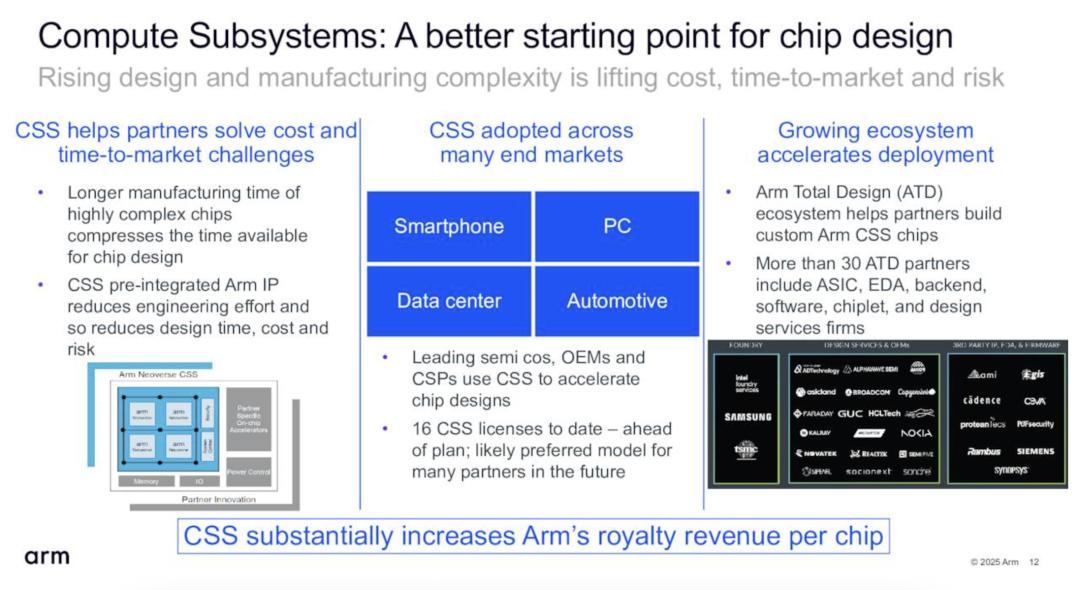
Core Insights - Arm has announced its strategic shift towards developing its own chips, moving away from its traditional model of licensing chip design blueprints to other companies [1][2][10] - The first self-developed chips are expected to be launched as early as summer 2023, with TSMC as the foundry partner and Meta potentially being one of the first customers [3][10] Group 1: Strategic Shift - Arm's CEO René Haas confirmed the company's decision to invest more in developing physical chips, which are seen as a tangible representation of their existing Compute Subsystem (CSS) products [2][3] - The move to self-developed chips is a response to the growing demand for high-performance chips in the data center market, which is projected to be a trillion-dollar industry [10][11] Group 2: Financial Performance - Arm's Q1 revenue was reported at $1.05 billion, slightly below market expectations of $1.06 billion, with adjusted earnings per share at $0.35, in line with expectations [3] - For Q2, Arm forecasts adjusted earnings per share between $0.29 and $0.37, with revenue expectations of $1.01 billion to $1.11 billion, aligning with market predictions [3] Group 3: Key Developments - Arm's collaboration with SoftBank on the "Stargate" project aims to support a broader AI vision, leveraging Arm's technology as the core CPU for various applications [4][5] - The company has seen a 40% year-over-year increase in enterprises running AI workloads on Arm Neoverse data center chips, with a 14-fold increase since 2021 [5] - Arm's CSS platform has signed 16 licenses with 10 companies, more than doubling from the previous year, indicating strong demand for its technology [6] Group 4: Chiplet Development - Arm is actively developing Chiplets, which allow for modular design and independent scaling of compute or memory, supported by over 70 partners [9] - The Chiplet architecture is seen as a way to diversify product offerings without requiring significant investment in single-chip SoC designs [9] Group 5: Market Impact - The introduction of self-developed chips may disrupt Arm's long-standing relationships with existing clients, as it transitions from a partner to a competitor [10] - This strategic move is viewed as a necessary step for Arm to achieve higher profit margins compared to its licensing model, especially in the booming AI-driven data center market [10][11]