
就业结构

Search documents
新的视角:从不同经济主体容纳比例变化看就业形势
Xin Lang Cai Jing· 2026-02-19 08:10
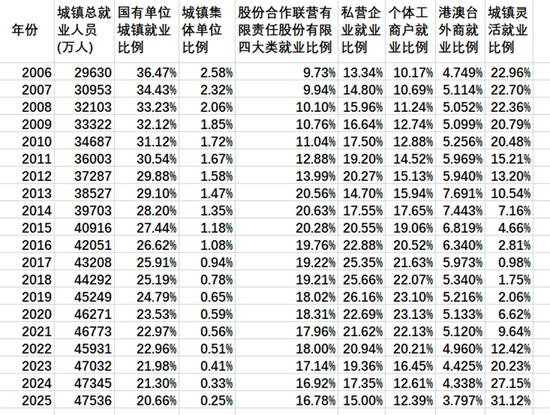
Core Viewpoint - The article discusses the impact of government policies favoring state-owned enterprises over private and small businesses, leading to a decline in formal employment and an increase in informal employment from 2006 to 2025 [1][6]. Employment Structure Changes - The proportion of employment in state-owned and collective enterprises has consistently decreased, from 36.47% and 2.58% in 2006 to 20.66% and 0.25% in 2025, respectively [4][9]. - Non-state-owned economic sectors initially saw an increase in employment share, peaking in 2014 and 2019, but are projected to decline by 2025 to 16.78% for joint-stock cooperatives, 15.00% for private enterprises, 12.39% for individual businesses, and 3.797% for foreign investments [4][10]. Informal Employment Trends - The proportion of informal employment decreased from 22.96% in 2006 to 1.75% in 2018 due to the expansion of formal employment; however, it is expected to rise again to 31.12% by 2025 due to the ongoing squeeze on formal jobs from state and collective enterprises [5][10]. - The article highlights that individual businesses straddle the line between formal and informal employment, and a high rate of closures could significantly increase the informal employment ratio [5][10]. Conclusion on Employment Policy - The article concludes that promoting private enterprises, especially individual businesses, could alleviate employment pressures; conversely, prioritizing state-owned enterprises may lead to significant job losses and increased employment difficulties [5][10].

就业增长不及预期一半!美ADP数据重创美元,黄金要重回高点?
Sou Hu Cai Jing· 2026-02-05 06:30
Group 1 - The overall employment growth of 22,000 new jobs is primarily driven by the education and healthcare sectors, which added 74,000 jobs in January, while other industries are experiencing negative growth [1] - Key industries such as professional and business services saw a reduction of 57,000 jobs, and manufacturing lost 8,000 positions, indicating a synchronized contraction that could impact the dollar's long-term outlook [3] - Despite a decline in employment numbers, wage growth remains resilient at around 4.5% year-on-year, creating a dilemma for the Federal Reserve regarding monetary policy [4] Group 2 - The employment slowdown is expected to weaken the dollar, leading to a potential increase in gold prices as a hedge against uncertainty [6] - ADP employment data is more suitable for adjusting short-term expectations rather than determining long-term reversals, emphasizing the need for caution in forex strategy formulation [7] - Understanding the interrelationship between assets is crucial for investors, as markets price in changes rather than outcomes, highlighting the importance of maintaining a logical perspective in trading [9]

国家统计局:就业形势总体稳定,就业结构持续优化
Yang Shi Wang· 2025-09-28 02:07
Core Viewpoint - The employment situation in China is generally stable, with ongoing optimization in employment structure, as reported by the National Bureau of Statistics on September 28, 2023 [1] Employment Statistics - By the end of 2024, the total number of employed persons in China is projected to reach 734.39 million, with urban employment at 473.45 million, an increase of 10.74 million from the end of 2020, accounting for 64.5% of total employment [1] - Rural employment is expected to decrease to 26.094 million, a reduction of 2.699 million, representing 35.5% of total employment [1] Sectoral Employment Trends - The third industry is expected to employ 35.866 million people by the end of 2024, an increase of 600,000 from the end of 2020, and will account for 48.8% of total employment, up by 1.1 percentage points [1] Employment Support Measures - The average urban survey unemployment rate is projected to be 5.1% in 2024, a decrease of 0.5 percentage points from 2020 [1] - The average unemployment rate for urban migrant agricultural workers is expected to be 4.6%, down by 1.0 percentage point [1] - In 2024, 5.15 million unemployed individuals are expected to be assisted in re-employment, with 1.63 million from vulnerable groups receiving employment support [1]