
就业形势

Search documents
有人预测:过完年,社会上将会发生4大变化,大家提前做好准备
Sou Hu Cai Jing· 2026-02-21 05:21
Group 1 - The core viewpoint is that after the Spring Festival, several trends will emerge that directly impact finances, work, and family life [1][3] Group 2 - Change 1: Wages are increasing but not enough to cover living costs. The average wage in 2025 is projected to be 24,555 yuan, a 5.3% increase from the previous year [5]. However, the actual growth rate for salaries is expected to decline slightly, with 4.3% in 2024 and 4.4% in 2025 [7]. The rising costs of living, including housing loans and education, are outpacing wage increases [9]. There is significant industry disparity, with high-tech and AI sectors seeing better wage growth compared to traditional manufacturing and service industries [11] Group 3 - Change 2: There is an increase in the number of people participating in matchmaking activities after the New Year. Data shows a rise in activity on dating platforms, particularly among younger generations and seniors [13][15]. The pressure from parents regarding marriage is also intensifying during this period [19] Group 4 - Change 3: Many elderly individuals return to being home alone after the festive season. The proportion of empty-nest elderly people is nearing 60%, with over 1.8 billion individuals affected [24]. There is a noticeable increase in cases of depression and anxiety among the elderly post-holiday [26] Group 5 - Change 4: Job hunting remains challenging after the New Year. The number of college graduates in 2025 is expected to reach 12.22 million, an increase of 430,000 from the previous year [28]. While job openings are increasing, the competition for basic positions is becoming more intense, with many employers seeking candidates with experience [30]. There is a growing demand for skilled positions in areas like electrical work and elder care, which are often unfilled [32]


新的视角:从不同经济主体容纳比例变化看就业形势
Xin Lang Cai Jing· 2026-02-19 08:10
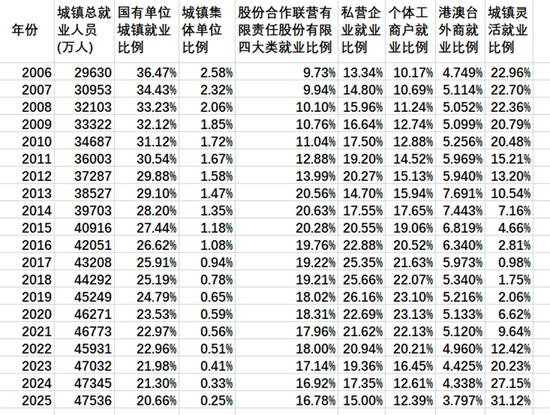
Core Viewpoint - The article discusses the impact of government policies favoring state-owned enterprises over private and small businesses, leading to a decline in formal employment and an increase in informal employment from 2006 to 2025 [1][6]. Employment Structure Changes - The proportion of employment in state-owned and collective enterprises has consistently decreased, from 36.47% and 2.58% in 2006 to 20.66% and 0.25% in 2025, respectively [4][9]. - Non-state-owned economic sectors initially saw an increase in employment share, peaking in 2014 and 2019, but are projected to decline by 2025 to 16.78% for joint-stock cooperatives, 15.00% for private enterprises, 12.39% for individual businesses, and 3.797% for foreign investments [4][10]. Informal Employment Trends - The proportion of informal employment decreased from 22.96% in 2006 to 1.75% in 2018 due to the expansion of formal employment; however, it is expected to rise again to 31.12% by 2025 due to the ongoing squeeze on formal jobs from state and collective enterprises [5][10]. - The article highlights that individual businesses straddle the line between formal and informal employment, and a high rate of closures could significantly increase the informal employment ratio [5][10]. Conclusion on Employment Policy - The article concludes that promoting private enterprises, especially individual businesses, could alleviate employment pressures; conversely, prioritizing state-owned enterprises may lead to significant job losses and increased employment difficulties [5][10].
欧洲股市,集体上涨!黄金、白银反弹
Sou Hu Cai Jing· 2026-02-18 14:12
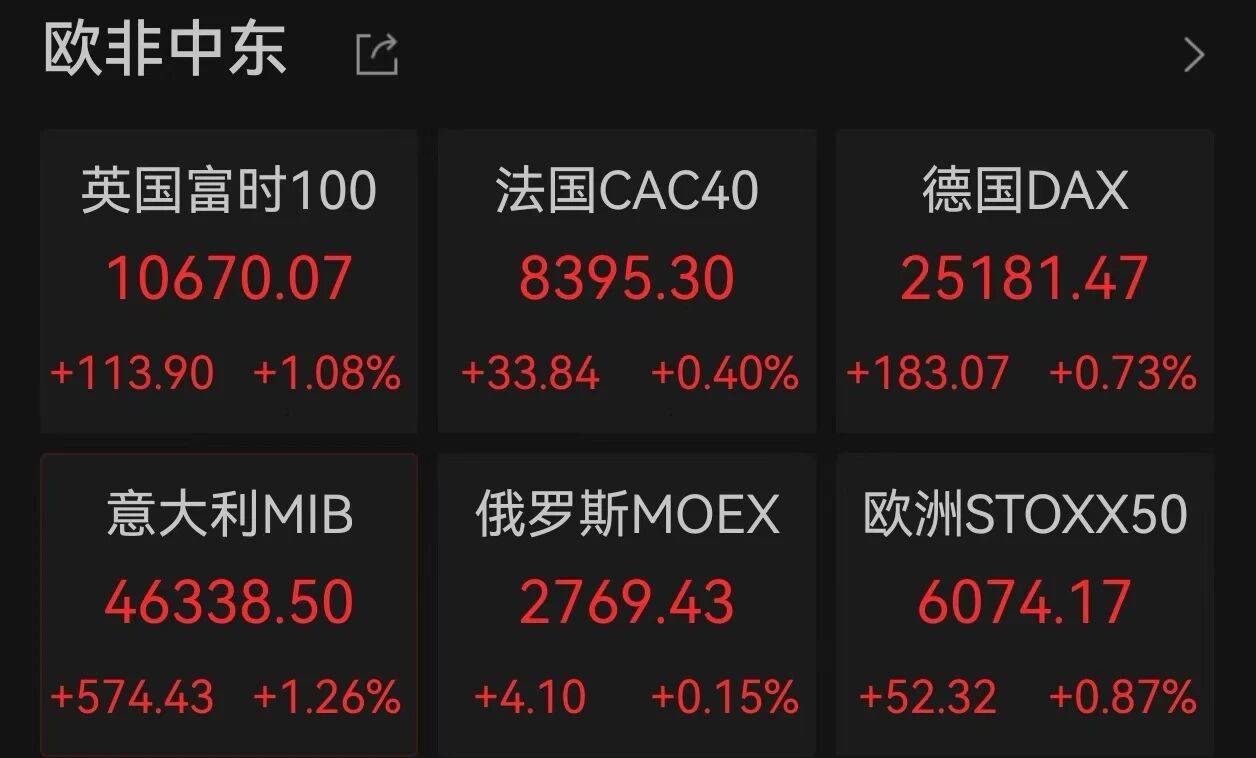
Group 1: European Stock Market Performance - European stock markets experienced a broad rally on February 18, with multiple indices reaching or approaching historical highs. The UK FTSE 100 index rose over 1% and hit a record high, while the French CAC40, German DAX, and Euro Stoxx 50 indices increased by 0.4%, 0.73%, and 0.87% respectively, nearing their historical peaks [1][3]. - The Italian MIB index also saw a significant increase, rising over 1% [3]. Group 2: Commodity Market Trends - The international precious metals market saw a collective rebound, with COMEX gold futures and London gold spot prices increasing by 0.77% and 1.13%, reaching $4943.6 per ounce and $4931.611 per ounce respectively [5]. - Silver prices showed even more pronounced gains, with COMEX silver futures and London silver spot prices rising by 2.69% and 2.8%, priced at $75.52 per ounce and $75.548 per ounce respectively [5][6]. - In the energy sector, both NYMEX crude oil and ICE Brent crude oil futures rose by over 2%, with NYMEX approaching $64 per barrel and ICE nearing $70 per barrel [5].
高人预测:今年春节后,社会上出现这4大“变化”,太真实了!
Sou Hu Cai Jing· 2026-02-17 23:35
Group 1 - The first change indicates that job security for workers is becoming more challenging, yet skilled labor is increasingly valuable. The overall employment situation remains stable, with an expected 12.67 million new urban jobs in 2025 and an average unemployment rate of around 5.2% [5][11]. However, the number of college graduates is at a record high, with over 12 million expected in 2026, leading to intense competition for entry-level positions [7]. Conversely, there is a persistent labor shortage in skilled trades, with higher salaries compared to typical white-collar jobs [9][13]. Group 2 - The second change reflects a shift in consumer behavior towards more prudent spending. During the 2026 Spring Festival, over half of the population opted for "moderate consumption," prioritizing savings while still maintaining essential spending for family gatherings and necessary purchases [17][20]. The government has also introduced initiatives to stimulate consumption, such as subsidies and vouchers for various sectors [20]. Group 3 - The third change highlights a trend of increasing divorce rates post-Spring Festival, as couples confront economic pressures and communication issues that become apparent during family gatherings. The normalization of divorce procedures and a shift in marriage perspectives, particularly among women valuing quality of life, contribute to this trend [22][28][26]. Group 4 - The fourth change indicates a decline in the traditional "return home" phenomenon during the Spring Festival, as many individuals find employment opportunities closer to home. The development of local economies and the financial benefits of staying in urban areas during the holiday season are influencing this trend [30][33][35].

机构:若非农强劲数据得以保持 距中性利率或比市场预期更近
Xin Lang Cai Jing· 2026-02-11 14:39
Group 1 - The potential employment situation appears to be stronger than expected, possibly more optimistic than the recent assessments by the Federal Open Market Committee (FOMC) [1] - If these data remain consistent in subsequent months' revisions, the implications for monetary policy suggest that the market is closer to a neutral interest rate than previously priced in [1]
我国经济总量首次突破140万亿元 经济底盘更实抗风险能力更强
Zhong Guo Qing Nian Bao· 2026-01-20 00:57
Economic Overview - In 2025, China's GDP reached 140,187.9 billion yuan, marking a 5% increase from the previous year, showcasing a stable and resilient economic growth trajectory [1][2] - The "14th Five-Year Plan" period saw China's economy achieve significant milestones, with GDP surpassing 110 trillion, 120 trillion, 130 trillion, and finally 140 trillion yuan [1] Economic Stability and Growth - The year 2025 is characterized by stability in economic metrics such as total GDP, employment, and foreign trade, with a notable increase in goods trade and foreign exchange reserves exceeding 3.3 trillion USD [2][3] - High-tech manufacturing's value added accounted for 17.1% of industrial output, and final consumption contributed over 50% to economic growth, indicating a shift towards a more optimized economic structure [2] Trade and Innovation - China's exports of high-tech products grew by 13.2% in 2025, with total goods imports and exports increasing by 3.8%, and exports alone rising by 6.1% [3] - Research and development expenditure reached 2.8% of GDP, surpassing the OECD average for the first time, and China's innovation index entered the global top ten [3] Social Welfare and Employment - The average disposable income per capita for residents was 43,377 yuan, reflecting a 5% real growth, with rural incomes growing even faster at 6% [5] - The urban unemployment rate remained stable at an average of 5.2%, with the total number of migrant workers reaching 30.115 million, an increase of 0.5% from the previous year [4][5] Urbanization and Education - By the end of 2025, the urbanization rate in China reached 67.89%, with the average education level for the population aged 16-59 increasing to 11.3 years [6] Future Outlook - Despite external challenges, the foundation for China's economic growth remains strong, with expectations for continued stability and opportunities in 2026 [6][7]
全省居民人均可支配收入36120元
Xin Lang Cai Jing· 2026-01-19 18:11
Group 1: Agricultural Production - The total grain production in Sichuan for 2025 is projected to be 36.625 million tons, an increase of 287,000 tons or 0.8% compared to the previous year [1] - The grain planting area is expected to reach 9.6185 million acres, an increase of 97,000 acres or 0.1% year-on-year [1] - The grain yield is anticipated to be 380.8 kg per acre, an increase of 2.6 kg per acre or 0.7% from the previous year [1] - The total meat production (pork, beef, lamb, and poultry) is projected to be 6.669 million tons, an increase of 211,000 tons or 3.3% [1] - Pork production is expected to be 5.02 million tons, a growth of 4.7%, while beef production is projected at 390,000 tons, a growth of 5.1% [1] Group 2: Resident Income and Consumption - The per capita disposable income in Sichuan is projected to be 36,120 yuan, a nominal increase of 5.2% and a real increase of 5.5% after adjusting for price factors [2] - Urban residents' per capita disposable income is expected to be 49,428 yuan, a nominal increase of 4.4%, while rural residents' per capita disposable income is projected at 22,494 yuan, a nominal increase of 5.6% [2] - The per capita consumption expenditure in Sichuan is anticipated to be 26,073 yuan, a nominal increase of 4.8% and a real increase of 5.1% [2] - The consumer price index (CPI) in Sichuan is expected to decrease by 0.3% compared to the previous year, while the core CPI, excluding food and energy, is projected to rise by 0.5% [2] Group 3: Employment Situation - The average urban survey unemployment rate in Sichuan is projected to be 5.3%, remaining stable compared to the previous year [3] - The unemployment rate is expected to fluctuate throughout the year, with a peak of 5.4% in the first and third quarters and a low of 5.1% in the second quarter [3] - By December, the urban survey unemployment rate is anticipated to be 5.2% [3]
(经济观察)“暖”数据传递中国民生保障温度
Zhong Guo Xin Wen Wang· 2026-01-19 12:26
Group 1: Employment Stability - The overall employment situation in China remains stable, with an average urban survey unemployment rate of 5.2% in 2025, lower than the expected target of around 5.5% [1] - The unemployment rate in 31 major cities averaged 5.1%, consistent with the previous year, and remained between 5.0% and 5.3% throughout the year [1] - The unemployment rate for urban labor aged 30-59 was 4.0%, 1.2 percentage points lower than the national urban average, indicating a stable employment foundation for this demographic [1] Group 2: Income Growth - In 2025, the per capita disposable income of residents reached 43,377 RMB, reflecting a real growth of 5.0%, in line with economic growth [3] - Rural residents' income growth outpaced urban residents by 1.5 and 1.8 percentage points in nominal and real terms, respectively, leading to a reduction in the urban-rural income gap from 2.34 to 2.31 [3] - The growth in income is supported by stable increases in wage income, operating net income, and transfer net income [3] Group 3: Price Stability - The Consumer Price Index (CPI) in China remained stable in 2025, with a year-on-year increase of 0.8% in December, the highest since March 2023 [4] - The overall CPI for the year was flat compared to the previous year, while the core CPI, excluding food and energy, rose by 0.7%, an increase of 0.2 percentage points from the previous year [4] - Favorable climate conditions and sufficient supply of food contributed to the stability of prices, with ongoing policies aimed at boosting consumption expected to further support price stability [4]
王萍萍:2025年就业形势保持总体稳定
Guo Jia Tong Ji Ju· 2026-01-19 03:35
Group 1 - The overall urban survey unemployment rate in 2025 averaged 5.2%, which is below the expected target of around 5.5% [2] - The unemployment rate fluctuated throughout the year, peaking at 5.4% in February and stabilizing at 5.1% in the last quarter [2] - The average unemployment rate in 31 major cities was 5.1%, remaining stable compared to the previous year and lower than the national urban average by 0.1 percentage points [2] Group 2 - The unemployment rate for urban workers aged 30-59 averaged 4.0%, which is 1.2 percentage points lower than the national urban average [3] - The unemployment rate for migrant workers remained stable, averaging 4.7% for the year, with a decrease to 4.4% in November and December [3] - Efforts to support migrant workers through labor matching and the development of rural industries contributed to overall employment stability [3] Group 3 - Employment in the transportation, accommodation, and catering sectors continued to increase in 2025, reflecting the implementation of employment-first strategies [4] - The manufacturing sector maintained a stable share of national employment, while service industries showed significant growth in employment numbers [4] - Economic stability, industrial transformation, and supportive employment policies provided a solid foundation for maintaining employment levels [4]
国家统计局:就业形势总体稳定 城镇调查失业率与上月持平
Guo Jia Tong Ji Ju· 2025-12-15 02:06
Group 1 - The average urban survey unemployment rate in China from January to November is 5.2% [1] - In November, the urban survey unemployment rate remains at 5.1%, unchanged from the previous month [1] - The unemployment rate for local registered labor is 5.3%, while the rate for migrant labor is 4.7%, with agricultural migrant labor at 4.4% [1] Group 2 - The urban survey unemployment rate in 31 major cities is 5.1%, consistent with the previous month [1] - The average weekly working hours for employed persons in the country is 48.6 hours [1]