工业启蒙

Search documents
文化繁荣如何带来经济持续增长:2025年诺贝尔经济学奖的启示
Xin Jing Bao· 2026-01-28 05:40
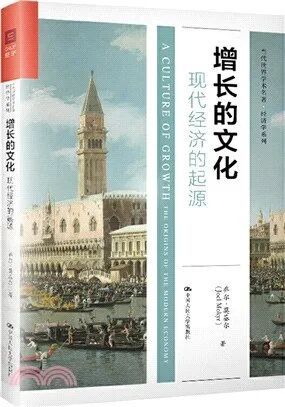
Core Insights - The article discusses the cultural transformation that enabled sustained economic growth in Europe since the 18th century, as articulated by Joel Mokyr, the 2025 Nobel Prize winner in Economics [1][6][31] - Mokyr's work emphasizes the importance of "useful knowledge" and cultural evolution in shaping economic systems and technological paths, rather than merely focusing on institutional or geographical factors [4][31] Group 1: Cultural Evolution and Economic Growth - Mokyr argues that the key to modern economic growth lies in a "growth-friendly culture" that emerged in Europe between the 16th and 18th centuries, characterized by a belief in controlling nature, valuing empirical evidence, and promoting open communication among intellectuals [3][4][31] - The concept of "cultural entrepreneurs" is introduced, highlighting figures like Francis Bacon and Isaac Newton, who reshaped societal attitudes towards knowledge and innovation [15][18] Group 2: Knowledge Structures - Mokyr distinguishes between propositional knowledge (understanding why) and prescriptive knowledge (knowing how), asserting that the interaction between these two forms of knowledge is crucial for technological advancement [10][12][31] - The article notes that the scientific revolution in the early modern period led to a systematic approach to knowledge accumulation, allowing for continuous innovation rather than sporadic advancements [11][12] Group 3: The Role of Institutions and Competition - Mokyr emphasizes that the political fragmentation of early modern Europe fostered a competitive "market of ideas," which encouraged innovation and the dissemination of new knowledge [18][19] - The concept of a "republic of letters" is introduced, where intellectuals could freely exchange ideas, contributing to a culture of knowledge sharing and collaboration [19][22] Group 4: Industrial Enlightenment - The article discusses the "Industrial Enlightenment," which connects the application of systematic knowledge to practical improvements in production processes and living standards [23][24] - Mokyr highlights the rise of "philosophical engineers," who combined theoretical knowledge with practical skills, thus enhancing the precision and effectiveness of industrial practices [26][27] Group 5: Comparative Analysis with China - Mokyr contrasts the cultural and institutional environments of Europe and ancient China, suggesting that China's centralized governance stifled innovation and the exploration of new ideas, which hindered its industrial development [28][29][30] - The article critiques the Chinese examination system for promoting rote learning over innovative thinking, which limited the integration of practical and theoretical knowledge [29][30] Group 6: Implications for Modern Economic Growth - Mokyr's insights suggest that fostering a culture that values knowledge, encourages innovation, and supports the integration of theory and practice is essential for sustained economic growth [31][32] - The article concludes that understanding the historical context of knowledge production and dissemination can inform contemporary policies aimed at enhancing innovation and economic development [41][42]

刷新认知!2025诺奖获得者,把经济增长的底层逻辑说透了
商业洞察· 2025-10-18 09:30
Core Viewpoint - The Nobel Prize in Economic Sciences was awarded to Joel Mokyr, Philippe Aghion, and Peter Howitt for their contributions to understanding innovation-driven economic growth [1][4]. Group 1: Joel Mokyr's Contributions - Mokyr received half of the 11 million Swedish Krona prize for his discovery of the prerequisites for sustained growth through technological advancement [4]. - His research focuses on why the Industrial Revolution occurred in 18th century Western Europe rather than elsewhere, proposing a new theoretical framework centered on knowledge as the core of economic growth [8]. - Mokyr distinguishes between two types of knowledge: "propositional knowledge" (knowledge about natural laws) and "procedural knowledge" (knowledge about how to do things), arguing that their interaction in modern Europe prepared fertile ground for technological application [8]. Group 2: Cultural and Political Insights - Mokyr's theory of "growth culture" explores the complex interactions between culture, ideas, and institutions leading to the Industrial Revolution, emphasizing the importance of a competitive "market of ideas" in Europe compared to a more controlled intellectual environment in China [9][11]. - He argues that the fragmented political landscape in Europe fostered competition among thinkers, which was crucial for continuous innovation, contrasting it with the more centralized control in China that limited knowledge innovation [11]. - Mokyr highlights that the cultural shift in 18th century Europe towards valuing scientific knowledge and its application was essential for the conditions that led to the Industrial Revolution [11]. Group 3: Contemporary Relevance - Mokyr's research provides a framework for understanding current technological transformations, emphasizing that breakthroughs in fields like artificial intelligence and biotechnology stem from long-term knowledge accumulation and advancements in basic sciences [12]. - The key to a society's long-term prosperity lies in its ability to stimulate, absorb, and adapt to technological innovations, necessitating an ecosystem that encourages exploration and supports basic scientific research [12]. - Mokyr warns against a Eurocentric view of history, advocating for an understanding of diverse developmental paths and the importance of nurturing a cultural environment conducive to innovation [13].
诺奖半额奖金独归他,从背负历史伤痕的 "流浪者",到改写经济增长认知的莫基尔
3 6 Ke· 2025-10-18 00:05
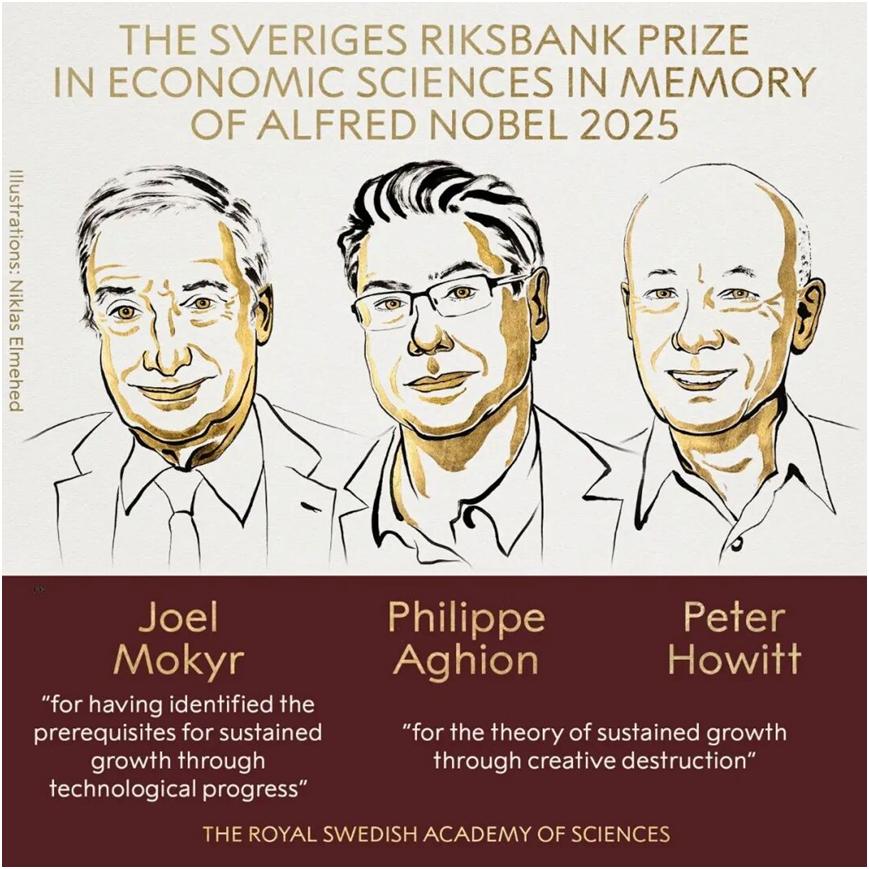
Core Points - The Nobel Prize in Economic Sciences for 2025 was awarded to Joel Mokyr, Philippe Aghion, and Peter Howitt for their contributions to the understanding of innovation-driven economic growth [1] - Mokyr received half of the 11 million Swedish Krona prize for his discovery of the prerequisites for sustained growth through technological advancement [5] Group 1: Mokyr's Background - Joel Mokyr was born on July 26, 1946, in Leiden, Netherlands, and faced significant personal challenges early in life, including the loss of his father and the impact of his mother's experiences during the Holocaust [5] - He studied economics and history at Hebrew University in Jerusalem, earning his bachelor's degree in 1968, and later obtained a Ph.D. from Yale University in 1974 [6] Group 2: Theoretical Contributions - Mokyr's research focuses on why the Industrial Revolution occurred in 18th-century Western Europe rather than elsewhere, proposing a new theoretical framework that emphasizes knowledge as central to economic growth [7][8] - He distinguishes between two types of knowledge: "propositional knowledge" (knowledge about natural laws) and "procedural knowledge" (knowledge about how to do things), arguing that their interaction in modern Europe prepared the ground for technological advancements [8] Group 3: Cultural Perspectives - Mokyr introduced the concept of "growth culture," exploring the complex interactions between culture, thought, and institutions leading to the Industrial Revolution [9][11] - He contrasts the competitive "market of ideas" in fragmented Europe with the more controlled cultural changes in China, highlighting the importance of an open and competitive intellectual environment for sustained innovation [11] Group 4: Contemporary Relevance - Mokyr's work provides a framework for understanding current technological transformations, emphasizing that breakthroughs in emerging technologies stem from long-term knowledge accumulation and foundational scientific advancements [12] - He advocates for an innovation ecosystem that encourages exploration, tolerates failure, and supports basic scientific research, which is crucial for long-term societal prosperity [12]