
市场定价机制

Search documents
金银暴跌突发,行情急转直下,投资者该怎么办?
Sou Hu Cai Jing· 2026-02-07 21:49
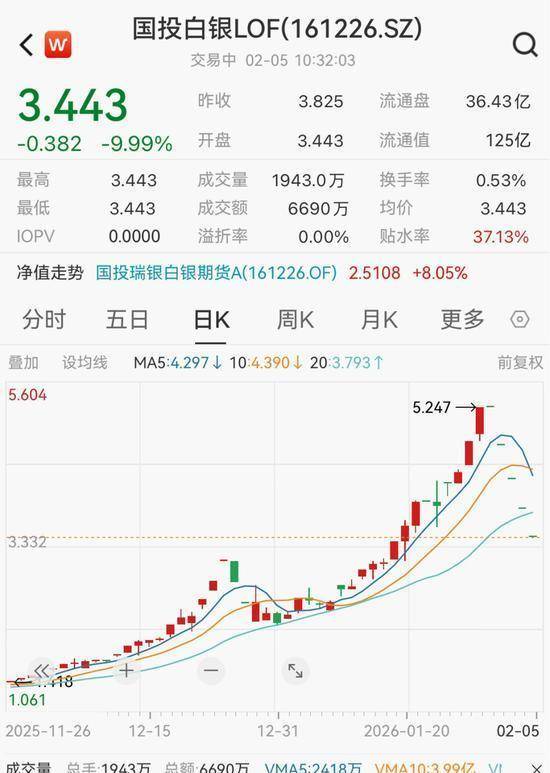
Core Viewpoint - The precious metals market experienced a sudden and significant drop, with spot gold falling below $4900 and silver dropping below $81, indicating a rapid market reaction influenced by various factors [1][2]. Group 1: Market Dynamics - Precious metal prices are influenced by international risk sentiment, the exchange rate of the Chinese yuan, a strong US dollar, liquidity in the market, and the positions of funds, with silver being particularly sensitive due to its dual industrial and investment attributes [2][4]. - The recent decline in silver prices, including a four-day consecutive limit down for the Guotou Silver LOF, reflects a broader market signal regarding investor sentiment and fund flows [2][4]. - The precious metals sector in the A-share market saw widespread declines, with companies like Hunan Gold and Hunan Silver hitting 10% limit down, indicating severe impacts on individual stocks [4][5]. Group 2: Factors Behind the Decline - The first key factor is the strengthening of the US dollar and the re-pricing of US Treasury yields, which raised the opportunity cost of holding precious metals, particularly during periods of fluctuating inflation expectations [5][6]. - The second factor involves structural issues in funding, where passive products like ETFs and LOFs tend to experience sharp declines in extreme market conditions, leading to liquidity issues [6]. - The third factor is market sentiment and speculative behavior, where short-term funds and algorithmic trading exacerbate price volatility, triggering stop-loss orders and margin calls [6][10]. Group 3: Regulatory and Market Mechanisms - The volatility in pricing and premium rates indicates a lack of smooth linkage between on-market and off-market activities, suggesting a need for improved transparency in pricing mechanisms [7][10]. - Regulatory measures should focus on enhancing transparency regarding premium rates and holding structures, as well as providing risk education to investors about the nature of precious metals as non-zero-risk assets [10][12]. - There is a call for temporary protective measures during extreme market conditions to prevent liquidity crises, which would not contradict market principles but rather aim to mitigate systemic risks [10][12]. Group 4: Long-term Perspectives - The recent market turmoil highlights a long-standing contradiction in global financial markets between asset prices and fundamentals, influenced by central bank policies and geopolitical factors [10]. - Investors are advised to diversify their portfolios and match investment horizons appropriately, avoiding the pitfalls of over-reliance on precious metals as a safe haven [10][12]. - The fundamental aspects of the precious metals industry, such as mining capacity and industrial demand, remain intact despite short-term price shocks, emphasizing the need for rational investment strategies [12].

完善市场化定价是国债做市的核心
第一财经· 2025-08-20 00:51
Core Viewpoint - The article emphasizes the importance of improving the government bond yield curve as a foundation for the financial market, highlighting recent measures taken by the Ministry of Finance to enhance liquidity in the secondary market for government bonds [2][3]. Summary by Sections Government Bond Market Operations - The Ministry of Finance announced operations to support the market for government bonds, specifically selling 2.7 billion yuan of 2025 10-year bonds and 2.8 billion yuan of 2025 12-year bonds to improve liquidity and reflect market supply and demand [2][3]. Current Market Conditions - The article discusses the ongoing asset shortage and declining policy interest rates, which have increased investor preference for government bonds, leading to a liquidity squeeze in the bond market [2][3][4]. - In July, there was a net decrease of 1.11 trillion yuan in household deposits, indicating a shift in financial asset distribution among residents [3]. Importance of a Healthy Yield Curve - A well-functioning government bond yield curve is crucial for the stability and predictability of the financial system, especially as household asset exposure risks change [3][4]. - The Ministry of Finance's operations aim to balance supply and demand in the market, preventing excessive price increases and ensuring that the yield curve reflects market conditions [3][4]. Challenges in the Market - The article identifies two main issues contributing to the current market's risk-averse behavior: low policy interest rates leading to credit tightening and insufficient capacity to generate effective risk assets, exacerbating the asset shortage [4][5]. - The focus on safe assets like government bonds has resulted in liquidity problems in the secondary market, as investors prefer to hold rather than trade these securities [4][5]. Recommendations for Improvement - To enhance the government bond yield curve and market pricing mechanisms, it is essential to address low interest rates and promote a more open economic environment that encourages risk-taking and innovation among market participants [5][6]. - The article advocates for comprehensive reforms to eliminate barriers to market efficiency and foster a competitive legal market order, ultimately improving investment returns and addressing the asset shortage [5][6].

一财社论:完善市场化定价是国债做市的核心
Di Yi Cai Jing· 2025-08-19 12:56
Core Viewpoint - The article emphasizes the importance of improving the government bond yield curve and establishing a solid pricing foundation for the financial market, which requires addressing the benefits and drawbacks of low interest rate policies and fostering market participants' risk-taking spirit and creativity [1][4][5] Group 1: Government Bond Market Operations - The Ministry of Finance announced operations to support the market for government bonds, specifically through selling operations for the 2025 government bonds, with amounts of 270 million and 280 million respectively [1][2] - The government bond market support operations are not new, having been implemented since the issuance of the operational rules in September 2016, and are increasingly regularized due to recent changes in the financial market [1][2] - The current selling operations reflect a supply-demand imbalance in the market for key maturity government bonds, aiming to prevent excessive price increases and improve liquidity in the secondary market [2][3] Group 2: Financial Asset Distribution Changes - In July, there was a net decrease of 1.11 trillion yuan in household deposits, highlighting the significance of a healthy government bond yield curve as the distribution of household financial assets changes [2] - The shift in household asset exposure risks necessitates a more stable and predictable financial system, which places higher demands on the healthy operation of the government bond yield curve [2] Group 3: Market Pricing Mechanism - To create a healthy liquidity environment for the government bond market, it is crucial to establish a sound pricing mechanism and reduce transaction costs, allowing the yield curve to effectively cover risk exposures [3][4] - The current market's risk-averse behavior is driven by a persistent asset shortage and low policy interest rates, leading to liquidity issues in the government bond secondary market [3][4] - The article suggests that addressing low interest rates and enhancing the marginal investment return is essential for guiding changes in the government bond yield curve [4][5] Group 4: Structural Reforms - Comprehensive reforms and opening up various sectors are necessary to broaden the productive boundaries of market participants and eliminate non-market barriers to effective market operation [4][5] - The government bond market support operations are seen as a starting point, with the ultimate goal being to improve the yield curve and market pricing foundation through deeper reforms [5]