
国债收益率曲线

Search documents
2026年4月1日利率债观察:做平30Y-10Y的机会已现
EBSCN· 2026-04-01 05:26
Group 1: Report's Industry Investment Rating - No information provided Group 2: Report's Core View - The opportunity to flatten the 30Y - 10Y spread has emerged, and currently, betting on the convergence of the 30Y - 10Y Treasury bond spread has a high probability of success. Similarly, the probability of success in betting on the convergence of the 30Y local government bond and 10Y Treasury bond spread is also high [1][2][3] Group 3: Summary Based on Related Catalogs 30Y - 10Y Treasury Bond Spread Analysis - The 10Y is the most - watched maturity on the Treasury yield curve. The spread between 30Y and 10Y Treasury bonds is used as an indicator to compare the investment cost - effectiveness of the two maturities. The higher the spread's historical quantile, the higher the investment cost - effectiveness of 30Y relative to 10Y [1][7] - In the medium - term, the 30Y - 10Y Treasury bond spread has a significant mean - reversion characteristic. From January 2010 to December 2022, the spread was generally in the range of 40 - 80bp, with a median of 57bp [1][7] - After December 2022, the spread trended downward, but has risen rapidly in the past six months. As of March 31, 2026, the spread is 53.5bp, at the 52% quantile since January 2010, at least at a historical neutral level [1][7] - The current spread is higher than the fitted value calculated from the 10Y Treasury yield. The spread and the 10Y Treasury yield are positively correlated, with a Pearson correlation coefficient of 0.44. An OLS model can be established: 30Y - 10Y Treasury bond spread = 10.23×10Y Treasury yield + 19.00. The actual spread has the motivation to revert to the fitted value [1][7] 30Y and 10Y Treasury Bond Yield Ratio Analysis - The ratio of 30Y and 10Y Treasury bond yields focuses on measuring the investment cost - effectiveness of the two assets from the perspectives of static yield and holding - period coupon income. It also has a mean - reversion characteristic [2][10] - Currently, the 30Y and 10Y Treasury bond yields are 2.35% and 1.82% respectively, and their ratio is 1.29, the highest since June 2020. The future decline of the ratio is only a matter of time, indicating that betting on the convergence of the 30Y - 10Y Treasury bond spread has a high probability of success [2][10] 30Y Local Government Bond and 10Y Treasury Bond Spread Analysis - The current spread between 30Y local government bonds and 10Y Treasury bonds is 79.3bp, at the 82% quantile since January 2021. The spread has basically returned to the level of March 2022 [3][12] - The current ratio of 30Y local government bond and 10Y Treasury bond yields is 1.39, the second - highest since January 2021. Betting on the convergence of the 30Y local government bond and 10Y Treasury bond spread has a high probability of success [3][12]
国债期货周报:资金偏松,曲线趋陡-20260323
Yin He Qi Huo· 2026-03-23 11:13
Report Industry Investment Rating - Not provided in the content Core Viewpoints of the Report - The marginal improvement of domestic macro - economic indicators from January to February is significant, but the absolute value of domestic demand growth is still low. External demand is the main driver of the improvement in the early - year fundamentals. The 1 - 2 month tax revenue growth turned slightly positive, and whether tax revenue and industrial enterprise profits can rise in sync with industrial product prices is an important factor to test the quality of PPI. The impact of energy supply disruptions on domestic industrial production is currently relatively controllable, and external demand may remain strong. The real - estate sales volume has seasonally increased, but there are few bright spots in prices, and the "price - for - volume" strategy in the second - hand housing market may continue. The impact of tax payments and government bond issuances on the capital market is limited, and market liquidity is expected to remain relatively loose, but the possibility of the central bank's liquidity management returning to a phased tight balance cannot be ruled out. The bond market lacks strong upward drivers, and it is recommended to wait and see. For the yield curve, it is advisable to consider a "left - hand" light - position attempt to short the 30Y - 7Y term spread [6][7]. Summary According to Relevant Catalogs First Part: Weekly Core Points Analysis and Strategy Recommendations - **Economic Data**: The domestic economic data from January to February showed significant marginal improvement, better than market expectations. However, the absolute value of domestic demand growth was still low, with fixed - asset investment and total retail sales of consumer goods increasing by only 1.8% and 2.8% year - on - year respectively. External demand was the main driver of the improvement in the early - year fundamentals, and domestic demand needed further boosting [12]. - **Tax Revenue**: From January to February, the general public budget revenue increased by 0.7% year - on - year, with tax revenue increasing by 0.1% and non - tax revenue by 3.4%. Tax revenue growth was still weak but improved compared to December last year. Whether tax revenue and industrial enterprise profits can rise in sync with industrial product prices is an important factor to test the quality of PPI [13]. - **High - Frequency Data**: In the chemical industry, the impact of energy supply disruptions on domestic industrial production was relatively controllable. In March's second week, port cargo throughput and container throughput rebounded, with year - on - year increases of 2.3% and 11.1% respectively, indicating strong external demand. The real - estate sales volume increased seasonally, but the second - hand housing "price - for - volume" strategy may continue, and the second - hand housing listing price index declined for the third consecutive week. The bill interest rate dropped slightly, with the 3M and 6 - month national - share transfer discount rates at 1.43% and 1.17% respectively, down 5bp and 6bp from last week [6][25][31]. - **Liquidity**: The impact of tax payments and government bond issuances on the capital market was limited. As of Friday, DR001 and DR007 were at 1.3207% and 1.4209% respectively, and the overnight and 7 - day non - bank capital spreads were 7.54bp and 5.60bp respectively. The 1 - year inter - bank certificate of deposit issuance rate of joint - stock banks continued to decline, falling below 1.53%. Market liquidity is expected to remain relatively loose, but the central bank may return to a phased tight - balance liquidity management if external supply shocks persist [37]. - **Futures Market**: As of Friday, the IRRs of TS, TF, T, and TL main contracts were 1.2762%, 1.2858%, 1.3341%, and 0.5332% respectively. The futures market valuation was relatively low, indicating a cautious market sentiment. The net long - position ratios of the top ten seats in TS, TF, T, and TL were - 17.76%, - 6.96%, + 0.87%, and - 2.73% respectively, with changes of + 3.59, - 1.62, + 1.99, and + 2.16 percentage points from last Friday [42][43]. - **Strategy Recommendations**: For unilateral trading, it is recommended to wait and see. For arbitrage, it is advisable to consider a light - position attempt to short the 30Y - 7Y term spread (TL - 3T) [8]. Second Part: Relevant Data Tracking - **Trading Volume and Open Interest**: The trading volume and open interest data of TS, TF, T, and TL contracts are presented, but specific analysis is not provided in the content [52]. - **Inter - delivery Spread**: The inter - delivery spread data of TS, TF, T, and TL contracts are presented [55]. - **Inter - commodity Spread**: The inter - commodity spread data of 2TS - TF, 3TF - 2T, 3T - TL, and TS + T - 2TF are presented [58]. - **Cash Bond Yield Curve and Spread**: The current and 5 - day - ago cash bond yield curves, weekly yield changes, key - term spreads, and the spreads between national bonds and local bonds are presented. The 30Y - 7Y term spread has reached a relatively high level in the past decade [61]. - **Historical Quantile of Term Spread**: The historical quantile data of 5Y - 2Y, 7Y - 5Y, and 30Y - 7Y term spreads are presented [64][65]. - **US Treasury Yield and Exchange Rate**: The data of the US 10 - year Treasury yield, 10Y US Treasury break - even inflation rate, US dollar index, and US dollar - offshore RMB exchange rate are presented [67].
2026年国债期货白皮书:宏观继续稳增长,利率延续震荡市
Ge Lin Qi Huo· 2026-03-06 07:31
1. Report Industry Investment Rating - Not provided in the content 2. Core Viewpoints of the Report - The global economy is expected to maintain steady growth in 2026, similar to 2025. Developed countries will keep stable economic growth, and developing countries will also maintain a relatively stable growth rate. Global geopolitics may ease [3][57]. - China's economic growth rate in 2026 may slow slightly compared to 2025, with the full - year growth rate likely ranging from 4.5% - 5.0%. The marginal effect of the "two - new" policies will diminish, real estate investment may continue to decline, and export growth may fall slightly compared to 2025 [3][57]. - China's monetary policy in 2026 is expected to remain generally loose. There is a possibility of a small - scale interest rate cut, and the probability of raising policy interest rates is low. The short - end of the Treasury yield curve may continue to decline, while the long - end and ultra - long - end may remain horizontally volatile, making band trading suitable for Treasury futures [3][70][90]. 3. Summary According to the Table of Contents 3.1 First Part: Treasury Futures Contracts and Delivery System - China Financial Futures Exchange has four listed Treasury futures varieties: 2 - year, 5 - year, 10 - year, and 30 - year. Each has specific contract elements such as contract value, minimum price change, daily price limit, minimum margin, and deliverable bond maturity [13][14]. - Treasury futures contracts have common elements including trading hours, last trading day, last delivery day, delivery method, contract months, and quotation methods. The delivery process includes rolling delivery and centralized delivery. The price of Treasury futures is mainly affected by spot prices, which are influenced by factors such as money supply, macro - economic policies, and supply - and - demand [16][17][18]. 3.2 Second Part: Treasury Yield and Futures Market Review in 2025 - Over the past 10 years, the 10 - year Treasury yield has shown different trends due to factors such as nominal economic growth, inflation, and the COVID - 19 pandemic. In 2024 - 2025, due to low inflation and loose monetary policies, the yield continued to decline [23][26]. - In 2025, Treasury futures prices fluctuated due to factors such as central bank policies, A - share market performance, and international trade relations. The market first rose, then fell, and rebounded later [3][27]. - In 2025, the cumulative trading volume of 30 - year Treasury futures was 30.46 million lots, 10 - year was 21.85 million lots, 5 - year was 16.80 million lots, and 2 - year was 9.66 million lots. The total annual trading volume was 97 trillion yuan, a 44% year - on - year increase. By the end of December, the 10 - year Treasury futures had the largest open interest, followed by the 30 - year, 5 - year, and 2 - year. The total open - interest amount was about 726 billion yuan [35]. 3.3 Third Part: Macroeconomic Review and Outlook - China's GDP grew by 5.0% in 2025, achieving the target set by the Two Sessions [3][38]. - In 2025, national fixed - asset investment decreased by 3.8% year - on - year. General infrastructure investment decreased by 1.5%, manufacturing investment increased by 0.6%, and real estate development investment decreased by 17.2%. In 2026, manufacturing investment may maintain low - single - digit growth, and real estate investment is likely to continue to decline [40][43]. - In 2025, the total retail sales of consumer goods was 50.1202 trillion yuan, a 3.7% year - on - year increase. In 2026, fiscal policies may continue to promote consumption, and the total retail sales growth rate is expected to be about 4.5% [46][48]. - In 2025, China's total export value was $3.77 trillion, a 5.5% year - on - year increase, and the import value was $2.58 trillion, remaining flat. In 2026, export growth may decline slightly [51][57]. - In 2025, the CPI remained flat compared to the previous year, and the PPI decreased by 2.6%. In 2026, CPI may have a moderate increase of about 0.5%, and the year - on - year decline of PPI is expected to narrow significantly [54]. 3.4 Fourth Part: Analysis of Treasury Supply and Demand - China's fiscal deficit rate has generally increased since 2012. In 2025, the target deficit rate was raised to 4%. In 2026, more active fiscal policies will be continued, including boosting consumption, expanding investment, supporting innovation, and strengthening social security [58][60][62]. - In 2025, the central bank cut the reserve requirement ratio by 0.5 percentage points and the 7 - day reverse repurchase rate by 10 basis points. The open - market Treasury trading operation was restarted in October. In 2026, the central bank will maintain liquidity and guide market interest rates [66][67][69]. 3.5 Fifth Part: Outlook for Treasury Futures Trends - In 2026, China's monetary policy will remain loose. The short - end of the Treasury yield curve may decline, and the long - end and ultra - long - end may remain horizontally volatile. The probability of a slightly bull - steep yield curve is high [70][72]. - The 10 - year Treasury yield in 2026 is expected to fluctuate between 1.5% - 2.0% [73]. 3.6 Sixth Part: Analysis and Outlook for Treasury Futures Arbitrage Opportunities - Curve strategy: When the spread between the 30 - year and 10 - year Treasury yields is around 0.15% or lower, consider going long on the spread. Also, when the yield curve is likely to steepen, consider going long on 2*TS - T [76][77][79]. - Spot - futures strategy: When the implied repo rate (IRR) of the Treasury futures main contract exceeds the 3 - month interbank certificate of deposit yield, there is an opportunity for positive arbitrage. When IRR is significantly lower than the funding rate minus the bond - borrowing cost, the value of reverse arbitrage is prominent. Also, consider trading based on the relationship between the Treasury futures price and the basis [81][83]. - Inter - delivery - month strategy: There may be arbitrage opportunities in the inter - delivery - month spread near the delivery month. For example, in 2025, there were opportunities to short TL00 - TL01 when it exceeded 0.30 yuan [86]. 3.7 Seventh Part: Treasury Futures Hedging Case - In October 2025, an insurance company expected new premiums in January 2026. To avoid the risk of rising Treasury prices, it bought Treasury futures with the same amount expiring in three months. After the funds arrived, it could choose to buy Treasury bonds in the spot market and close the long - position in the futures market or take delivery at maturity [89]. 3.8 Eighth Part: Conclusion and Operational Suggestions - In the first half of 2026, the Fed is likely to continue cutting interest rates, and China's monetary policy may also cut interest rates. The inflation level in 2026 is expected to rise compared to 2025. Band trading is suitable for Treasury futures [90].
美国债市:国债在再融资公告后涨跌互现 收益率曲线陡化
Xin Lang Cai Jing· 2026-02-04 21:10
Core Viewpoint - The U.S. Treasury bonds closed mixed on Wednesday, with the 7-year yield remaining stable, influenced by the quarterly refinancing announcement, which met expectations and showed no significant changes in the Treasury's debt issuance strategy [1][7]. Yield Movements - Short-term yields decreased by less than 1 basis point, while long-term yields increased by approximately 2 basis points, leading to a steepening of the yield curve [1][7]. - The 10-year U.S. Treasury yield closed at 4.275%, essentially unchanged, while the 10-year German bonds outperformed U.S. bonds by 4 basis points, and the U.K. bonds underperformed by 2 basis points [1][7]. Spread Changes - The 2s10s and 5s30s yield spreads both steepened by about 2 basis points during the day [1][7]. - The spread between the 2-year and 10-year Treasury yields increased by 2.03 basis points to 71.41 basis points [12]. - The spread between the 5-year and 30-year Treasury yields rose by 1.97 basis points to 107.888 basis points [12]. Market Reactions - Following the refinancing announcement, U.S. Treasury bonds began to exhibit a steepening trend, and the dollar swap spreads subsequently narrowed, indicating that some positions betting on widening spreads were unwound [1][7]. - Recent flows related to hedging by financial firms issuing bonds also contributed to the narrowing of spreads this week [8]. Economic Indicators - The services PMI and ISM services index showed robust performance, with limited reaction from U.S. Treasury bonds, as the market maintained expectations for cumulative rate cuts of about 50 basis points by the end of the year [8].
美联储如期按兵不动后 美国国债变动较小
Sou Hu Cai Jing· 2026-01-28 19:19
Core Viewpoint - The Federal Reserve decided to maintain interest rates unchanged, but there were dissenting opinions from Waller and Milan advocating for a 25 basis point cut [1] Group 1 - U.S. Treasury yields increased across the curve by 1 to 2 basis points, with the yield spread differing by less than 1 basis point from Tuesday's closing levels [1] - OIS contracts linked to the Federal Reserve's meeting continue to bet on a cumulative rate cut of approximately 45 basis points by the end of the year, remaining stable throughout the day [1]
欧洲债市:英国国债下跌 受到政治因素拖累
Xin Lang Cai Jing· 2026-01-22 17:48
Group 1 - The UK government bond yield curve has steepened, influenced by the potential retirement of Manchester Mayor Andy Burnham, who has vowed to address the bond market, posing a challenge to Prime Minister Keir Starmer [1][3] - The German government bond yield curve has flattened, ending a three-day steepening trend, as favorable supply prospects led to long-term bonds outperforming, while short-term bonds declined following a lower-than-expected rise in initial jobless claims in the US [1][3] - The yield spread between French and German government bonds narrowed by 3 basis points to 63 basis points, marking the narrowest close since July 2024 [1][3] Group 2 - The German government bond yield remains relatively stable at 2.88% [2][4] - German government bond futures fell by 5 points to 127.76 [2][4] - The yield on Italian 10-year government bonds decreased by 2 basis points to 3.51% [2][4] - The yield on French 10-year government bonds decreased by 3 basis points to 3.52% [2][4] - The yield on 10-year UK government bonds increased by 1 basis point to 4.47% [2][4]
国内政策优化供给,美联储降息预期减退
Yin He Zheng Quan· 2026-01-11 08:01
Domestic Macro - Domestic policies are optimizing supply, and the synergy between growth stabilization and "anti-involution" policies is evident[1] - Consumer demand remains strong, with a 6.1% increase in travel activity, but movie box office revenues are down 9.8% compared to last year[1] - External demand shows marginal decline, with the Baltic Dry Index (BDI) dropping 21.7% to 1811.4[1] - Production intensity is stronger than previous years, with a production increase of 1.55 percentage points to 79.15%[1] Price Performance - Consumer Price Index (CPI) shows a 1.79% increase, with pork prices stabilizing and apple prices rising seasonally[2] - Producer Price Index (PPI) indicates a rebound in crude oil prices, with a 2.52% increase in WTI[2] Overseas Macro - U.S. non-farm payroll data fell short of expectations, leading to a slowdown in future interest rate cuts[1] - Employment growth is slowing but has not triggered signals of a hard landing, with a 4.4% unemployment rate[2] - Short-term interest rate cut expectations have significantly diminished[2] Fiscal and Monetary Policy - Local government bonds are being issued to promote domestic demand, with a total issuance of 4950 billion[3] - National debt yields are rising, with SHIBOR007 increasing by 51 basis points to 1.9560%[3]
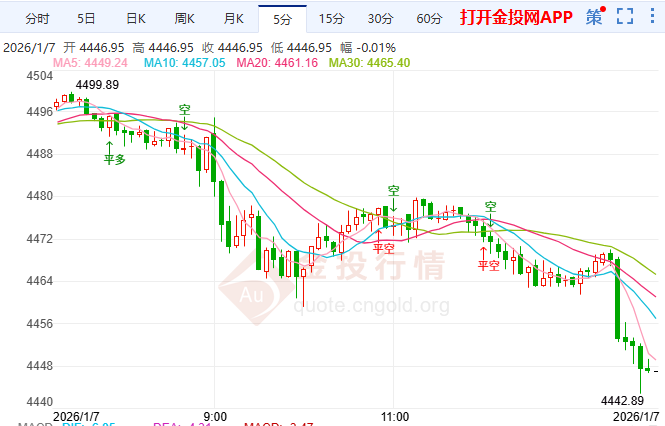
多头趋势未改 黄金震荡上行仍是主旋律
Jin Tou Wang· 2026-01-07 06:00
Group 1 - The core viewpoint is that gold enters 2026 with strong historical upward momentum, despite being labeled "overbought" in 2024-2025, and the market's positioning remains reasonable, with gold showing the smallest pullback among precious metals [1][3] - The primary driving logic for gold's rise in 2024-2025 is the low real yields caused by political uncertainty in the U.S., which is expected to continue into 2026 due to high government spending pushing inflation expectations and a dovish interest rate environment [3] - Central bank purchases are a long-term key support for gold prices, with global reserve allocation imbalances leading to accelerated buying from central banks in 2024-2025, particularly from countries like China and Turkey [3] Group 2 - Geopolitical tensions, such as the Russia-Ukraine conflict and recent events in Venezuela, are significant catalysts for gold prices, as risk aversion drives funds towards gold [3] - The emergence of AI narratives has injected industrial demand into the precious metals sector, potentially offsetting weak jewelry consumption and reinforcing the trend of gold prices moving in tandem with the Nasdaq index [3] - Potential risks include unexpected hawkish moves from the Federal Reserve or a surge in long-term yields, but current market expectations lean towards easing, providing a buffer for gold prices [3] Group 3 - Monthly gold prices maintain a bullish channel, but the RSI is at historical highs, indicating a need for time correction; weekly analysis shows fluctuations around the 10-week moving average [4] - Key resistance levels are identified at 4516-4544, while support levels are at 4230-4274 and 4115, with an extreme level at 4000 [4] - The strategy suggests high selling and low buying within the range, with a breakout above 4400 targeting 4516-4544, and a drop below 4230 indicating weakness [4]

美国债市:国债在2年期标售后走低 5年期标售将至
Xin Lang Cai Jing· 2025-12-22 20:41
Core Viewpoint - After the U.S. Treasury's auction of $69 billion in 2-year notes, U.S. Treasury yields continued to decline during the trading session, with expectations for upcoming 5-year and 7-year note issuances [1][9]. Group 1: Treasury Auction Results - The auction of $69 billion in 2-year notes had a high yield approximately 0.3 basis points above pre-auction trading levels [1][9]. - The allocation to primary dealers was 12.7%, the highest since June [1][9]. - Direct bidders received 34.1% of the allocation, above the average of 31.7%, while indirect bidders received 53.2%, below the average of 57.1% [1][9]. Group 2: Market Trends and Yields - U.S. Treasury yields rose slightly, with the 2-year yield up by 1.91 basis points to 3.5025%, the 5-year yield up by 1.76 basis points to 3.7109%, the 10-year yield up by 1.57 basis points to 4.1628%, and the 30-year yield up by 1.53 basis points to 4.8395% [3][4][5][6]. - The yield curve showed a bear flattening trend, with the short and mid-ends lagging as investors positioned for upcoming auctions [1][9]. - The 2-year and 10-year yield spread decreased by 0.34 basis points to 65.821 basis points, while the 5-year and 30-year spread decreased by 0.24 basis points to 112.677 basis points [7][8][12]. Group 3: Market Activity - Trading volume in U.S. Treasury futures was only 50% of the 20-day average, indicating a lack of significant price catalysts [1][9]. - In the options market, a notable hedge trade of approximately $28 million was made, betting on a decline in the 10-year yield to around 4.05% in the coming weeks [2][10].
今日财经要闻TOP10|2025年12月18日
Xin Lang Cai Jing· 2025-12-18 12:06
Group 1: Photovoltaic Industry - The production of polysilicon has decreased for the first time in 12 years, with a year-on-year decline of 29.6% to approximately 1.113 million tons from January to October 2025 [1] - The production of silicon wafers has also seen a year-on-year decline for the first time since 2009, dropping by 6.7% to about 567 GW [1] - In contrast, the production of battery cells increased by 9.8% to approximately 560 GW, and the production of photovoltaic modules rose by 13.5% to about 514 GW [1] Group 2: Economic Policy and Market Trends - The central bank is expected to further promote the stabilization of the national bond yield curve and reform the Loan Prime Rate (LPR) quoting mechanism, focusing on price-based regulatory tools [3][10] - There is an emphasis on enhancing the coordination between fiscal and monetary policies to expand policy effectiveness in various areas, including loan interest subsidies and risk compensation [10] Group 3: Stock Market Performance - The three major U.S. stock indices closed lower, with the Dow Jones down by 0.47%, the Nasdaq down by 1.79%, and the S&P 500 down by 1.14% [4][11] - Notable declines included Tesla and Broadcom, both dropping over 4%, while Oracle fell by more than 5% [11] Group 4: A-Share Market Insights - The ChiNext Index fell by 1.81%, while the Shanghai Composite Index rose by 0.16% and the Shenzhen Component Index decreased by 0.85% [6][14] - The total market turnover reached 1,059.2 billion yuan, an increase of 19 billion yuan compared to the previous day [14] - The commercial aerospace sector showed strong performance, with several stocks hitting the daily limit [14]



