
市场改革

Search documents
韩国股市大涨原因找到了,触发熔断
Wind万得· 2026-03-18 06:56
Group 1 - The South Korean stock index experienced a significant increase, closing up 5.04% at 5925.03 points, with major stocks like SK Hynix rising by 8.87% and Samsung Electronics by 7.53% [3] - The KOSPI index triggered a circuit breaker due to a 5% intraday rise, leading to a 5-minute suspension of program trading. The financial regulatory authority indicated a potential expansion of the 100 trillion KRW market stabilization plan [6] - A report indicated that 50% of the stock market's rise is attributed to market reforms, while the other 50% is due to the semiconductor industry's upward cycle [6] Group 2 - The major Asia-Pacific stock indices closed higher, with the Nikkei 225 index up 2.87% at 55239.4 points, driven by significant gains in companies like Mitsubishi Corporation and SoftBank Group [7] - The market anticipates that the Bank of Japan will maintain a cautious hawkish stance in its upcoming interest rate decision, keeping the policy rate at 0.75% while monitoring spring wage negotiations and inflation risks [8]


港股,利好!港交所将推进三方面工作
Zhong Guo Zheng Quan Bao· 2026-02-25 08:40
Group 1 - The Hong Kong government released the 2026-2027 fiscal budget, which includes measures to optimize the securities market and attract issuers [1] - The Hong Kong Stock Exchange (HKEX) plans to revise the listing requirements for "dual-class shares," facilitate secondary listings for overseas issuers, and provide more flexibility for biotech and specialized technology companies in the IPO process [1] - HKEX aims to implement a structured product listing framework and consult on the specific implementation of a "T+1" settlement cycle in the first half of the year [1] Group 2 - The budget also outlines reforms to the ongoing regulatory framework for listed companies and provides specific guidelines for overseas companies seeking secondary listings in Hong Kong [1] - HKEX Chairman stated that the measures proposed in the budget will strengthen Hong Kong's position as a leading global financial center and demonstrate the government's commitment to enhancing the long-term competitiveness and resilience of Hong Kong's financial market [1] - The CEO of HKEX emphasized the importance of deepening market connectivity, building a diverse asset ecosystem, and enhancing market resilience and efficiency to maintain Hong Kong's status as an international financial hub [2]

香港金融业开市 业界期“快马加鞭”
Xin Hua Wang· 2026-02-20 10:41
Group 1 - The Hong Kong Stock Exchange (HKEX) opened its first trading day of the Lunar New Year on February 20, with the Hang Seng Index having risen nearly 6,500 points, a 32% increase during the previous year [1] - The IPO and subsequent fundraising amounts have shown strong performance, with significant liquidity in the stock market and a diverse international funding source [1] - The HKEX anticipates a cautious yet optimistic market outlook for the Year of the Horse, emphasizing the need for an open and fair market environment, continuous market reforms, and effective risk management [1] Group 2 - Since 2026, 24 new stocks have been listed on the HKEX, raising over HKD 87 billion, with 488 companies currently in the listing queue [2] - The HKEX is committed to maintaining high standards in the listing review process while enhancing the listing system and T+1 consultation documents this year [2] - The Hong Kong government aims to establish the city as an international gold trading center, targeting over 2,000 tons in gold storage expansion within three years [2]
韩国综合指数收高6.8% 创下历史最高收盘点位 盘中大涨一度触发临停
Xin Lang Cai Jing· 2026-02-03 07:18
Core Viewpoint - The South Korean stock market experienced a significant rebound, closing nearly 7% higher, driven by the tech sector's performance and expectations for domestic market reforms, reaching a historical high closing point [1][4]. Group 1: Market Performance - The KOSPI index closed up 338.41 points, a 6.84% increase, reaching 5,288.08 points, marking the highest closing level in history and the largest single-day percentage gain since March 24, 2020 [1][4]. - The index had previously dropped 5.3%, the largest single-day decline since April 7, 2025 [2][5]. - The index triggered a trading halt for five minutes due to a 5% rise in futures [1][4]. Group 2: Key Stocks - Samsung Electronics surged 11.37% to a historical high, marking the largest single-day gain since October 30, 2008 [2][5]. - SK Hynix rose by 9.28%, while LG Energy Solution increased by 2.89%, and Hyundai Motor and Kia Motors saw gains of 2.82% and 2.60%, respectively [2][5]. Group 3: Foreign Investment and Analyst Predictions - Foreign investors net purchased stocks worth 703.3 billion KRW (approximately 486.11 million USD) [3][6]. - Analysts from JPMorgan predict that the KOSPI index could reach 7,500 points by 2026, with a base scenario target of 6,000 points for this year [3][7]. - The rise in chip prices is expected to continue until the end of 2027, with Samsung Electronics and SK Hynix leading the index's growth, and these stocks are projected to have a 45%-50% upside by 2026 [3][7].
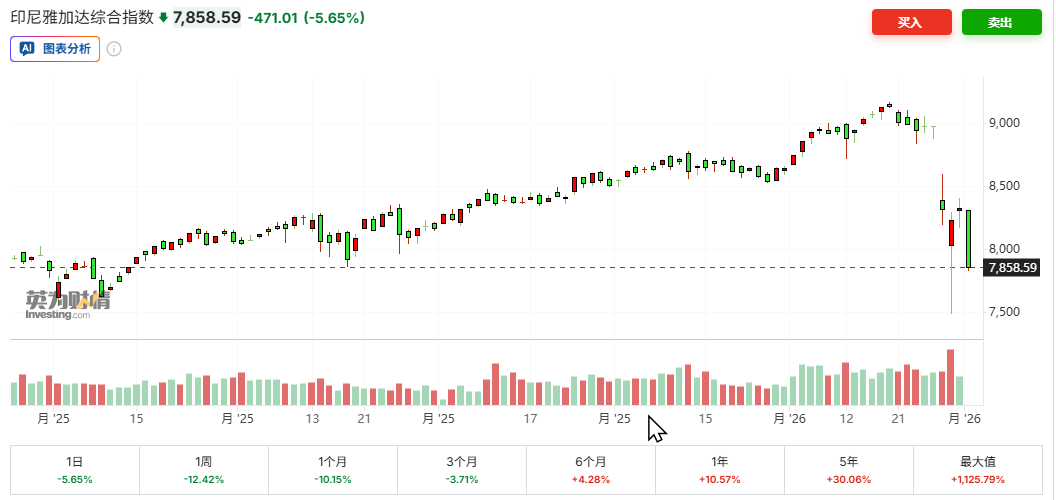
屋漏偏逢连夜雨!商品暴跌拖累,印尼股市重挫6%
Hua Er Jie Jian Wen· 2026-02-02 07:17
Core Viewpoint - Indonesia's stock market is experiencing significant declines, with the Jakarta Composite Index dropping 6% amid weak commodity prices, particularly affecting mining and energy stocks, which poses challenges to recent regulatory efforts aimed at restoring market confidence [1][2]. Group 1: Market Performance - The Jakarta Composite Index faced a "black week," plummeting 16% over two days, resulting in a market capitalization loss exceeding $80 billion [1]. - The recent sell-off is attributed to a combination of falling metal prices and a strengthening dollar, following the nomination of a new Federal Reserve chair by Trump [1][2]. Group 2: Regulatory Response - In response to the market turmoil, Indonesian regulators announced several reforms, including directing the sovereign wealth fund Danantara to guide its asset management companies to buy stocks and planning to double the minimum free float requirement to 15% [1]. - Some institutions view the recent regulatory measures positively, noting that the newly appointed regulatory leader has practical experience in key areas emphasized by MSCI [5]. Group 3: Investment Sentiment - Analysts express concerns that the ongoing commodity sell-off may force regulators to adopt a more defensive approach, potentially slowing down reform momentum and complicating efforts to improve Indonesia's long-term investability [4]. - Despite the recent reforms, foreign investors remain cautious due to uncertainties in macro policies, with firms like Nomura and Goldman Sachs downgrading their ratings on Indonesian stocks due to perceived risks [6].
证监会最新发布,吴清重要表态
2 1 Shi Ji Jing Ji Bao Dao· 2026-01-17 06:52
Core Viewpoint - The China Securities Regulatory Commission (CSRC) is committed to enhancing market supervision and enforcement, focusing on combating financial fraud, market manipulation, and insider trading to ensure fair market practices and support high-quality capital market development [2][4]. Group 1: Achievements in 2025 - In 2025, the CSRC successfully handled 701 cases of securities and futures violations, with penalties totaling 154.7 billion yuan, significantly enhancing regulatory deterrence [4]. - The market showed resilience with a total of 12.6 trillion yuan in IPOs and refinancing, and bond issuance reached 16.3 trillion yuan, indicating a recovery trend [4]. - The CSRC implemented comprehensive reforms, including the introduction of the "1+6" policy for the Sci-Tech Innovation Board and the activation of a third set of standards for the Growth Enterprise Market [4]. Group 2: Key Tasks for 2026 - The CSRC will focus on five key tasks: maintaining market stability, enhancing service quality for high-quality development, enforcing strict regulations, promoting the growth of listed companies, and advancing higher levels of openness [5][6][7]. - The first task emphasizes strengthening market monitoring and counter-cyclical adjustments to prevent extreme market fluctuations [5]. - The second task aims to enhance the inclusiveness of multi-tiered equity markets and promote the integration of various market segments [5]. - The third task involves a strict crackdown on severe violations, ensuring effective administrative and criminal coordination [5]. - The fourth task focuses on improving the quality of listed companies through new regulatory guidelines and enhancing shareholder engagement [6]. - The fifth task seeks to optimize the foreign investor framework and improve cross-border investment convenience [7].
吴清:深化市场改革,证券业肩负四大使命
Feng Huang Wang· 2025-12-06 08:04
Core Viewpoint - The Chairman of the China Securities Regulatory Commission, Wu Qing, outlined four major missions for the securities industry during the 14th Five-Year Plan period, emphasizing the importance of high-quality development and risk management in the sector [1] Group 1: Missions of the Securities Industry - The securities industry will focus on serving the real economy, optimizing asset allocation for residents, supporting the construction of a financial powerhouse, and promoting a high level of openness [1] - The industry aims to deepen market reforms, moving away from simple scale expansion and ranking orientation, and instead concentrating on high-quality development [1] Group 2: Risk Management and Stability - The securities sector has significantly enhanced its ability to prevent and mitigate risks, particularly in managing risks related to stock pledges, thereby contributing to financial stability [1] - The industry has played a crucial role in safeguarding financial security during complex situations, demonstrating improved risk resistance capabilities [1] Group 3: Investment Products and Demand - The securities industry will leverage its professional advantages to meet diverse investment needs and enrich long-term investment products [1] - There is a focus on enhancing compliance and risk control to elevate core competitiveness and market leadership [1]
韩国将启动24小时外汇市场 放开韩元交易限制
智通财经网· 2025-09-26 00:08
Core Points - The South Korean government is planning to extend the foreign exchange market to 24 hours and relax restrictions on non-resident transactions in Korean won, aiming to enhance market access for foreign investors [1] - President Lee Jae-myung emphasized the commitment to improving market transparency, corporate governance, and reducing geopolitical risks during a global investor relations event in New York [1] - The upcoming legislative changes are intended to eliminate structural barriers in the foreign exchange market, which are seen as necessary for South Korea's inclusion in the MSCI developed market index [1][2] Group 1 - The South Korean Ministry of Finance is set to implement 24-hour trading in the foreign exchange market next year [1] - The government aims to ensure that foreign investors can benefit from the "Korean premium" [1] - Structural barriers in the foreign exchange market are currently limiting non-resident transactions due to reporting obligations and regulatory restrictions [1] Group 2 - MSCI has stated that South Korea must achieve full currency convertibility to be classified as a developed market [2] - The report highlights the need to abolish capital controls and establish deeper, more active onshore and offshore markets [2] - Key characteristics of developed foreign exchange markets include broad participation from global investors, real-time price transparency, and a reliable settlement system [2]

证券ETF(512880)涨超1.2%,金融监管强化与市场改革或提振行业预期
Mei Ri Jing Ji Xin Wen· 2025-07-21 03:34
Group 1 - The core viewpoint is that the financial regulatory authority has issued guidelines for local Asset Management Companies (AMCs) to focus on mitigating regional financial risks, with operations limited to their respective provinces [1] - The People's Bank of China has released a draft for the management of interbank market brokerage business, aiming to standardize the scope of brokerage activities and enhance internal control systems for improved market transparency [1] - The signing of the US GENIUS Act marks the formal entry of stablecoins into a compliant financial ecosystem, potentially attracting global digital asset resources [1] Group 2 - The non-bank financial sector, particularly the insurance segment, is expected to maintain a stable liability side and mitigate asset-side risks by 2025 [1] - The securities sector is anticipated to benefit from improved market conditions and sustained high trading activity, with long-term capital market reforms expected to create additional growth opportunities [1] - The Securities ETF (512880) tracks the securities company index (399975), which includes companies closely related to the securities market, reflecting the overall performance of listed companies in the securities industry [1] Group 3 - Investors without stock accounts may consider the Guotai CSI All Share Securities Company ETF Link A (012362) and Link C (012363) for investment opportunities [1]