市场诚信

Search documents
Polymarket Publishes Enhanced Market Integrity Rules Across Its DeFi Platform and CFTC-Regulated U.S. Exchange
Businesswire· 2026-03-23 14:00
Core Insights - Polymarket has announced updated market integrity rules for its DeFi platform and CFTC-regulated U.S. exchange, emphasizing the prevention of insider trading and market manipulation to enhance market quality and user protection [1][2] Summary by Categories Market Integrity Rules - The updated rules clarify three core categories of prohibited insider trading conduct, including trading on stolen confidential information, trading on illegal tips, and trading by those who can influence the outcome of events [6] Surveillance and Enforcement - Polymarket employs a multi-layered surveillance system on its DeFi platform, partnering with technology specialists to ensure market integrity, with all trades executed on the Polygon blockchain for transparency [5] - On Polymarket US, surveillance operates at three levels: partnerships with trade surveillance specialists, a control desk for real-time monitoring, and a Regulatory Services Agreement with the National Futures Association for trade practice surveillance [8] Reporting Mechanisms - Both platforms provide dedicated channels for users to report suspicious activity, with the DeFi platform utilizing Discord and email, while Polymarket US allows confidential reports via a specific email address [9] Commitment to Market Integrity - The enhancements in market integrity rules reflect Polymarket's commitment to clear communication and compliance infrastructure as it scales, ensuring that markets effectively surface truth [2]


谨防购金“一口价” 稀释市场诚信纯度
Xin Lang Cai Jing· 2026-02-10 21:07
Core Viewpoint - The rise in gold jewelry consumption has led to increased consumer disputes due to deceptive sales practices, including lack of transparency regarding weight and purity, which threatens market integrity [1][2]. Group 1: Sales Practices - Some merchants use "one price" sales to obscure critical information such as weight and pricing methods, leading to consumer confusion and potential financial loss [1][2]. - The "one price" model, originally intended to highlight artistic value, has been misused by some sellers to avoid transparent pricing, undermining consumer rights [2]. Group 2: Market Trends - There is a growing trend of merchants downplaying weight and emphasizing marketing tactics like "limited edition" or "designer" to drive impulsive purchases, which can mislead consumers [2]. - The use of live streaming to promote low-weight, high-margin products, often accompanied by false advertising, is disrupting market order and eroding consumer trust [2]. Group 3: Regulatory and Industry Response - There is an urgent need for regulatory bodies to establish clear sales standards for gold jewelry, mandating the disclosure of weight, purity, and other relevant information [3]. - Industry associations should advocate for standardized information disclosure and promote transparent business practices to restore consumer confidence [3]. - E-commerce platforms must enhance merchant qualification checks and monitor live content to prevent misleading sales tactics [3].
亲水平台“一景双卖” 居民要维权
Xin Lang Cai Jing· 2026-02-05 22:20
Core Viewpoint - The dispute over the shared water platform at the Financial Street Rongfu Rixing Yayuan residential complex in Nankai District, Tianjin, highlights concerns regarding the alteration of property rights and the integrity of developer commitments to homeowners [1][2]. Group 1: Homeowner Concerns - Homeowners are worried that the developer's recent claim allowing commercial buyers to "exclusively enjoy" the water platform contradicts previous commitments that it would be a shared space for all residents [1]. - Key concerns include potential access restrictions to the platform, unauthorized entry into the residential area through commercial spaces, and the risk of diminishing shared resources for homeowners [1]. Group 2: Developer and Regulatory Response - The Nankai District Real Estate Market Service Center confirmed that the commercial properties being sold do not include the water platform, which remains a public area for all homeowners [2]. - The developer has assured that the sold properties will not encroach on the communal landscape, and any misleading marketing claims regarding exclusive rights to the water platform have been addressed [2]. Group 3: Market Integrity and Oversight - The situation underscores the importance of maintaining trust in new residential developments, emphasizing that developers must clearly delineate public amenities from private rights [3]. - Regulatory bodies are urged to enhance supervision throughout the planning and sales process to ensure that developers' promotional materials align with actual property rights and community resources [3].
纳斯达克拟改小型IPO上市规则,中企赴美受影响?
Sou Hu Cai Jing· 2025-09-05 01:13
Core Viewpoint - The proposed changes to Nasdaq's IPO listing standards will significantly raise the entry barriers for companies, particularly affecting Chinese firms seeking to go public in the U.S. market [3][4][13]. Summary by Relevant Sections Proposed Changes - Nasdaq has proposed three main changes to its IPO listing standards: 1. Minimum public holding market value for companies choosing to list based on net profit will increase to $15 million from the current $5 million [3]. 2. Companies with listing deficiencies and a market value below $5 million will face accelerated delisting processes [3]. 3. A minimum fundraising requirement of $25 million will be set for new companies primarily operating in China [3][4]. Impact on Chinese Companies - The new rules will raise the listing threshold for many small and medium-sized Chinese enterprises, making it more challenging for them to meet the new standards [4]. - The increased delisting risk due to accelerated processes will affect existing Chinese companies with low market values or other listing deficiencies [4]. Market Reactions - Some companies may consider shifting their IPO plans to other markets, particularly the Hong Kong market, which has seen a surge in IPO activity and recently revised its own IPO rules [4][5]. - Nasdaq's adjustments are seen as a response to potential market manipulation and a move to enhance investor protection and market integrity [5][6]. Regulatory Context - The proposed changes are part of Nasdaq's ongoing efforts to improve market quality and competitiveness amid a challenging global capital market environment [7]. - If approved by the SEC, the new requirements will be implemented immediately, with a 30-day grace period for companies already in the IPO process [7].

重大调整 中国企业赴美上市受影响
Sou Hu Cai Jing· 2025-09-04 07:57
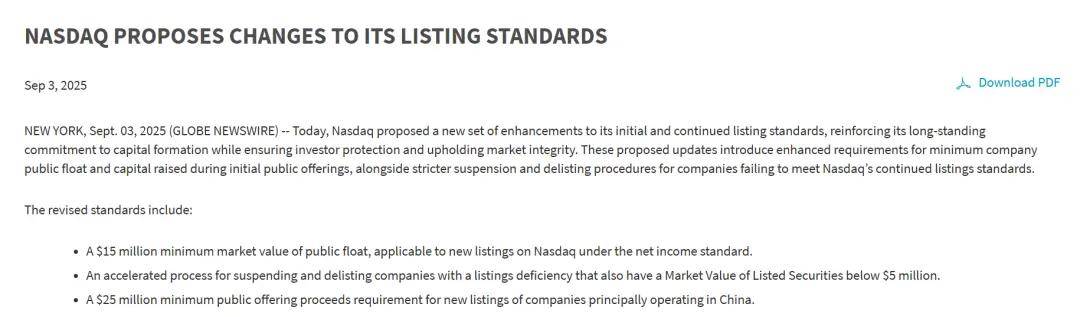
Core Points - Nasdaq proposes to amend listing standards, particularly increasing minimum fundraising requirements for companies primarily operating in China [1][3] - The new standards include a minimum public float market value of $15 million for companies choosing the net income listing standard, up from $5 million [1] - Companies with listing deficiencies and a market value below $5 million will face accelerated delisting processes [1][4] - The minimum public offering fundraising requirement for new listings primarily operating in China is set at $25 million [1][3] Summary by Category Listing Standards - Nasdaq's revised standards include a minimum public float market value of $15 million for net income listing standard companies, an increase from the previous $5 million [1] - The minimum public offering fundraising requirement for companies primarily operating in China is established at $25 million, consistent with previous regulations [1][3] Delisting Procedures - Nasdaq has previously implemented rules to accelerate the delisting process for companies with stock prices below $0.10 for ten consecutive trading days [4] - New proposals will allow for accelerated delisting if a company's stock price remains below $0.10 and is suspended for ten consecutive trading days [4] Regulatory Context - Nasdaq emphasizes that these changes aim to enhance investor protection and market integrity, reflecting ongoing efforts by regulators and market participants [3] - The proposed rules will be submitted to the SEC for review, with an immediate implementation plan upon approval [4]

重大调整!中国企业赴美上市受影响
Zheng Quan Shi Bao· 2025-09-04 02:25
Core Points - Nasdaq has proposed changes to its listing standards, particularly increasing the minimum fundraising requirements for companies primarily operating in China [1][3] - The new rules include a minimum public float market value of $15 million for companies choosing the net income listing standard, an expedited delisting process for companies with market values below $5 million, and a minimum public offering requirement of $25 million for new listings from China [1][4] Group 1 - Nasdaq's mission emphasizes investor protection and market integrity, with the new standards aimed at providing healthier liquidity for public investors while still allowing access to emerging company stocks [3] - The introduction of the minimum public offering requirement for companies from "restricted markets" is a continuation of previous regulations aimed at enhancing investor protection and liquidity [3][4] - Nasdaq has previously implemented rules to accelerate the delisting process for companies that fail to meet certain criteria, including stock price thresholds [4][5] Group 2 - The proposed rules will be submitted to the SEC for review, with a 30-day period for companies already in the initial listing process to comply with prior standards, after which all new listings must meet the new requirements [5] - The expedited delisting procedures are set to be implemented 60 days after SEC approval [5]
重大调整!中国企业赴美上市受影响!
证券时报· 2025-09-04 02:20
Core Viewpoint - Nasdaq is proposing to amend its listing standards, particularly increasing the minimum fundraising requirements for companies primarily operating in China, which aims to enhance investor protection and market integrity [1][4]. Group 1: Proposed Changes to Listing Standards - The revised standards include three main changes: 1. Companies choosing to list based on net profit must have a minimum public float market value of $15 million (up from $5 million) [2]. 2. Companies with listing deficiencies and a market value below $5 million will face expedited delisting processes [2]. 3. New companies primarily operating in China must raise a minimum of $25 million in public offerings [2]. Group 2: Rationale Behind Changes - Nasdaq emphasizes that these changes are part of its mission to protect investors and maintain market integrity, providing healthier liquidity conditions for public investors while still allowing access to emerging company stocks [4]. - The introduction of the $25 million minimum public offering requirement for companies from "restricted markets" is consistent with previous regulations established in 2020 [4]. Group 3: Accelerated Delisting Procedures - Nasdaq has previously implemented rules to accelerate the delisting process for companies, including restrictions on excessive reverse stock splits and immediate delisting for stocks trading below $0.10 for ten consecutive days [5]. - The proposed changes will be submitted to the SEC for review, with a 30-day grace period for companies already in the initial listing process to comply with the old standards before the new requirements take effect [5].