市场趋势判断

Search documents
技术看市:A股再现“神秘力量”强控盘,沪指四平八稳背后,方向选择一触即发
Jin Rong Jie· 2026-01-27 11:05
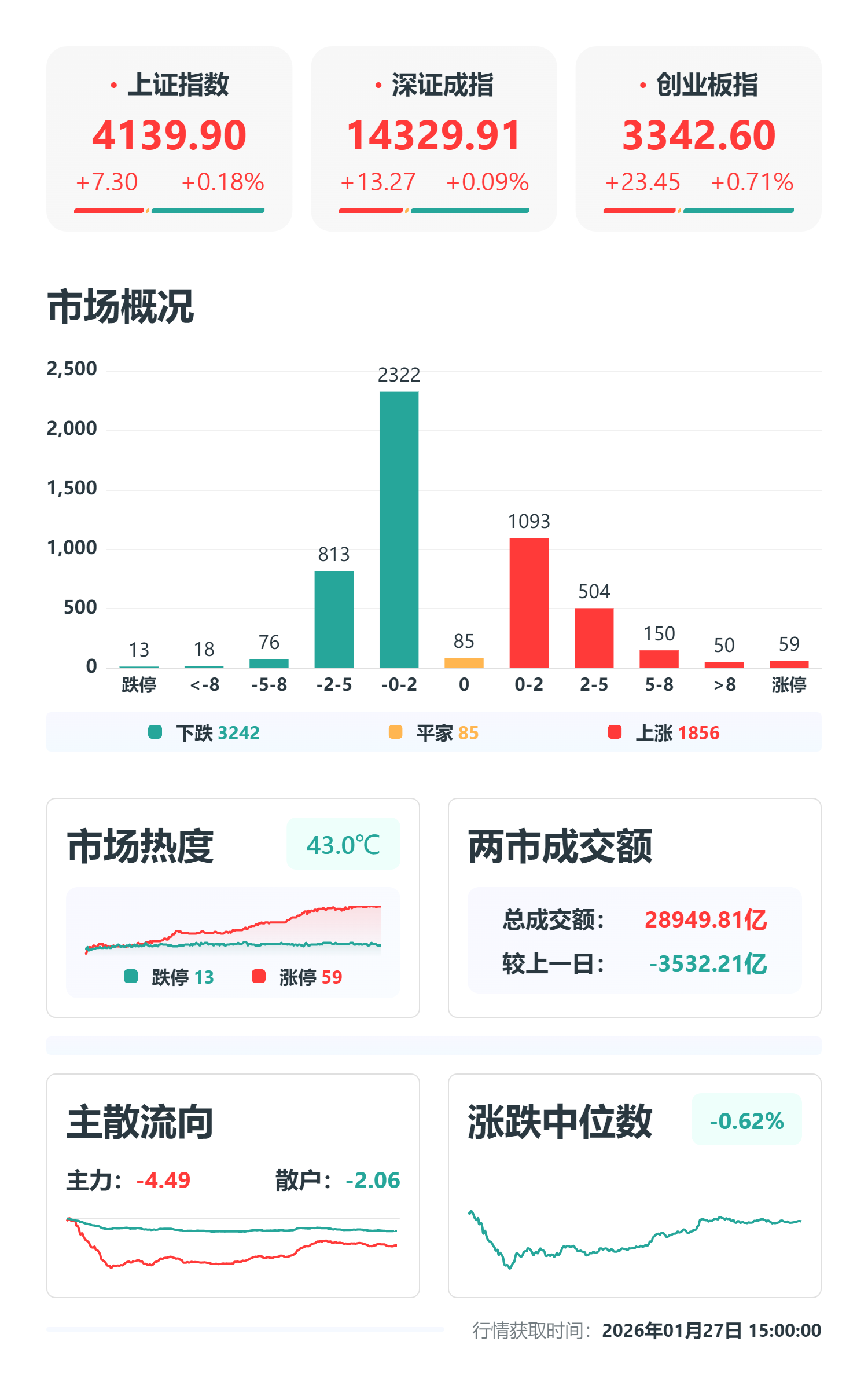
Group 1 - The A-share market experienced a reversal on January 27, with major indices recovering after an early drop, closing in the green despite some late-session control by unidentified forces [1] - The Shanghai Composite Index rose by 0.18% to 4139.9 points, while the Shenzhen Component increased by 0.09%, and the ChiNext Index gained 0.71%. The CSI 300 fell by 0.03%, and the STAR 50 rose by 1.51% [1] - A total of 1856 stocks rose, 3237 fell, and 90 remained unchanged, with a total trading volume of 2.89 trillion yuan, a decrease of approximately 353.22 billion yuan from the previous trading day, and a net outflow of 55.94 billion yuan in major funds [1] Group 2 - Semiconductor sector saw the highest net inflow of major funds, followed by communication equipment, banking, insurance, and aerospace, while non-ferrous metals experienced the largest net outflow [7] - Notable gains were observed in themes such as silver, automotive chips, analog chips, and semiconductors, while declines were seen in lithium sulfide, VC concepts, and epoxy propane [7] - Market analyst Xu Xiaoming noted the current market remains divided, with a significant number of individual stocks declining despite stable index performance, suggesting a cautious approach until market conditions change [7]

怎样交易股指期货:理性探索的进阶路径
Sou Hu Cai Jing· 2025-07-25 13:59
Group 1 - The core concept of trading index futures involves understanding the rules and market dynamics, akin to navigating a ship, requiring both foundational knowledge and strategic adjustments based on market trends [1] - Familiarity with contract details such as underlying index characteristics, contract multipliers, and expiration months is essential for formulating a trading plan [1] - Analyzing macroeconomic data, technical patterns, and market sentiment is crucial for determining market trends and making informed trading decisions [1] Group 2 - Risk management is highlighted through the establishment of position strategies that balance risk and opportunity, ensuring a stable trading approach [1] - The importance of timing entry points based on key breakout levels and volume signals is emphasized to enhance the probability of successful trades [1] - Setting profit and loss limits acts as a protective mechanism, allowing traders to manage risks effectively during unexpected market conditions [2] Group 3 - The ability to adjust positions in response to market changes is vital, allowing traders to capitalize on favorable conditions or mitigate risks when trends deviate from expectations [4] - Recognizing the right moments to close positions reflects an understanding of market trends, enabling traders to secure profits or avoid losses [4] - Continuous learning and reflection on past trades are essential for improving trading skills and adapting strategies based on market behavior [5]