开放水平提升

Search documents
2026年预算草案解读三:重点支出方向① | 落实更加积极的财政政策
Xin Lang Cai Jing· 2026-02-09 10:10
Group 1: Support for Domestic Demand Expansion - The government is committed to increasing support for domestic demand by securing central transfer payments and ultra-long-term special treasury bond funds, focusing on "two heavy" construction and implementing "two new" policies [4][16] - Initiatives to boost consumption include encouraging bulk consumption, stimulating regular consumption, and supporting economic activities related to holidays, events, performances, winter sports, and senior services [4][16] - A budget of 1.4 billion yuan is allocated for investment in water conservancy, electricity, and urban-rural infrastructure projects [4][16] Group 2: Infrastructure Development - A total of 13.63 billion yuan is allocated for transportation expenditures to support key projects in highways, railways, and waterways, as well as rural road and village road construction [6][18] - An additional 6.57 billion yuan is designated to strengthen the infrastructure system, including water networks, railway networks, highway networks, and pipeline networks [6][18] Group 3: Industrial Transformation and Upgrading - The government plans to allocate 3 billion yuan for the Inner Mongolia key industry guidance fund, 1.49 billion yuan for high-quality manufacturing development, and 180 million yuan for strategic emerging industry development [8][21] - Efforts will focus on enhancing deep processing of agricultural and livestock products, extending and strengthening traditional industries, and fostering the development of emerging industries [8][21] - A budget of 3 billion yuan is set aside for the development of key industrial parks, promoting intelligent, green, and integrated transformation and upgrading [9][21] Group 4: Enhancing Openness - A total of 770 million yuan is allocated for business and port development, as well as for key development and opening-up pilot zones, to accelerate the construction of the China (Inner Mongolia) Free Trade Zone [11][23] - Support will be provided for port infrastructure construction, intelligent upgrades, and processing of imported resources, with a focus on increasing exports of used cars and specialty agricultural and livestock products [11][23] Group 5: Financial Incentives - A fund of 4 billion yuan is established to reward localities for developing industries, cultivating new productive forces, and enhancing tax sources [14] - The government will implement a matching policy for central competitive review projects, allocating 1.5 billion yuan to encourage localities to actively pursue these projects [14]


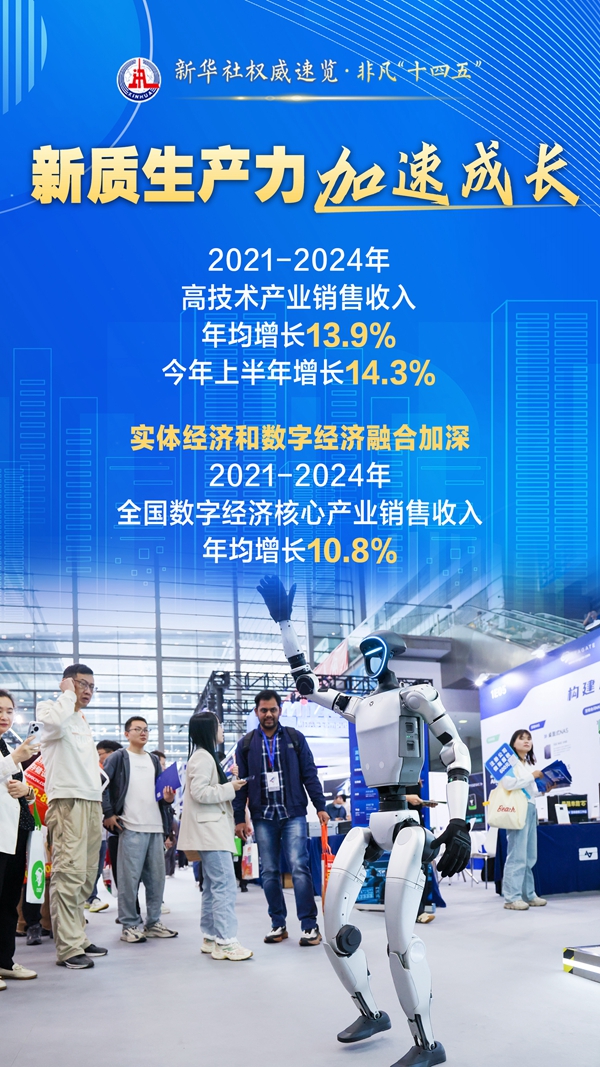
新华社权威速览·非凡“十四五”丨五个维度,看税收这样支撑高质量发展
Xin Hua Wang· 2025-08-12 06:10
Group 1: Economic Development Indicators - Tax revenue data serves as a barometer for economic and social development, highlighting the role of tax policies in supporting high-quality growth during the "14th Five-Year Plan" period [1] - The three major economic regions—Beijing-Tianjin-Hebei, Yangtze River Delta, and Pearl River Delta—account for over 50% of national sales revenue, with respective growth rates of 4.2%, 6.2%, and 5.6% in the first half of this year [3] - The proportion of county-level economic sales revenue in the national total increased from 22.8% in 2020 to 24.3% in the first half of this year [3] Group 2: Green Transition - The clean energy generation sector is projected to grow at an average annual rate of 13.1% from 2021 to 2024, with its share of total electricity sector revenue rising from 30.3% to 33.8% [5] - Revenue from ecological protection-related industries is expected to grow at an average annual rate of 26% during the same period [5] Group 3: Openness and Foreign Investment - As of June this year, the number of foreign-invested tax-related entities has increased by 12.7% compared to 2020, indicating a stable growth in foreign enterprise sales revenue [6] - The average annual growth rate of export tax rebates processed by national tax authorities is projected to be 6.6% from 2021 to 2024, with a further increase to 7.1% in the first half of this year, reflecting strong resilience in China's foreign trade exports [6] Group 4: Social Welfare and Consumption - From 2021 to 2024, the government is implementing tax relief policies in areas such as pension, childcare, healthcare, and education, with an average annual tax reduction growth of 11.7% [7] - National commodity consumption is expected to grow at an average annual rate of 6.8%, with a growth rate of 7.7% in the first half of this year [7]