开源治理

Search documents
“别犯蠢了,”Linus怒怼“AI垃圾代码”争论:靠写文档,根本救不了Linux内核
3 6 Ke· 2026-01-09 11:29
Core Viewpoint - The Linux kernel community is debating whether to establish a specific submission guideline for "tool-generated code," particularly concerning AI programming assistants and LLM-generated patches, amid concerns about the influx of low-quality "AI-generated patches" known as AI Slop [1][3]. Group 1: Linus Torvalds' Position - Linus Torvalds emphasizes that documentation should focus on the tools themselves rather than targeting AI directly, as AI-assisted submissions will persist regardless of documentation [1][3]. - He criticizes the notion that AI-generated code can be effectively labeled or regulated through documentation, stating that those submitting low-quality AI code are unlikely to mark it as such [3][5]. - Torvalds dismisses the idea that documentation can solve the issue of AI-generated garbage code, labeling such discussions as naive and ineffective [3][5]. Group 2: Community Perspectives - There are two extreme viewpoints within the community: one side believes AI will destroy software engineering, while the other sees it as a revolutionary force for automation [5]. - Torvalds maintains a neutral stance, insisting that the only appropriate characterization of AI in documentation is as a tool, avoiding any divisive rhetoric [5][6]. - The debate reflects a broader anxiety within the Linux community about the future of development practices and the role of AI, rather than merely a technical specification issue [5][6]. Group 3: Governance and Code Quality - Torvalds argues that rules can only constrain those who are already compliant, and those who wish to submit low-quality patches will ignore any guidelines, regardless of their length [4][5]. - He asserts that the real focus should be on code review mechanisms, the judgment of maintainers, and the community culture, which cannot be automated or regulated through documentation [6].


开源项目遭“夺权”,原核心维护者全被踢出局后怒批:这是一次恶意接管
3 6 Ke· 2025-09-25 07:36
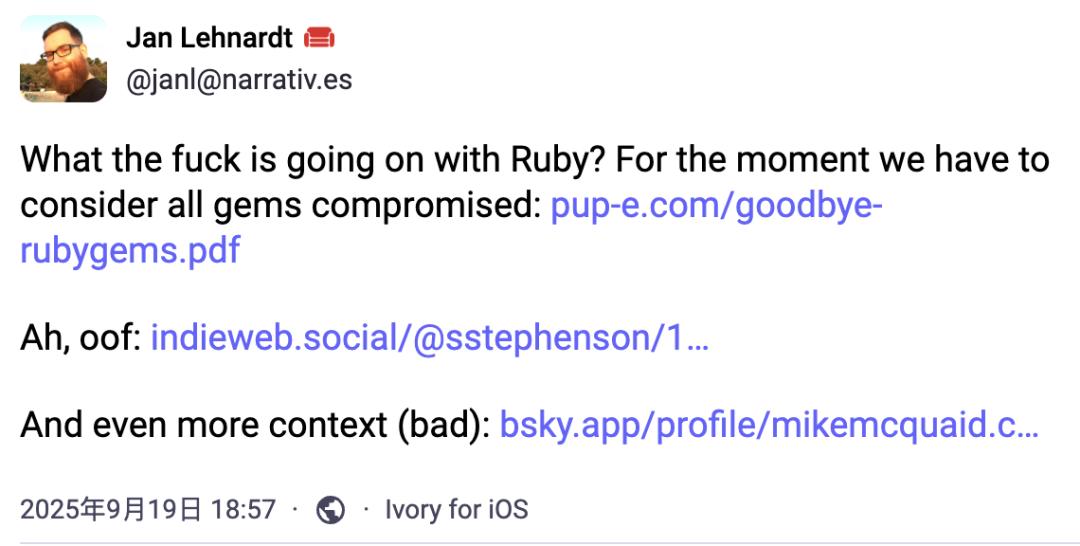
Core Points - The recent controversy in the Ruby community revolves around the management of the RubyGems and Bundler projects, with accusations of a "hostile takeover" by Ruby Central, the non-profit organization overseeing these tools [1][11][12] - Long-time maintainers, including Ellen Dash, have expressed their outrage over being removed from their roles without prior notice or explanation, leading to significant community backlash [5][10][14] - Ruby Central's justification for these actions is centered on enhancing security and governance, citing the need to protect the Ruby ecosystem from supply chain attacks [11][12] Summary by Sections Project Management and Governance - RubyGems and Bundler, essential tools for the Ruby programming language, have been maintained by a dedicated team for years without formal compensation [2] - The abrupt removal of maintainers, including Ellen Dash, was executed by Marty Haught, Ruby Central's open-source director, raising questions about governance practices [5][6][11] Community Response - The Ruby community has reacted strongly against Ruby Central's actions, with many developers expressing disappointment and anger on social media [14][16] - Critics argue that Ruby Central's actions reflect a shift towards corporate influence over community-driven projects, undermining the principles of open-source collaboration [14][16] Future Implications - The incident highlights the ongoing struggle between professional management and community autonomy in open-source governance, emphasizing the need for transparency and communication [20] - As core maintainers resign, the new management team faces scrutiny to prove their capability and maintain community trust [20]