AI编程助手

Search documents
速递|AI编程Cursor三个月翻倍,ARR于2月突破20亿美元,约60%的收入来自企业客户
Z Potentials· 2026-03-03 05:25
Core Insights - Cursor's annualized revenue surpassed $2 billion in February, indicating its popularity as an AI programming assistant [2] - The company's revenue run rate has doubled in the past three months [3] Revenue Sources - Approximately 60% of Cursor's revenue comes from enterprise clients, including both new users and existing customers purchasing additional seats [4] Company Growth - Founded less than five years ago, Cursor has become one of the fastest-growing startups in history, with a valuation of $29.3 billion following a funding round led by Accel and Coatue [4] - Cursor's products are integrated into the daily work of programmers across various industries, from tech companies like OpenAI to brands like Budweiser [4] Market Position - Cursor is competing in the rapidly growing AI programming assistant market alongside companies like OpenAI, Anthropic, and Google, as well as smaller firms like Replit and Lovable [4] Product Development - The latest software update allows Cursor to implement code, conduct testing, and record progress videos for users [5] - Cursor has introduced a new programming style called "ambient programming," enabling developers to create complex software with simple prompts, allowing AI to handle most of the work [6]


GitLab CEO:为何AI未能帮助企业更快交付代码
Sou Hu Cai Jing· 2026-02-25 10:54
Core Insights - AI programming tools are not accelerating software delivery despite high investment and developer enthusiasm, as companies report no significant increase in innovation speed [2][3] - Developers spend only 10% to 20% of their time writing code, with the majority of their time (80% to 90%) spent on code review, pipeline execution, security scans, compliance checks, and deployment, which remain largely unautomated [3][7] - GitLab's Duo AI platform aims to automate the entire software development lifecycle (SDLC) and introduces a "smart agent flow" to manage feature requests from issue tracking to merge requests [3][4] GitLab's Duo AI Platform - The Duo AI platform's key differentiator is its ability to provide context by integrating metadata such as issue trackers, error reports, and security scans into a knowledge graph, unlike standalone AI tools that only access local codebases [4][8] - GitLab's integrated platform allows both humans and AI agents to leverage comprehensive project visibility, enhancing the overall development process [4][8] Competitive Landscape - The emergence of numerous AI developer tool startups does not concern GitLab, as the company has been observing innovations in the open-source and startup ecosystem and integrating these insights into its platform [5][9] - GitLab believes that the integration of various AI tools is crucial, as each additional tool creates context silos and governance complexities, making an integrated platform more advantageous [5][9]


亚马逊力推Kiro限制Claude Code,员工对此有话说!
Sou Hu Cai Jing· 2026-02-12 13:36
Core Insights - Amazon is prioritizing its in-house developed AI programming tool Kiro, restricting employees from using third-party products like Claude Code without formal approval [1][3] - This internal policy has sparked criticism among employees, particularly those involved in selling third-party AI services, who question how they can promote products they are not allowed to use themselves [3] Group 1 - Amazon is a major shareholder in Anthropic and has assisted the startup in bringing its AI models and products to the consumer market [3] - The internal directive to favor Kiro over Claude Code has been in place since last fall, leading to significant internal debate and dissatisfaction among employees [3] - Some engineers argue that Claude Code outperforms Kiro, warning that enforcing the use of a less capable tool could hinder development progress [4] Group 2 - Employees have expressed concerns that a tool unable to keep pace with competitors cannot drive true innovation, indicating frustration with the forced use of Kiro [4]


未知机构:智谱02513HK中国cursor走向全球天风计算机缪欣君团队-20260210
未知机构· 2026-02-10 01:50
Company and Industry Summary Company: 智谱 (02513.HK) Key Points 1. **Model Iteration and Launch** 智谱 recently released and open-sourced GLM-4.7-Flash, which replaces GLM-4.5-Flash. The model is positioned for "lightweight deployment + strong inference/coding" [1] 2. **PonyAlpha Testing and Feedback** OpenRouter launched the stealth model PonyAlpha on February 6, which supports 200K context. Feedback from the overseas community highlights its outstanding capabilities in "coding/agentic workflows," suggesting it may be the next generation of GLM [1] 3. **Developer Market Potential** An official report indicates that the number of software developers in China has surpassed 9.4 million. The Ministry of Industry and Information Technology disclosed that software business revenue is projected to reach 137.276 billion yuan (approximately 13.7 trillion yuan) in 2024. Even a single-digit penetration of AI programming assistants/agents in the toolchain corresponds to a potential market space in the hundreds of billions [2] 4. **Client Base and Revenue Drivers** According to the company's prospectus, it serves over 8,000 institutional clients. Nine out of the top ten internet companies in China are using GLM models, and the quality of government and enterprise clients is high, indicating strong customer retention and willingness to pay [2] 5. **Cloud Business Revenue and Profitability** The company's cloud business revenue and gross profit are expected to continue to show elasticity as model capabilities improve [3]
一句话生成游戏,OpenAI 也来爆锤游戏公司了
3 6 Ke· 2026-02-03 08:09
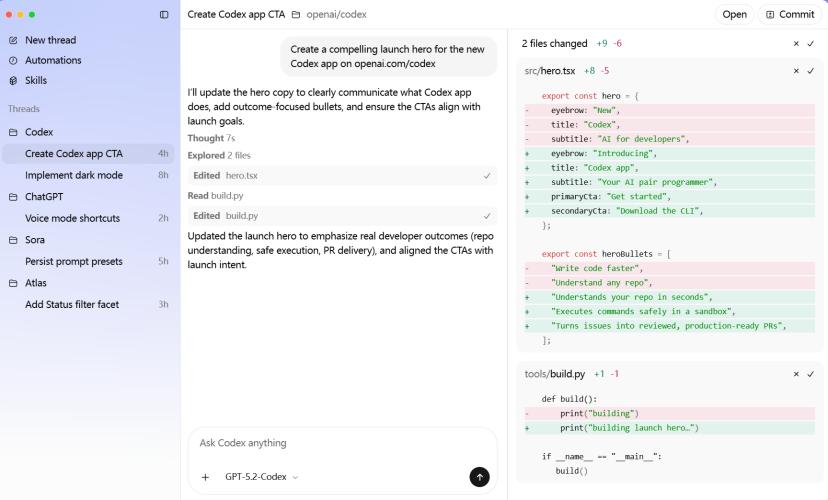
Core Insights - OpenAI officially launched the Codex macOS desktop application on February 3, which is available for all ChatGPT users, including free and paid subscribers, with temporary double usage limits for paid users [1] - The application features a simple interface centered around a chat-like dialogue box, allowing developers to input requirements and receive generated code snippets [1] - Codex is built on the GPT-5.2-Codex model, capable of processing up to 400,000 tokens, equivalent to approximately 100,000 lines of code, and supports over 50 programming languages [1] Features and Functionality - Users can upload multimodal content, such as interface sketches, as development references [2] - The application includes a customizable "Skills" system that allows users to adjust Codex's output style, enhancing the interaction experience [2] - An "Automations" feature enables Codex to execute tasks automatically at user-defined intervals, streamlining processes for software teams [2] - In internal tests, Codex was able to generate a complete video game using a single prompt, involving over 7 million tokens [2] Market Position and Competition - OpenAI positions the Codex application as a "command center for agent-based programming," allowing multiple AI agents to work concurrently on different projects [4] - The application aims to reduce development cycles from weeks to days by enabling developers to collaborate while agents handle long-term tasks [4] - Codex's main competitor is Anthropic's Claude Code, which has shown strong performance since its release, achieving an annual recurring revenue exceeding $1 billion [4][5] User Experience and Feedback - Initial user experiences have reported issues, including configuration file errors and difficulties with the login interface [6][8] - Users have encountered a configuration file error with a size of 260,000 lines, which could be resolved by backing up and removing the file [13] - The login key refresh issue was noted, with users needing to re-login after finding the login option in an unexpected location [10][11] Future Developments - OpenAI plans to expand the Codex application to Windows, although no specific date has been announced [14] - Future upgrades will focus on improving speed and enhancing the ability to handle complex coding tasks involving multiple agents [14] - The automation feature is expected to be enhanced to run even when the application is not open [14]
飞算科技宣布JavaAI专业版正式上线
Ge Long Hui· 2026-01-26 03:03
Core Insights - Feisuan Technology has officially launched the JavaAI Professional Edition, recognized as the only AI programming assistant certified by the China Academy of Information and Communications Technology for generating complete engineering code [2] - Since its introduction in early 2025, Feisuan JavaAI has assisted Java developers in generating over 1 million complete projects [2] Performance Improvements - The JavaAI Professional Edition has achieved systematic breakthroughs in model capability, code quality, and usage efficiency [2] - Code adoption rate has increased from 70% to 90% [2] - Generation speed has improved by 30% [2] - Rework and debugging time has been reduced by 20% [2] Tool Upgrades - The launch includes upgrades to ten AI tools that cover the full range of needs for Java developers, including code repair, test generation, and security protection [2] - These tools are designed to meet the daily work scenarios of Java developers, ensuring production readiness [2]

“别犯蠢了,”Linus怒怼“AI垃圾代码”争论:靠写文档,根本救不了Linux内核
3 6 Ke· 2026-01-09 11:29
Core Viewpoint - The Linux kernel community is debating whether to establish a specific submission guideline for "tool-generated code," particularly concerning AI programming assistants and LLM-generated patches, amid concerns about the influx of low-quality "AI-generated patches" known as AI Slop [1][3]. Group 1: Linus Torvalds' Position - Linus Torvalds emphasizes that documentation should focus on the tools themselves rather than targeting AI directly, as AI-assisted submissions will persist regardless of documentation [1][3]. - He criticizes the notion that AI-generated code can be effectively labeled or regulated through documentation, stating that those submitting low-quality AI code are unlikely to mark it as such [3][5]. - Torvalds dismisses the idea that documentation can solve the issue of AI-generated garbage code, labeling such discussions as naive and ineffective [3][5]. Group 2: Community Perspectives - There are two extreme viewpoints within the community: one side believes AI will destroy software engineering, while the other sees it as a revolutionary force for automation [5]. - Torvalds maintains a neutral stance, insisting that the only appropriate characterization of AI in documentation is as a tool, avoiding any divisive rhetoric [5][6]. - The debate reflects a broader anxiety within the Linux community about the future of development practices and the role of AI, rather than merely a technical specification issue [5][6]. Group 3: Governance and Code Quality - Torvalds argues that rules can only constrain those who are already compliant, and those who wish to submit low-quality patches will ignore any guidelines, regardless of their length [4][5]. - He asserts that the real focus should be on code review mechanisms, the judgment of maintainers, and the community culture, which cannot be automated or regulated through documentation [6].

刚刚,豆包编程模型来了,我们用四个关卡考了考它!
机器之心· 2025-11-11 08:40
Core Insights - The article discusses the evolution of AI programming assistants, highlighting the shift from simple code completion tools to more advanced models capable of understanding complex tasks and contexts. This evolution is represented by two main routes: IDE enhancement and Agentic coding [1][2]. Group 1: AI Programming Assistant Evolution - AI programming assistants have significantly changed development workflows, with even skeptics like Linus Torvalds acknowledging their utility [1]. - The article identifies two main routes for AI programming assistants by 2025: IDE enhancement (e.g., GitHub Copilot) and Agentic coding (e.g., Claude Code) [2]. Group 2: Doubao-Seed-Code Introduction - Doubao-Seed-Code, developed by Volcano Engine, aims to address the limitations of existing models by providing a robust programming model designed for complex tasks [2][4]. - The model has shown exceptional performance in various authoritative benchmarks, even surpassing Claude 4.5 Sonnet in some evaluations [6][8]. Group 3: Key Features of Doubao-Seed-Code - Doubao-Seed-Code boasts a native 256K long context capability, allowing it to handle complex projects that span multiple files and dependencies [10][11]. - The model is the first in China to support visual understanding, enabling it to generate code based on UI designs and perform visual comparisons for style and bug fixes [11]. Group 4: Performance Evaluation - The article outlines a series of practical tests to evaluate Doubao-Seed-Code's capabilities, including task planning, long context handling, and debugging abilities [18][22]. - In a test involving the refactoring of a poorly structured Python script, Doubao-Seed-Code completed the task in under three minutes, demonstrating its debugging capabilities [23][24]. Group 5: Advanced Task Execution - Doubao-Seed-Code successfully executed a complex task of converting a C++ game to Python, showcasing its long context and task planning abilities. The entire process took approximately 40 minutes [26][30]. - The model autonomously planned and executed the project, demonstrating its capability to handle significant programming challenges [31]. Group 6: Cost and Accessibility - Doubao-Seed-Code aims to address pricing and usage limitations faced by developers, offering a subscription service with competitive pricing [48][50]. - The "Coding Plan" subscription service provides significant discounts and aims to lower costs by 62.7%, making it accessible to a broader range of developers [49][50]. Group 7: Conclusion - Doubao-Seed-Code is positioned as a powerful alternative in the Agentic coding space, capable of handling complex tasks autonomously and efficiently [52][53]. - The model not only addresses performance issues but also offers a cost-effective solution for developers, paving the way for widespread adoption of Agentic coding [53][54].

Anthropic这两天真没闲着:上线网页版Claude Code,还让Claude搞科研
AI前线· 2025-10-21 04:54
Core Insights - Anthropic has launched the web version of its AI programming assistant, Claude Code, making coding more accessible by eliminating the need for command-line tools and complex commands [2][5] - The web version is currently in testing and available only to Pro and Max subscribers, aimed at gathering user feedback for further improvements [6] - Claude Code has seen a tenfold increase in users since its broader release in May, generating over $500 million annually for Anthropic [27] Group 1: Claude Code Features - The web version allows users to initiate programming tasks directly through a browser, connecting to GitHub repositories and describing task requirements for Claude to handle automatically [12][13] - Claude Code can process multiple tasks in parallel, providing real-time progress tracking and the ability to guide the AI during task execution [14] - The cloud-based execution ensures tasks run in isolated environments, enhancing security by limiting access to authorized repositories and allowing custom network configurations [16] Group 2: Claude for Life Sciences - Anthropic has introduced Claude for Life Sciences, utilizing the Claude Sonnet 4.5 model, which outperforms human averages in experimental protocol understanding [20] - This version includes specialized connectors for direct integration with experimental platforms, databases, and literature, enabling Claude to function as a research assistant [21][22] - The new Agent Skills feature allows Claude to execute specific tasks autonomously, enhancing its capabilities in scientific research [23] Group 3: Market Impact and Growth - Anthropic's valuation has reached $183 billion, reflecting its significant market presence and growth potential [28] - The introduction of Claude Code and its rapid user growth indicate a strong demand for AI-driven programming solutions [27]

速递|谷歌风投在种子轮仅4 个月后再次加码开发者工具初创公司 Blacksmith
Z Potentials· 2025-09-19 02:43
Core Insights - The article highlights the rapid growth and funding success of Blacksmith, a startup focused on accelerating code deployment processes in the AI-driven software industry [1][2]. Funding and Performance - Blacksmith secured a $10 million Series A funding round led by Google Ventures, completing the deal in just 14 days, following a $3.5 million seed round in May [2]. - The company has seen significant growth in annual recurring revenue (ARR), increasing from $1 million to $3.5 million after expanding its team from 4 to 8 members and acquiring over 700 customers [3]. Market Position and Services - Blacksmith offers continuous integration and continuous delivery (CI/CD) services that complement GitHub Actions, addressing the high costs and unpredictability associated with software deployment [2][3]. - The startup operates on high-performance gaming-grade CPUs, achieving up to 2x processing speed and reducing computing costs by up to 75% compared to traditional cloud service providers [4][6]. Business Model and Strategy - By utilizing a bare-metal architecture, Blacksmith claims to have better economic control than large-scale cloud providers, allowing for improved profit margins as they scale their customer base [6]. - The target customers are enterprises with engineering teams of over 500, and notable clients include Ashby, Chroma, and Supabase [6][7]. Team and Background - The founding team of Blacksmith has experience from Faire and Cockroach Labs, where they recognized the challenges in the software release process [3]. - The company graduated from Y Combinator's winter 2024 batch and currently has a team of 11 members [7].