异地就医备案

Search documents
海南发布异地就医备案指南
Hai Nan Ri Bao· 2026-02-16 03:14
Core Viewpoint - Hainan Province has released a guide for cross-province medical treatment registration, aimed at facilitating insured individuals during the long holiday period, ensuring they can access medical services conveniently while away from their registered locations [2][4]. Group 1: Types of Cross-Province Medical Treatment - There are three main categories of individuals eligible for cross-province medical treatment: 1. Long-term residents outside their insured area, such as retirees living with children or employees stationed in other provinces [3]. 2. Temporary medical treatment seekers who need urgent care while away, including patients requiring emergency procedures or those with serious illnesses needing specialized treatment [3]. 3. Other individuals who do not fall into the above categories but seek medical care in other provinces [4]. Group 2: Registration Process and Benefits - Registration for cross-province medical treatment is essential for enjoying direct settlement services, eliminating the need for upfront payments or reimbursement processes. Long-term residency registrations are valid indefinitely, while temporary and other types are valid for one year [4]. - The registration process can be completed online through the "National Medical Insurance Service Platform" app or the "Hainan Medical Insurance" app, with clear instructions provided for uploading necessary documents and information [4].
医药管理“组合拳”提升群众幸福感
Xin Lang Cai Jing· 2026-01-06 19:29
Group 1 - The core viewpoint of the articles highlights the efforts of Qinghai Province's Medical Insurance Bureau to enhance the accessibility and affordability of healthcare for insured individuals during the 14th Five-Year Plan period [1][2] Group 2 - Qinghai has dynamically adjusted its medical insurance drug list, incorporating 387 national negotiated drugs and competitive drugs into a "dual-channel" guarantee system to improve patient access to medications [1] - An additional 150 types of Tibetan medicinal herbs have been included in the medical insurance payment scope, making a total of 531 types and 3200 items available [1] - The province has included 499 ethnic medical diagnosis and treatment projects in the medical insurance payment scope, achieving an inclusion rate of 88% [1] - 127 surgical procedures have been added to the day surgery settlement range without a threshold, reimbursed according to inpatient policies [1] - Six specific Tibetan and Chinese medicine advantageous disease categories have been included in the day ward medical insurance settlement, with no bed fees charged for hospitalization and nursing fees set at 50% of the standard for tertiary care [1] Group 3 - The province has integrated village health clinics into the medical insurance designated point system, with 4343 out of 4469 clinics now covered, ensuring basic coverage for all administrative villages [2] - A smart regulatory system for medical insurance has been established to enhance early detection and management of illegal activities [2] - The province has optimized the cross-regional medical treatment registration service, allowing for online registration through WeChat mini-programs and the Qinghai Medical Insurance App, effectively eliminating the need for in-person registration [2] - The direct settlement channel has been established to resolve issues related to insured individuals having to pay upfront for services [2]
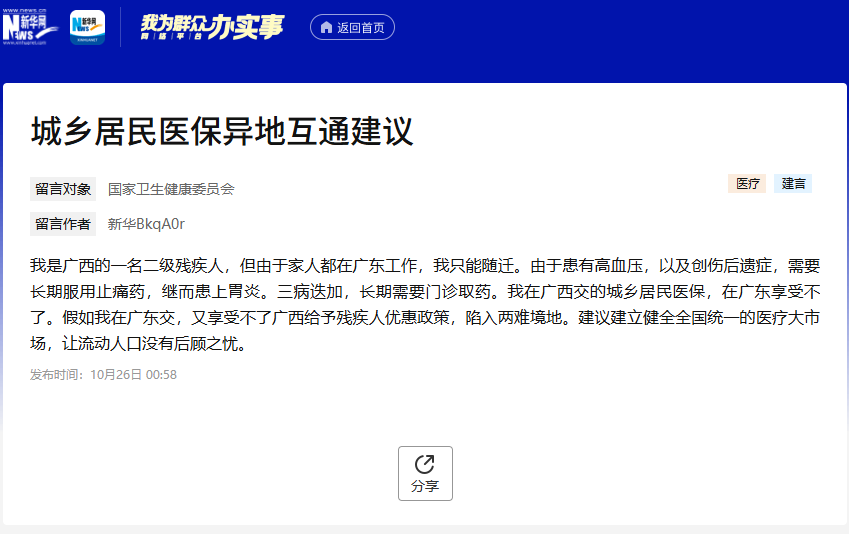
我为群众办实事|异地居住医疗救助对象的医保待遇如何保障?
Xin Hua Wang· 2025-11-26 05:29
Core Viewpoint - The article emphasizes the increasing attention on medical insurance rights and protections, particularly regarding the policies for cross-regional medical treatment, highlighting the need for better understanding of these policies among the public [1]. Group 1: Policy Overview - Current policies allow insured individuals residing long-term in different regions to enjoy direct settlement services for cross-regional medical treatment after completing the necessary registration [3]. - The medical expenses for inpatient care, outpatient services, and chronic disease treatments are subject to the payment scope and regulations of the treatment location, while adhering to the insurance policies of the insured's home region [3]. Group 2: Registration Process - Registration for cross-regional medical treatment can be completed through both online and offline channels [4]. - Online registration is facilitated through various platforms, including the "National Medical Insurance Bureau" WeChat account, the National Medical Service Platform App, and local apps specific to provinces [5]. - Offline registration requires individuals to visit local medical insurance offices or service centers with necessary documents, including identification and residency proof [6]. Group 3: Benefits and Conditions - After completing the registration, insured individuals can receive medical services or purchase medications at designated medical institutions in their residing area using their medical insurance cards or electronic codes, without needing to enroll in local basic medical insurance [7]. - Medical assistance recipients can continue to enjoy benefits from their home region's insurance policies, such as government subsidies and special treatments, without losing their eligibility for these benefits [7].