
异地就医直接结算

Search documents
异地居住医疗救助对象的医保待遇如何保障?
Xin Hua She· 2025-11-26 05:39
Core Viewpoint - The article emphasizes the increasing attention on medical insurance rights and protections, particularly in the context of cross-regional medical treatment, highlighting the need for better understanding of existing policies [1] Group 1: Policy Overview - Current policies allow insured individuals, including those receiving medical assistance, to enjoy direct settlement services for cross-regional medical treatment after completing the necessary registration [3] - The medical expenses for inpatient care, general outpatient services, and outpatient chronic special diseases are subject to the payment scope and regulations of the treatment location, while adhering to the insurance fund's standards and policies of the insured location [3] Group 2: Registration Process - Registration for cross-regional medical treatment can be completed through both online and offline channels [4] - Online registration is facilitated through various platforms, including the "National Medical Insurance Bureau" WeChat account, the National Medical Service Platform App, and Alipay [4] - Local exclusive channels are available in different provinces, such as the "E-Hubei" App in Hubei and "Jiangxi Service App" in Jiangxi, allowing users to complete the registration process [4] Group 3: Offline Registration - Offline registration requires individuals to visit local medical insurance service centers with necessary documents, including identification and residency proof [5] - After registration, insured individuals can access medical services at designated healthcare institutions in their residence area without needing to enroll in local basic medical insurance [5]

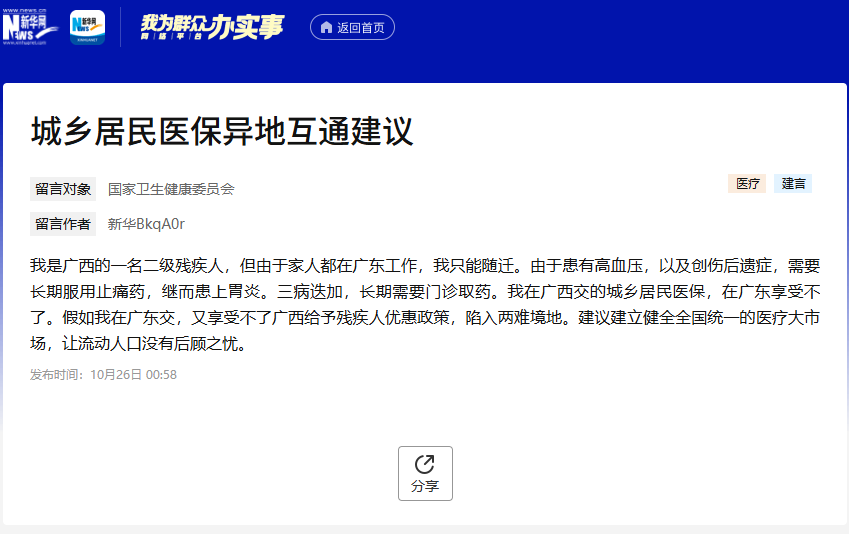
我为群众办实事|异地居住医疗救助对象的医保待遇如何保障?
Xin Hua Wang· 2025-11-26 05:29
Core Viewpoint - The article emphasizes the increasing attention on medical insurance rights and protections, particularly regarding the policies for cross-regional medical treatment, highlighting the need for better understanding of these policies among the public [1]. Group 1: Policy Overview - Current policies allow insured individuals residing long-term in different regions to enjoy direct settlement services for cross-regional medical treatment after completing the necessary registration [3]. - The medical expenses for inpatient care, outpatient services, and chronic disease treatments are subject to the payment scope and regulations of the treatment location, while adhering to the insurance policies of the insured's home region [3]. Group 2: Registration Process - Registration for cross-regional medical treatment can be completed through both online and offline channels [4]. - Online registration is facilitated through various platforms, including the "National Medical Insurance Bureau" WeChat account, the National Medical Service Platform App, and local apps specific to provinces [5]. - Offline registration requires individuals to visit local medical insurance offices or service centers with necessary documents, including identification and residency proof [6]. Group 3: Benefits and Conditions - After completing the registration, insured individuals can receive medical services or purchase medications at designated medical institutions in their residing area using their medical insurance cards or electronic codes, without needing to enroll in local basic medical insurance [7]. - Medical assistance recipients can continue to enjoy benefits from their home region's insurance policies, such as government subsidies and special treatments, without losing their eligibility for these benefits [7].
山东7市将康复辅助器具租赁费纳入长期护理保险报销范围
Qi Lu Wan Bao Wang· 2025-09-30 06:57
Core Insights - The Shandong Provincial Medical Insurance Bureau is implementing a series of measures to enhance public medical insurance services, focusing on addressing common concerns of the public regarding medical insurance [1][8] Group 1: Key Initiatives - The bureau has launched 10 initiatives aimed at improving public services, with 2 of these initiatives included in the provincial government's key livelihood projects [1] - A multi-level medical insurance system is being developed to improve the quality and accessibility of medical services for the public [1] Group 2: Targeted Support for Vulnerable Groups - A comprehensive long-term care insurance system is being established, with pilot programs in 16 cities, covering 5.57 million insured individuals, including 2.79 million residents [2] - Unemployed individuals are now eligible for maternity insurance benefits, alleviating financial pressure during unemployment [2] - Adjustments to severe illness insurance policies are being made to ensure sustainable financial support for patients [3] Group 3: Strengthening Grassroots Services - The initiative aims to enhance the accessibility of medical services at the grassroots level, with 25 recommended disease groups and 105 disease types established for primary healthcare institutions [4] - The number of participating units in the drug procurement program has reached 33,000, increasing accessibility to quality medications [5] Group 4: Streamlining Reimbursement Processes - Efforts are being made to facilitate direct settlement for medical expenses incurred during cross-regional medical treatment, including maternity and long-term care insurance [6] - A pilot program for customized commercial insurance claims is being implemented to improve efficiency in reimbursement processes [6] Group 5: Enhancing Service Efficiency - The bureau has updated its service item list to include 27 standardized services, promoting seamless access to medical insurance services across different regions [7] - Public awareness campaigns are being conducted to improve understanding and accessibility of medical insurance policies [7] Future Directions - The bureau will continue to focus on addressing urgent public concerns and enhancing the overall medical insurance system to ensure the health and well-being of the population [8]