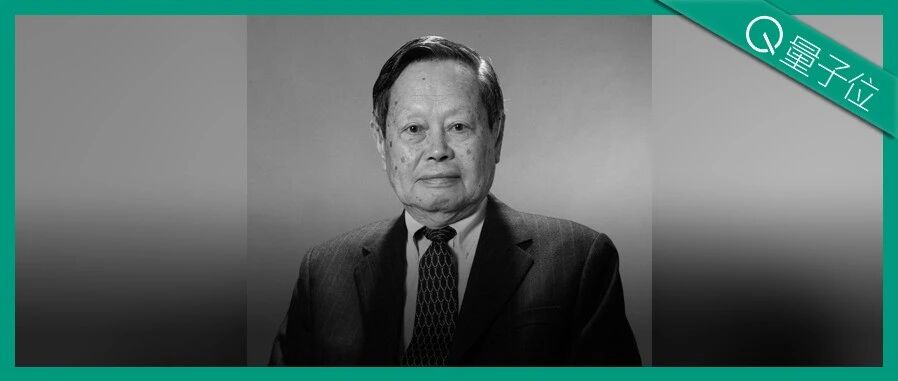
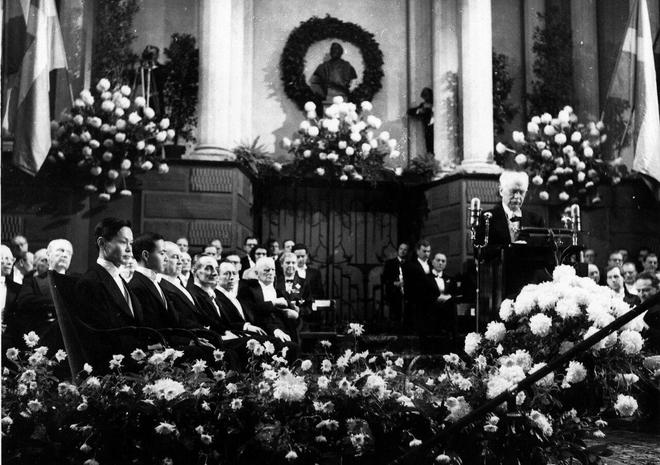
弱相互作用中宇称不守恒理论

Search documents
李政道研究所所长向杨振宁治丧委员会致唁电!称感佩其博学
Nan Fang Du Shi Bao· 2025-10-21 10:12
Core Points - The news reports the passing of Yang Zhenning, a prominent figure in the field of physics, with condolences expressed by Zhang Jie, the director of the Li Zhengdao Research Institute at Shanghai Jiao Tong University [1][3] - Yang Zhenning, along with Li Zhengdao, made significant contributions to modern physics, particularly through their theory on the non-conservation of parity in weak interactions, which earned them the Nobel Prize in Physics in 1957 [3] - Zhang Jie highlighted Yang's impact on the scientific community and his contributions to China's education and research, particularly during his later years at Tsinghua University [3] Summary by Sections - **Condolences and Tributes** - Zhang Jie sent a condolence message on behalf of the Li Zhengdao Research Institute and personally, expressing deep sorrow over Yang Zhenning's death and offering condolences to his family [1][3] - The message was sent to Yang's funeral committee and acknowledged as received [1][3] - **Contributions to Physics** - Yang Zhenning is recognized as a giant in the world of physics and a distinguished representative of Chinese scientists [3] - His work with Li Zhengdao fundamentally changed the understanding of modern physics and earned them the Nobel Prize, enhancing the reputation of Chinese academia globally [3] - **Personal Reflections** - Zhang Jie reflected on his admiration for Yang's intelligence, memory, and insight, noting that his passing is a significant loss for the scientific community [3]

杨振宁教授千古!中国 AI 计算机产业因他而不同
程序员的那些事· 2025-10-18 10:40
Core Viewpoint - The article commemorates the life and contributions of Yang Zhenning, a prominent Chinese theoretical physicist, who passed away at the age of 103, highlighting his significant impact on physics and education in China [1][2]. Contributions to Physics - Yang Zhenning, along with Li Zhengdao, proposed the theory of parity violation in weak interactions in 1956, which fundamentally changed the understanding of basic symmetries in nature and is considered a milestone in 20th-century physics [2][3]. - He co-developed the Yang-Mills theory in 1954, which has had a profound influence on fundamental physics and modern differential geometry, serving as the foundation for the Standard Model of particle physics [5]. - In 1967, he discovered the Yang-Baxter equation, which became a core tool for solving many integrable systems [5]. Educational Impact - Yang Zhenning was a significant educator, returning to China in the 1970s to introduce cutting-edge physics theories, such as gauge field theory and statistical mechanics [6]. - He played a crucial role in the establishment of the "Young Scholars Program" at the University of Science and Technology of China, which laid the groundwork for computer education in China [6]. - His influence extended to other scholars, such as Yao Qizhi, who returned to China to teach at Tsinghua University, inspired by Yang's work and vision [7]. Contributions to Chinese Higher Education - Yang Zhenning was instrumental in founding the Tsinghua University Institute for Advanced Study in 1997, attracting top international scholars to China [7]. - He actively supported the funding of Chinese scholars to study in the United States, significantly contributing to the development of China's scientific community [11]. - His efforts in promoting scientific exchange and advising on major scientific projects have had a lasting impact on China's educational reforms and scientific advancements [11].
杨振宁教授千古!中国AI计算机产业因他而不同
量子位· 2025-10-18 04:45
Core Viewpoint - The article commemorates the life and contributions of Yang Zhenning, a prominent Chinese theoretical physicist, who passed away at the age of 103, highlighting his significant impact on physics and education in China [1][3]. Contributions to Physics - Yang Zhenning was best known for his collaboration with Li Zhengdao in 1956, proposing the theory of parity violation in weak interactions, which fundamentally changed the understanding of basic symmetries in nature and is considered a milestone in 20th-century physics [3][4]. - He co-developed the Yang-Mills theory in 1954 with Robert Mills, which has had a profound influence on both fundamental physics and modern differential geometry, serving as the foundation for the Standard Model of particle physics [6]. - In 1967, he discovered the Yang-Baxter equation, which became a core tool for solving many integrable systems [6]. Educational Impact - Yang Zhenning was a significant educator, returning to China multiple times since the 1970s to introduce cutting-edge physical theories, such as gauge field theory and statistical mechanics [7]. - He played a crucial role in the establishment of the "Young Scholars Program" at the University of Science and Technology of China in 1978, which laid the groundwork for computer education in China [7]. - His influence extended to other scholars, such as Yao Qizhi, who returned to China to teach at Tsinghua University, inspired by Yang's encouragement [8]. Contributions to Chinese Higher Education - Yang Zhenning was instrumental in founding the Tsinghua University Institute for Advanced Study in 1997, attracting top international scholars to China [8]. - He actively supported the funding of the "Committee for Educational Exchange with China," which helped nearly a hundred Chinese scholars pursue studies in the United States, contributing to China's technological development [12]. - His efforts significantly impacted the reform and development of higher education in China, particularly in the fields of physics and basic sciences [12].