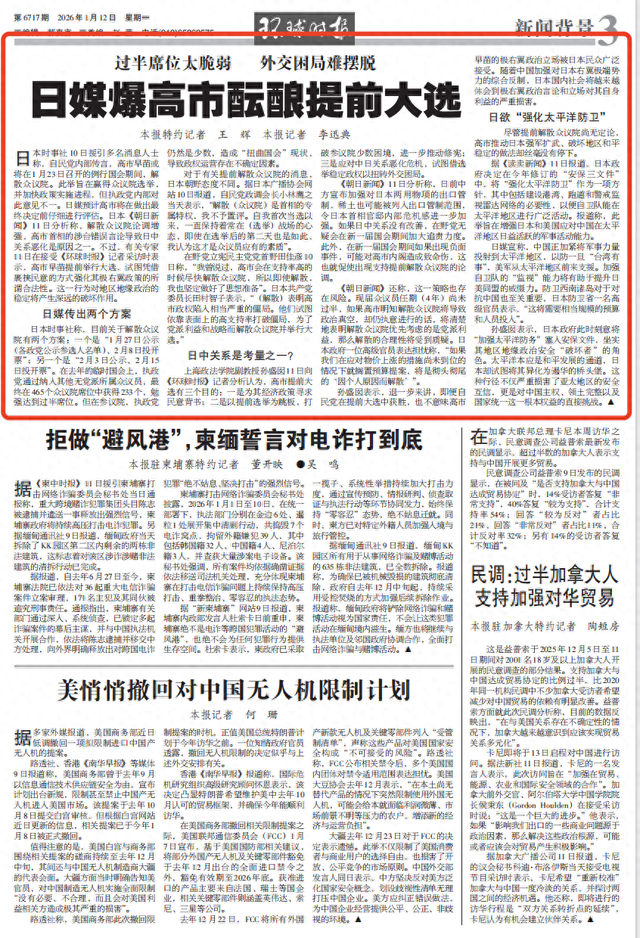
强化太平洋防卫

Search documents
日安保文件或加入强化太平洋防卫
Xin Lang Cai Jing· 2026-01-12 16:10
Group 1 - The core viewpoint of the article is that Japan's Prime Minister, Sanna Takichi, is pushing for the revision of the "National Security Strategy" and other "security three documents" by the end of 2026, with a focus on strengthening Pacific defense [1] - The Japanese government plans to include the concept of "strengthening Pacific defense" as a guideline in the revised security documents [1] - Experts suggest that Japan aims to further "bind" its alliance with the United States through the "strengthening Pacific defense" initiative, while also accelerating its "re-militarization" efforts [1]

日媒爆高市早苗或有大动作
中国能源报· 2026-01-12 02:07
Core Viewpoint - The article discusses the potential for early elections in Japan, driven by Prime Minister Kishi's desire to consolidate power and address internal party divisions, while also considering the implications for Japan-China relations and regional stability [3][6]. Group 1: Early Election Speculation - Reports suggest that Prime Minister Kishi may dissolve the House of Representatives during the upcoming regular Diet session on January 23, aiming to expedite policy implementation and secure a majority in the upcoming elections [3][4]. - Two potential election schedules have been proposed: one with candidate announcements on January 27 and voting on February 8, and another with announcements on February 3 and voting on February 15 [4]. - The ruling party currently holds 233 out of 465 seats in the House of Representatives, barely achieving a majority, while being in the minority in the House of Councillors, creating a "distorted Diet" situation [4]. Group 2: Political Motivations - Analysts suggest three main objectives for Kishi's potential early election: seeking public endorsement for economic policies, breaking the minority status in the House of Councillors to push for constitutional amendments, and stabilizing the government amid deteriorating Japan-China relations [6]. - The deterioration in Japan-China relations, exacerbated by recent Chinese export controls, has heightened the urgency for Kishi to stabilize his administration through an election [6][7]. Group 3: Regional Security Concerns - Despite the uncertainty surrounding the early election, Kishi's administration continues to push for military expansion and regional security measures, including strengthening Pacific defense capabilities [7][8]. - The Japanese government plans to revise its security documents to include measures for enhancing defense in the Pacific, which is seen as a response to increasing Chinese military activities in the region [7][8]. - This approach is viewed as a potential destabilizing factor in regional geopolitics, as Japan seeks to position itself as a counterbalance to China, raising concerns about mutual security trust in the Asia-Pacific region [8].


日媒爆高市早苗酝酿提前大选
Xin Lang Cai Jing· 2026-01-12 00:28
Core Viewpoint - The Japanese government, led by Prime Minister Kishi, is considering an early dissolution of the House of Representatives to strengthen its political position and expedite policy implementation, amidst internal party disagreements and deteriorating relations with China [1][2][3]. Group 1: Political Context - There are two proposed timelines for the early dissolution of the House of Representatives: one for January 27 public announcement and February 8 voting, and another for February 3 public announcement and February 15 voting [2][15]. - The ruling party, the Liberal Democratic Party (LDP), currently holds 233 out of 465 seats in the House, barely maintaining a majority, while it remains a minority in the Senate, creating a "distorted parliament" situation [2][3]. - The opposition parties have expressed differing views on the potential dissolution, with some indicating readiness for an election if it occurs [2][3]. Group 2: Economic and Diplomatic Implications - Analysts suggest that Kishi's motivations for an early election include seeking public support for economic policies, breaking the Senate minority deadlock, and addressing the crisis in Japan-China relations [2][3][4]. - Recent Chinese export controls on dual-use items, including potential restrictions on rare earth materials, have heightened concerns within the Japanese government regarding the impact on domestic politics and the economy [3][4]. - The potential for negative events during the new parliamentary session could pose significant risks to Kishi's administration, prompting discussions around the necessity of an early election [3][4]. Group 3: Military and Security Developments - Despite uncertainties regarding the early election, the Japanese government is advancing its military capabilities, particularly in the Pacific, as part of its revised security strategy [4][5]. - The focus on enhancing Japan's defense capabilities is seen as a response to increasing Chinese military activities in the region, with plans for infrastructure improvements to support the Self-Defense Forces [5]. - This military strategy has raised concerns about Japan's role in regional geopolitics, with implications for its relations with China and overall regional stability [5].