
提前大选

Search documents
日本迎“闪电大选”预期!日债收益率飙升,对冲基金疯狂做空日元
Jin Shi Shu Ju· 2026-01-19 10:26
Core Viewpoint - The Japanese government bond yields have surged to their highest levels in nearly 27 years, driven by market speculation that Prime Minister Fumio Kishida will leverage a promise to cut food taxes as a bargaining chip for an early election [2] Group 1: Bond Market Reaction - The 10-year Japanese government bond yield rose to 2.275%, the highest since February 1999, while yields on 5-year, 20-year, and 30-year bonds also reached historical highs [2] - This surge in bond yields coincides with Kishida's plans to announce an early election, which is expected to provide a clear mandate for large-scale stimulus spending [2] Group 2: Tax Policy Considerations - The ruling Liberal Democratic Party is considering suspending the current 8% value-added tax on food and beverages, which could result in an additional annual loss of 5 trillion yen (approximately $31.7 billion) for the Japanese government [2] - Kishida enjoys a support rate of up to 75% in some polls, and she is expected to clarify her reasons for calling the election earlier than most analysts anticipated [2] Group 3: Investor Sentiment and Currency Impact - Investors are concerned that Kishida's policies may worsen public finances, with analysts noting that there is little evidence of real pressure on the Japanese government bond market despite rising yields [3] - Hedge funds have significantly increased their bearish bets on the yen, with net short positions rising by 35,624 contracts, the largest increase since May 2015 [3] - The yen has fallen to its lowest level since July 2024, as traders speculate on Kishida's potential victory and subsequent stimulus measures, raising concerns about an expanding fiscal deficit [3]
高市早苗正式传达提前大选意向
Xin Jing Bao· 2026-01-14 10:18
Core Viewpoint - Japanese Prime Minister Fumio Kishida intends to dissolve the House of Representatives and call for early elections on the 23rd of this month, amid rising public dissatisfaction and economic concerns [1][1]. Group 1: Political Context - Kishida has communicated his intention to the ruling party's senior officials, indicating a strategic move to consolidate power before potential negative economic impacts arise [1][1]. - The decision for early elections is seen as a way to strengthen the ruling party's foundation, despite concerns about the party's future performance in the elections [1][1]. Group 2: Economic Implications - Following the announcement, Japanese government bond prices have fallen, and the yen has sharply depreciated against the US dollar, reflecting market apprehension regarding Japan's economic outlook [1][1]. - Analysts suggest that recent export control measures from China could have substantial effects on the Japanese economy in the coming months, contributing to the urgency of the early elections [1][1].
高市早苗打算提前大选,中方回应
Zhong Guo Ji Jin Bao· 2026-01-13 08:35
Group 1 - Japanese Prime Minister Kishi Nobuo plans to hold early elections, potentially in February [1] - The Chinese Foreign Ministry stated that this is an internal matter for Japan and refrained from commenting [1] - The G7 finance ministers have agreed to accelerate the reduction of rare earth imports from China to decrease dependency [1]
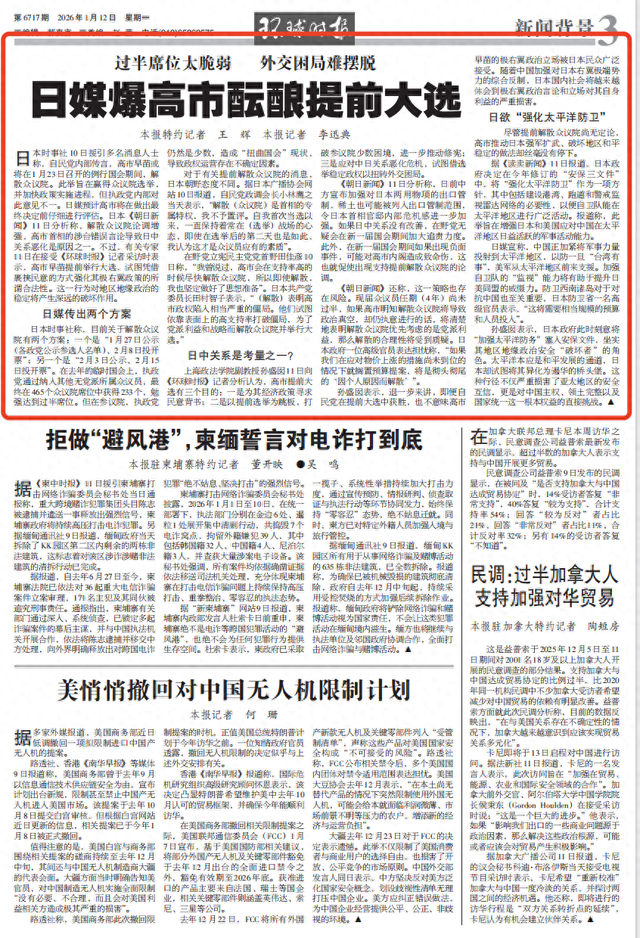
日媒爆高市早苗酝酿提前大选
Xin Lang Cai Jing· 2026-01-12 00:28
Core Viewpoint - The Japanese government, led by Prime Minister Kishi, is considering an early dissolution of the House of Representatives to strengthen its political position and expedite policy implementation, amidst internal party disagreements and deteriorating relations with China [1][2][3]. Group 1: Political Context - There are two proposed timelines for the early dissolution of the House of Representatives: one for January 27 public announcement and February 8 voting, and another for February 3 public announcement and February 15 voting [2][15]. - The ruling party, the Liberal Democratic Party (LDP), currently holds 233 out of 465 seats in the House, barely maintaining a majority, while it remains a minority in the Senate, creating a "distorted parliament" situation [2][3]. - The opposition parties have expressed differing views on the potential dissolution, with some indicating readiness for an election if it occurs [2][3]. Group 2: Economic and Diplomatic Implications - Analysts suggest that Kishi's motivations for an early election include seeking public support for economic policies, breaking the Senate minority deadlock, and addressing the crisis in Japan-China relations [2][3][4]. - Recent Chinese export controls on dual-use items, including potential restrictions on rare earth materials, have heightened concerns within the Japanese government regarding the impact on domestic politics and the economy [3][4]. - The potential for negative events during the new parliamentary session could pose significant risks to Kishi's administration, prompting discussions around the necessity of an early election [3][4]. Group 3: Military and Security Developments - Despite uncertainties regarding the early election, the Japanese government is advancing its military capabilities, particularly in the Pacific, as part of its revised security strategy [4][5]. - The focus on enhancing Japan's defense capabilities is seen as a response to increasing Chinese military activities in the region, with plans for infrastructure improvements to support the Self-Defense Forces [5]. - This military strategy has raised concerns about Japan's role in regional geopolitics, with implications for its relations with China and overall regional stability [5].

英国政坛风暴:副首相陷逃税丑闻请辞,内阁多高官换人,头号反对党笑了:提前大选
Hua Er Jie Jian Wen· 2025-09-05 17:53
Core Points - The UK Labour Party government is facing its most severe political crisis in a year, triggered by the resignation of Deputy Prime Minister Angela Rayner due to a property tax scandal [1] - Prime Minister Keir Starmer has initiated a major cabinet reshuffle, replacing several senior ministers, including the Foreign Secretary, Home Secretary, and Justice Secretary [1][3] - The Labour Party's average support rate has dropped to 20.5%, while the Reform UK party has risen to 28.6%, indicating a shift in public sentiment [2] Cabinet Reshuffle - Key positions affected in the cabinet reshuffle include David Lammy moving to Deputy Prime Minister and Justice Secretary, Yvette Cooper becoming Foreign Secretary, and Shabana Mahmood appointed as Home Secretary [3][4] - The retention of Chancellor Rachel Reeves is seen as a move to reassure financial markets ahead of the upcoming budget announcement [4] Political Implications - Rayner's resignation may lead to internal divisions within the Labour Party, as her departure triggers a party election that could challenge Starmer's authority [6][7] - The Reform UK party, led by Nigel Farage, is seizing the opportunity to criticize the Labour Party and predict significant splits within its ranks [7] - The crisis comes at a critical time for Starmer, who is attempting to launch the second phase of his government after a strong electoral victory last year [7]