
地缘政治稳定

Search documents
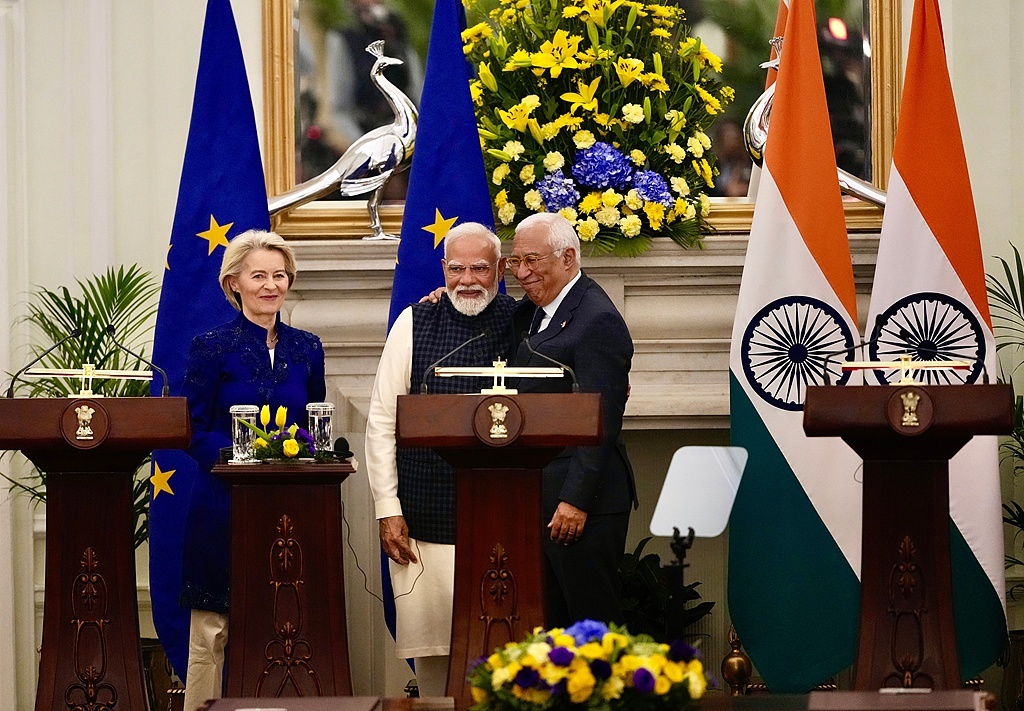
印欧签署自贸协定,美媒称“降低对美依赖”
Huan Qiu Shi Bao· 2026-01-27 22:43
Group 1 - The core point of the news is the signing of a free trade agreement between India and the European Union, which is seen as a new chapter in their strategic relationship and a move to reduce dependence on the United States [1][3] - The agreement covers approximately 25% of global GDP and about one-third of global trade, complementing India's previous trade agreements with the UK and the European Free Trade Association [3] - The agreement is expected to significantly boost India's manufacturing sector and expand its service industry, creating a large market covering 2 billion people [3] Group 2 - India will substantially reduce tariffs on EU products, with automotive tariffs decreasing from 110% to 10%, benefiting European car manufacturers [3] - Agricultural products have been excluded from the agreement to appease the Indian government, which views this as a non-negotiable "red line" [3] - The agreement is seen as a necessary response for India, which has been seeking alternative export markets due to punitive tariffs imposed by the United States [4]

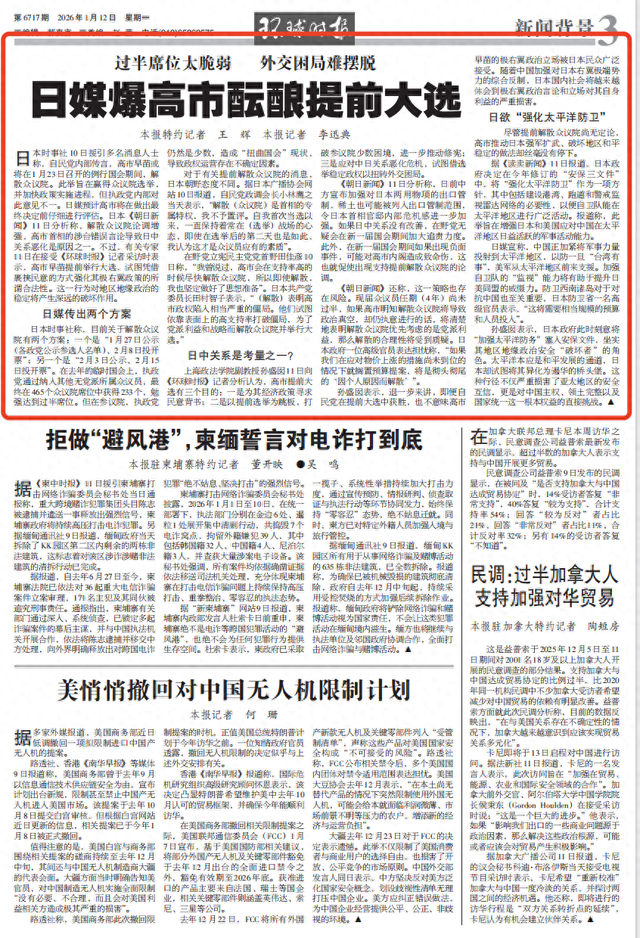
日媒爆高市早苗或有大动作
第一财经· 2026-01-12 01:06
Group 1 - The core viewpoint of the article suggests that there are rumors within the Liberal Democratic Party (LDP) regarding the potential dissolution of the House of Representatives by Prime Minister Fumio Kishida during the regular Diet session on January 23, aimed at winning the House election and accelerating policy implementation, although opinions within the ruling party are divided [1] - The Asahi Shimbun analysis indicates that the calls for dissolving the House of Representatives have strengthened, with Kishida's controversial remarks regarding Taiwan contributing to the deterioration of Japan-China relations [1] - Experts interviewed by the Global Times express that Kishida's attempt to hold early elections is a strategy to legitimize his far-right policies by rallying public opinion, which could have profound destabilizing effects on regional geopolitical stability [1]

日媒爆高市早苗酝酿提前大选
Xin Lang Cai Jing· 2026-01-12 00:28
Core Viewpoint - The Japanese government, led by Prime Minister Kishi, is considering an early dissolution of the House of Representatives to strengthen its political position and expedite policy implementation, amidst internal party disagreements and deteriorating relations with China [1][2][3]. Group 1: Political Context - There are two proposed timelines for the early dissolution of the House of Representatives: one for January 27 public announcement and February 8 voting, and another for February 3 public announcement and February 15 voting [2][15]. - The ruling party, the Liberal Democratic Party (LDP), currently holds 233 out of 465 seats in the House, barely maintaining a majority, while it remains a minority in the Senate, creating a "distorted parliament" situation [2][3]. - The opposition parties have expressed differing views on the potential dissolution, with some indicating readiness for an election if it occurs [2][3]. Group 2: Economic and Diplomatic Implications - Analysts suggest that Kishi's motivations for an early election include seeking public support for economic policies, breaking the Senate minority deadlock, and addressing the crisis in Japan-China relations [2][3][4]. - Recent Chinese export controls on dual-use items, including potential restrictions on rare earth materials, have heightened concerns within the Japanese government regarding the impact on domestic politics and the economy [3][4]. - The potential for negative events during the new parliamentary session could pose significant risks to Kishi's administration, prompting discussions around the necessity of an early election [3][4]. Group 3: Military and Security Developments - Despite uncertainties regarding the early election, the Japanese government is advancing its military capabilities, particularly in the Pacific, as part of its revised security strategy [4][5]. - The focus on enhancing Japan's defense capabilities is seen as a response to increasing Chinese military activities in the region, with plans for infrastructure improvements to support the Self-Defense Forces [5]. - This military strategy has raised concerns about Japan's role in regional geopolitics, with implications for its relations with China and overall regional stability [5].
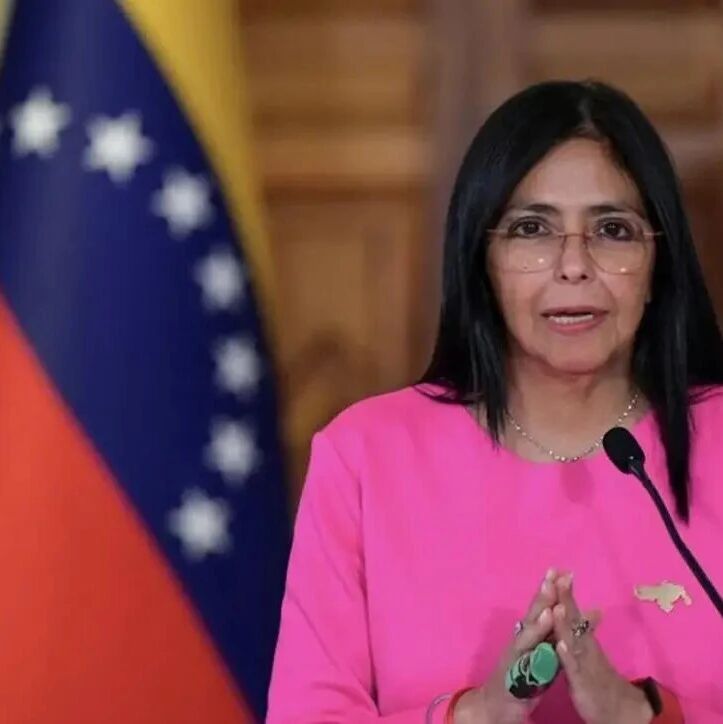
“如果她不做正确的事,可能比马杜罗更惨”!特朗普警告委内瑞拉“代总统”:必须听美国的
美股IPO· 2026-01-05 04:22
Core Viewpoint - The article discusses the recent U.S. military operation in Venezuela, where President Maduro was captured, and the subsequent warning issued by President Trump to the acting president, Rodriguez, emphasizing the potential consequences of opposing U.S. actions [1][3]. Group 1: Military Operation Details - The U.S. military operation, which took place on January 3, involved over 150 aircraft, including bombers, fighters, reconnaissance, and rotary-wing aircraft, launched from 20 bases [4]. - The operation aimed to dismantle Venezuela's air defense systems, resulting in explosions and widespread power outages in Caracas [4]. - The special forces, known as Delta Force, successfully apprehended Maduro and his wife after they attempted to escape to a fortified safe room [4]. Group 2: Intelligence and Planning - The operation, codenamed "Absolute Resolve," was based on months of intelligence gathering, tracking Maduro's movements, and understanding his habits [5]. - The planning for the operation began in mid-December, with earlier preparations dating back several months [5]. - A CIA team had been deployed to Venezuela to monitor Maduro, indicating a long-term strategy for U.S. involvement in the region [5]. Group 3: Political Implications - Trump's warning to Rodriguez highlighted the U.S. stance on Venezuela, suggesting that further military interventions could occur in other countries [3]. - Rodriguez's refusal to acknowledge the U.S. military action and her declaration of Maduro as the "only president" reflects the ongoing political tensions in Venezuela [3]. - The situation raises concerns about geopolitical stability and the potential for continued U.S. unilateral military actions [3].
“如果她不做正确的事,可能比马杜罗更惨”!特朗普警告委内瑞拉“代总统”:必须听美国的
Hua Er Jie Jian Wen· 2026-01-05 00:18
Core Viewpoint - The article discusses the U.S. military operation to capture Venezuelan President Maduro, highlighting President Trump's warnings to the interim president Rodriguez and the implications for U.S. foreign policy in Latin America [1][2]. Group 1: Military Operation Details - The U.S. military operation, named "Absolute Resolve," involved over 150 aircraft and was executed on January 3, with a duration of approximately five hours [2][3]. - The operation commenced with a strike that disabled Venezuela's air defense systems, leading to explosions and widespread power outages in Caracas [2]. - Special forces, specifically Delta Force, successfully captured Maduro and his wife after they attempted to escape to a fortified safe room [2][3]. Group 2: Intelligence and Planning - The intelligence operation to track Maduro's movements began months prior, with detailed surveillance on his habits and routines [3]. - The CIA had been active in Venezuela since at least December, with operatives embedded within the Venezuelan government to gather information [3]. - The operation was reportedly monitored in real-time by President Trump, indicating the use of advanced surveillance technology [3].
印尼总统:经过10年的谈判,我们已与欧盟达成自由贸易协定,印尼是东盟的重要组成部分,这将对经济和地缘政治的稳定做出非常重要的贡献。
news flash· 2025-07-13 11:38
Core Viewpoint - Indonesia has reached a free trade agreement with the European Union after 10 years of negotiations, which is expected to significantly contribute to economic and geopolitical stability in the region [1] Group 1 - The free trade agreement marks a crucial development for Indonesia as a key member of ASEAN [1] - The agreement is anticipated to enhance economic cooperation and trade relations between Indonesia and the EU [1] - The successful negotiation reflects Indonesia's strategic importance in the global trade landscape [1]
美银逆势看好美元:下半年跌不动了!
Jin Shi Shu Ju· 2025-07-11 09:07
Core Viewpoint - Bank of America predicts limited downside for the US dollar in the second half of 2025, contrasting with some current market sentiments [2][10] Supporting Factors for Dollar Resilience - Key factors supporting the view of limited downside for the dollar include interest rate differentials, economic performance, and global liquidity demand [3] - Despite potential Fed rate cuts, if US rates remain higher relative to the Eurozone or Japan, the dollar will still attract yield-seeking investors [3] - The US economy shows remarkable resilience and growth, providing fundamental support for the dollar [3] - The dollar remains the dominant global reserve currency, with structural demand particularly strong during periods of global uncertainty [3] Core Drivers of Dollar Trends in 2025 - Understanding the factors influencing the dollar's outlook in 2025 is crucial, with monetary policy, economic growth, and geopolitical stability being primary drivers [4] - The pace of Fed rate cuts compared to other central banks will be critical; a slower Fed cut could maintain dollar strength [4] - Even amid global economic slowdowns, the US's robust performance may attract capital inflows, supporting the dollar [4] - Geopolitical tensions often increase demand for the dollar as a safe-haven asset [4] - The inflation trajectory in the US will directly impact central bank policies and currency valuation [4] Interconnectedness of Dollar and Forex Markets - The dollar's performance is interconnected with broader forex market trends, influencing and being influenced by other major currencies and emerging market currencies [5][6] - If the ECB or BoJ maintain a more accommodative stance, the euro and yen may face continued pressure against the dollar [5] - Strong dollar often exerts pressure on emerging market currencies, particularly those with dollar-denominated debt [6] Basis of Analysis and Potential Challenges - Bank of America's analysis is based on a comprehensive approach, considering macroeconomic indicators and policy expectations [7] - Key aspects include labor market data, inflation trends, global trade, and capital flows, all of which significantly impact dollar demand [7] - While the analysis is compelling, potential challenges include unexpected global economic recovery leading to capital outflows from the US [7] Implications for Investors - Understanding these currency forecasts is crucial for investors, affecting portfolio construction and risk management [9] - A strong dollar can be a double-edged sword, enhancing the value of dollar-denominated assets while making US exports more expensive [9] - Companies and investors with significant international exposure should consider hedging strategies to mitigate currency risk [9]