恒生指数走势预测

Search documents
看好2026年恒生指数!中信里昂,再出风水研报
Xin Lang Cai Jing· 2026-02-07 23:32
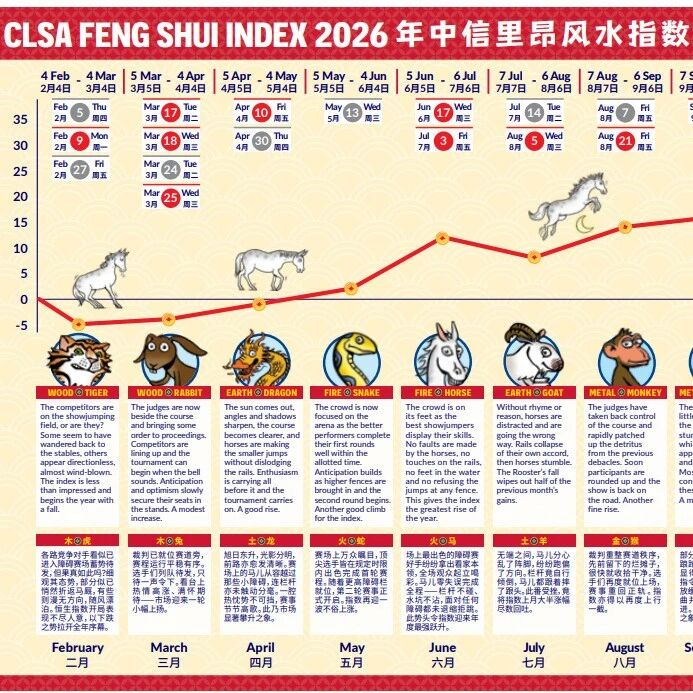
Core Viewpoint - The report from CITIC Securities emphasizes a positive outlook for the Hang Seng Index in 2026, predicting a significant upward trend after a period of hesitation in 2025, with a strong performance expected in the first half of the year [4][11]. Monthly Predictions for Hang Seng Index - February: The index is expected to start poorly with a downward trend [4][14]. - March: A slight upward movement is anticipated [4][14]. - April: A significant increase in the index is predicted [4][14]. - May: Another notable rise is expected [4][14]. - June: The index is forecasted to experience its strongest surge of the year [4][14]. - July: A substantial portion of the previous month's gains will be lost [4][14]. - August: The index is expected to rise again [4][14]. - September: A slight increase is anticipated [4][14]. - October: The index is likely to experience stagnation with weak upward momentum [4][14]. - November: A steady upward trend is expected [4][14]. - December: A significant decline is forecasted [4][14]. - January 2027: The index is predicted to rebound strongly [4][14]. Industry Predictions - Wood: Expected to be the strongest sector for the year, with a rebound anticipated towards the end of the year, benefiting agriculture and related industries [5][14]. - Fire: Industries related to fire are expected to perform well, although a decline may occur in the last two months of the year due to excessive water influence [15][14]. - Earth: The real estate sector may struggle, but construction materials like sand and cement are expected to perform well [15][14]. - Metal: The metal sector is predicted to have a strong year, particularly in machinery manufacturing and construction steel [15][14]. - Water: This sector is expected to be the weakest, with limited growth in shipping and tourism industries [16][14]. Review of 2025 Predictions - The report reflects on the unpredictable nature of the Hang Seng Index in 2025, which saw unexpected declines and rebounds, ultimately aligning with earlier predictions of market fluctuations [7][17]. Performance Metrics - As of February 4, 2026, the Hang Seng Index has shown a cumulative increase of 29.25% since January 29, 2025, with a volatility of 42.31% [10][20].

看好2026年恒生指数!中信里昂,再出风水研报
券商中国· 2026-02-07 23:29
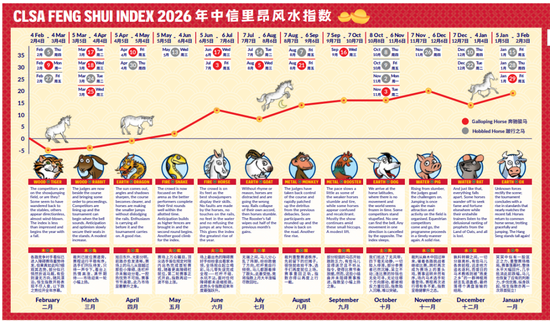
Core Viewpoint - The report from Citic Lyon emphasizes that 2026 will mark a departure from the hesitant trials of the Year of the Snake, with the Year of the Horse bringing a confident and powerful momentum to the market [5]. Market Predictions - The report provides a month-by-month forecast for the Hang Seng Index in 2026, predicting a poor start in February, followed by a series of upward movements from March to June, with the strongest performance expected in June. A significant decline is anticipated in December, before a rebound in January 2027 [5][6]. Industry Predictions - **Wood Sector**: Expected to be the strongest throughout the year, with a rebound anticipated towards the end of the year, benefiting agriculture and related industries [6]. - **Fire Sector**: Predicted to perform well, particularly in energy production and communication, but may face challenges in the last two months of the year due to excessive water influence [6]. - **Earth Sector**: Expected to have a moderate performance, with potential strength in construction materials like sand and cement, while real estate may struggle [6]. - **Metal Sector**: Forecasted to have a strong year, particularly in machinery manufacturing and construction steel, with a focus on innovation in financial products [6]. - **Water Sector**: Anticipated to be the weakest element, with stagnation expected in shipping and tourism, and limited growth in trade-related sectors [7]. Review of 2025 Predictions - The report reflects on the unpredictable nature of 2025, highlighting significant fluctuations in the Hang Seng Index, including unexpected declines and rebounds, aligning with earlier predictions of market behavior [8][10].