
能源生产

Search documents
CKH HOLDINGS(00001) - 2025 Q4 - Earnings Call Transcript
2026-03-19 10:30
Financial Data and Key Metrics Changes - Revenues for 2025 increased by 6% compared to 2024, with 2% attributed to foreign exchange differences and 4% representing underlying growth, amounting to approximately HKD 19 billion [2][3] - Net earnings on an underlying basis rose by 7%, translating to an increase of about HKD 1.5 billion compared to 2024 [3] - The underlying EBITDA increased by HKD 9.4 billion, approximately 9%, with 7% being fully underlying and 2% driven by favorable foreign exchange tailwinds [5] - The consolidated total net debt to net total capital ratio improved to 13.9% from 16.2% at the end of 2024 [6][23] - Operating free cash flow increased by 4% to HKD 40.5 billion [13] Business Line Data and Key Metrics Changes - Ports division revenue reached HKD 48.9 billion, an 8% increase over 2024, with throughput increasing by 3% to 90.1 million TEUs [27] - Retail division revenue grew by 10% to HKD 209.3 billion, with EBITDA increasing by 11% to HKD 18.2 billion [35][36] - CK Hutchison Group Telecom saw underlying EBITDA grow by 6% in local currency, with UK operations benefiting from the merger with Vodafone UK [50] Market Data and Key Metrics Changes - The ports division's EBITDA increased by 8% in reported currency, with significant contributions from Europe and Asia [27][28] - Retail division's EBITDA split showed 24% from Asia and 76% from Europe, indicating a strong performance in both regions despite challenges in specific markets [36][38] Company Strategy and Development Direction - The company aims to unlock asset value and strengthen its financial position through strategic corporate actions, such as the disposal of UK Power Networks [67] - There is a focus on achieving scale in operations to enhance productivity and cost efficiency, particularly in the context of AI advancements [68] - The company is committed to maintaining a strong financial profile while exploring value-accretive transactions [85] Management's Comments on Operating Environment and Future Outlook - Management expressed optimism about the ports division's resilience despite geopolitical risks and trade tensions, expecting to mitigate impacts through geographical diversification [31][32] - The retail division is poised for growth despite economic headwinds, with strategies in place to enhance product offerings and optimize store networks [39] - The telecommunications division is expected to deliver stable performance through customer base growth and cost efficiency initiatives following the merger [50] Other Important Information - The group's cash and liquid assets amounted to HKD 151 billion, providing a strong liquidity position amid volatile financial markets [24] - The average cost of debt decreased from 3.6% in 2024 to 3.3% in 2025, reflecting improved financial management [24] Q&A Session Summary Question: What are the drivers behind recent corporate actions? - The recent corporate actions reflect a consistent strategy to unlock asset value and strengthen financial position, with a focus on recycling capital efficiently [67] Question: What are the group's thoughts on the stake in Cenovus? - The energy sector has been a good asset despite volatility, with Cenovus's recent acquisition enhancing production levels significantly [70] Question: What impacts are expected from the escalating conflict in the Middle East? - Vessel calls at UAE ports are expected to reduce, but there has been an increase in requests for ad hoc calls at other ports, mitigating overall impact [78] Question: What is the update on the Panama transaction? - Ongoing legal proceedings are in place to protect the group's interests, and discussions regarding the larger transaction continue [81] Question: What is the capital allocation strategy post-asset sale? - The focus remains on maintaining financial resilience and exploring value-accretive opportunities, with dividend payouts and share buybacks being board decisions [85]

两会聚焦丨经济日报:迎接两会特稿 粮食能源供应底气充沛
国家能源局· 2026-03-03 03:23
Group 1: Food Security - Food security is a fundamental aspect of national security, with China focusing on enhancing food production capacity during the 14th Five-Year Plan, achieving a grain output of over 1.4 trillion jin [2][18] - The implementation of the national food security strategy has led to a stable grain output, with per capita grain availability reaching 1000 jin, significantly above the international safety line [4][19] - The supply structure has improved, with soybean production remaining above 20 million tons for four consecutive years, and the proportion of high-quality grain varieties increasing [4][19] Group 2: Food Supply Chain and Infrastructure - The capacity for grain circulation has significantly improved, with national grain storage capacity exceeding 730 million tons, and high-standard storage facilities increasing [5][19] - The grain reserve system has been optimized, enhancing the ability of local governments to respond to risks, supported by policies like minimum purchase prices [5][19] - The total industrial output value of the grain sector remains stable at over 4 trillion yuan, indicating a robust grain industry [5][19] Group 3: Energy Security - China's energy production accounts for over one-fifth of global totals, with significant advancements in renewable energy, including the largest electric vehicle charging network and record-breaking solar and wind energy capacities [6][21] - The energy self-sufficiency rate has consistently remained above 80%, supported by a comprehensive energy supply and pricing mechanism [7][21] - The share of renewable energy in total power generation capacity has increased from 40% to approximately 60%, reflecting a rapid transition to a low-carbon energy system [7][21] Group 4: Emergency Response Capabilities - The number of grain emergency processing enterprises has increased by 26%, and daily processing capacity has risen by 48%, enhancing the emergency supply network [10][11] - The establishment of a national-level electricity emergency support system has improved the resilience of energy supply, with no major power outages reported [10][11] - Continuous efforts are being made to strengthen the emergency response systems for both food and energy, ensuring stability in times of crisis [10][11]


南农晨读 | 春山深处是故乡
Nan Fang Nong Cun Bao· 2026-02-28 02:01
Group 1 - Guangdong province is focusing on high-quality agricultural and rural development, with various cities presenting unique plans and tasks to align with provincial goals [3][4][6][7] - The province is emphasizing the integration of manufacturing and service industries, as well as the "Hundred Million Thousand Project" for county-level industrial integration [5][6][10][12] Group 2 - Shantou has emerged as one of the most popular tourist destinations during the 2026 Spring Festival, attracting approximately 7.15 million visitors and generating around 7.16 billion yuan in tourism revenue [14][15][16] - The city utilized its cultural heritage and local cuisine to enhance its appeal, showcasing a strong performance in the tourism sector [14][16] Group 3 - The current market for freshly made lemon tea in China is projected to reach 11 billion yuan by 2025, with a year-on-year growth of 15.8%, positioning Guangdong as a leader in this segment [30][31][32] - The rise of specialized lemon tea shops has transformed this beverage from a mere accompaniment in restaurants to a standalone popular category [34][35] Group 4 - Yangxi County is aiming for a total energy installed capacity exceeding 20 million kilowatts and a 20% increase in fishery output this year, focusing on marine economy, health food, and tourism development [41][42][44] - The county's development strategy includes a "2+4+X" model for high-quality industrial growth [44] Group 5 - The city of Maoming has launched a campaign to promote its lychee industry, emphasizing the cultural significance of local traditions and the importance of seasonal agricultural practices [46][47][49] - The initiative aims to enhance community engagement and preserve local heritage through the promotion of lychee-related events [48][50]

意大利提高能源公司税收以补贴电费账单
Xin Lang Cai Jing· 2026-02-20 20:20
Group 1 - Italy has approved a 2 percentage point increase in the regional production tax for energy companies to fund measures aimed at reducing electricity costs for households and high-energy-consuming businesses [1][2] - This tax increase is expected to generate an additional €1 billion (approximately $1.18 billion) in revenue for the government by 2028, which will be used to subsidize electricity cost reduction plans [1][2] - Prime Minister Meloni stated that the plan will have a "significant impact," providing over €5 billion in benefits to households and businesses, although no specific timeline was provided [1][2] Group 2 - The regional production tax for energy companies is projected to rise from 3.9% to 5.9% under this plan [1][2] - Italy's electricity costs are higher than those of France or Spain due to its heavy reliance on imported natural gas for power generation, making it vulnerable to global price fluctuations and geopolitical tensions [1][2] - Additional subsidies have been introduced to assist low-income families with their electricity bills [1][2]
特朗普政策波动下,机构策略转向:看好非美股市与能源股等
智通财经网· 2026-02-13 08:13
Group 1: Global Economic Trends - The actions of President Trump are disrupting the previously maintained global order in economics, trade, and security, prompting allies to take action [1] - Financial markets are responding positively, with investors increasing investments in non-US stock markets and energy stocks, as well as showing optimism towards currencies like the Euro and Canadian Dollar [1] - The trend of "American exceptionalism" is fading, with major stock markets and emerging markets expected to achieve double-digit profit growth by 2026 [2] Group 2: European Market Developments - Over 73% of companies in the European Stoxx 600 index that reported Q4 earnings exceeded expectations, compared to 54% in the same period last year [2] - The FTSE 100 index in London has surpassed the 10,000-point mark, rising 5% this year, significantly outperforming the S&P 500's 1.4% increase [2] - A €600 million European strategic autonomy fund launched by BNP Paribas is focused on defense, industrial resilience, resource independence, and technology, driven by large-scale investment plans in Europe [2] Group 3: Defense and Energy Sector Insights - Defense stocks have surged by 200% since February 2022, highlighting their status as winners amid geopolitical tensions [5] - European energy stocks are nearing their highest levels since 2008, driven by increased focus on critical resources and infrastructure development [5] - The European Union is considering a "European manufacturing" strategy to protect domestic industries, although opinions among member states vary [8] Group 4: Currency Movements - The G10 currencies have shown significant appreciation against the US dollar since Trump announced tariffs, with the Swiss Franc up by 14.8% and the Euro by 9.6% [10]
看好2026年恒生指数!中信里昂,再出风水研报
券商中国· 2026-02-07 23:29
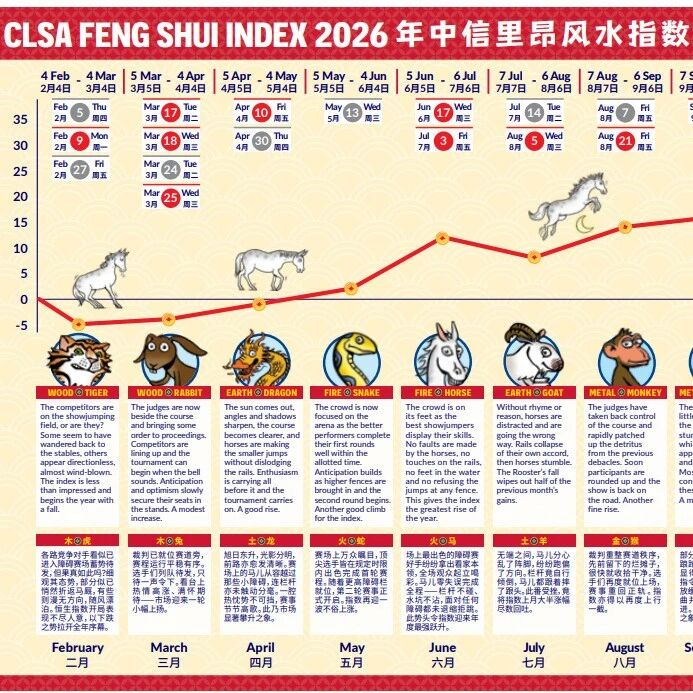
Core Viewpoint - The report from Citic Lyon emphasizes that 2026 will mark a departure from the hesitant trials of the Year of the Snake, with the Year of the Horse bringing a confident and powerful momentum to the market [5]. Market Predictions - The report provides a month-by-month forecast for the Hang Seng Index in 2026, predicting a poor start in February, followed by a series of upward movements from March to June, with the strongest performance expected in June. A significant decline is anticipated in December, before a rebound in January 2027 [5][6]. Industry Predictions - **Wood Sector**: Expected to be the strongest throughout the year, with a rebound anticipated towards the end of the year, benefiting agriculture and related industries [6]. - **Fire Sector**: Predicted to perform well, particularly in energy production and communication, but may face challenges in the last two months of the year due to excessive water influence [6]. - **Earth Sector**: Expected to have a moderate performance, with potential strength in construction materials like sand and cement, while real estate may struggle [6]. - **Metal Sector**: Forecasted to have a strong year, particularly in machinery manufacturing and construction steel, with a focus on innovation in financial products [6]. - **Water Sector**: Anticipated to be the weakest element, with stagnation expected in shipping and tourism, and limited growth in trade-related sectors [7]. Review of 2025 Predictions - The report reflects on the unpredictable nature of 2025, highlighting significant fluctuations in the Hang Seng Index, including unexpected declines and rebounds, aligning with earlier predictions of market behavior [8][10].
安全生产百日攻坚行动 | 兴中能源召开2025年度安全工作总结会暨2026年安全责任书签订仪式
Xin Lang Cai Jing· 2026-02-06 11:20
Core Viewpoint - The company emphasizes the importance of safety as a fundamental requirement for survival and high-quality development, setting a "zero accident" goal for 2026 [6][12]. Group 1: 2025 Safety Work Review - In 2025, the company achieved its annual safety production goal of zero accidents by closely following group directives and focusing on a three-year action plan for fundamental improvements [4][10]. - The meeting reviewed the effectiveness of safety work in 2025 and outlined key tasks for 2026, establishing a clear path and actionable measures for the upcoming year [4][10]. Group 2: 2026 Safety Work Focus - The company signed safety responsibility agreements for 2026, with the chairman and business leaders defining safety goals, responsibility lists, and assessment standards to ensure accountability [4][10]. - Six key measures were identified for 2026, including responsibility enforcement, hazard management, technological empowerment, enhancement of employee skills, key control, and support assurance [6][12].

港股收评:集体下跌!恒指跌1.21%,锂电池股逆市上升
Ge Long Hui· 2026-02-06 09:01
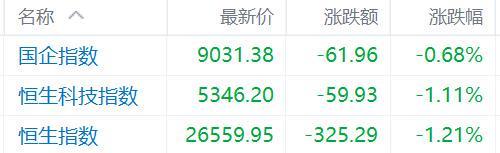
Market Overview - The Hong Kong stock market indices collectively declined, with the Hang Seng Index falling by 1.21%, the Hang Seng Tech Index down by 1.11%, and the Hang Seng China Enterprises Index decreasing by 0.68% [1] - Southbound funds recorded a net inflow of HKD 14.859 billion [11] Sector Performance - The lithium battery sector saw gains, with Cai Ke New Energy rising over 6%, and other companies like Zhong Chuang Innovation and Ganfeng Lithium also experiencing increases [4][7] - The oil and gas production sector performed well, with Yuanheng Gas surging over 27% and other companies like Jintai Feng International and United Energy Group rising over 7% [5][6] - The automotive sector continued to rise, with NIO increasing nearly 7%, and other companies like Li Auto and BYD also showing positive performance [7] Major Companies - Alibaba, Meituan, Kuaishou, NetEase, and Baidu all experienced declines of over 2%, while Tencent, JD.com, and Ctrip fell over 1% [2][3] - In contrast, Li Auto saw an increase of over 3%, and Xiaomi Group rose slightly by less than 1% [2][3] Cryptocurrency Market - The cryptocurrency sector faced significant declines, with Bitcoin dropping to around USD 64,000 [8] - Companies in the cryptocurrency space, such as New Fire Technology Holdings and Guofu Quantum, saw declines of over 7% and nearly 6%, respectively [8] Insurance Sector - The insurance sector experienced downturns, with AIA falling over 5%, Prudential down over 4%, and other companies like China Pacific Insurance and Zhong An Online also declining [9] Copper Industry - The copper sector faced declines, with China Metal Utilization dropping over 12% and other companies like China Nonferrous Metals and Minmetals Resources also experiencing losses [10] - Analysts predict that basic metals will maintain an upward trend this year, with copper, tin, and aluminum prices expected to rise by 20%, 16%, and 12% respectively by 2025 [10][11]






2026年中信里昂证券FS指数
2026-02-05 02:21
Summary of Key Points from the Conference Call Industry or Company Involved - The conference call focuses on the **2026 Feng Shui Index** and its implications for various industries, particularly the **real estate sector** and the **Hang Seng Index (HSI)**. Core Insights and Arguments - The **2025 market performance** was characterized by volatility, with the Hang Seng Index experiencing unexpected declines and subsequent rebounds, ultimately surpassing initial predictions [4][5]. - The **2026 Feng Shui Index** suggests a positive outlook for the year, with expectations of a strong market performance akin to a galloping horse, indicating a year of opportunities and potential surprises [8][12]. - The **real estate sector** is forecasted to face challenges, as it lacks direct auspicious influences in the current year's predictions. However, specific directions (East and Southeast) are noted to have favorable prospects, while the North and South may encounter disruptions [11][59]. - The **HSI**, categorized as an Earth element, is expected to benefit from the fire energy of the year, leading to a brighter outlook despite previous caution [11][12]. Other Important but Possibly Overlooked Content - The **Feng Shui Index** integrates traditional Chinese metaphysics, including the Five Elements theory, to predict market trends and sector performances [39][46]. - The **Wood element** is expected to thrive in 2026, positively impacting industries related to agriculture, furniture, and pharmaceuticals, while the **Fire element** is anticipated to boost sectors like energy production and communications [42][46]. - The **Water element** is predicted to be weak, potentially hindering the shipping and trade industries, as well as sectors related to small goods and aquaculture [56]. - The **real estate sector** is expected to struggle, but construction materials like sand and cement may see growth, particularly towards the end of the year [49]. This summary encapsulates the essential insights from the conference call, highlighting the anticipated trends and challenges across various sectors as influenced by the Feng Shui Index for 2026.
美股轮动风暴背后,竟是2001年与2022年的崩盘魅影!
Jin Shi Shu Ju· 2026-02-04 12:48
Core Viewpoint - The recent decline in U.S. tech stocks has led to a relative strength in value stocks, indicating a potential shift in market dynamics that may just be beginning [1][2]. Group 1: Market Trends - The Russell 1000 Value Index has risen by 8.6% since early November last year, outperforming its growth counterpart by 14 percentage points, which historically suggests further gains for value stocks [1]. - The recent outperformance of value stocks has raised concerns, as similar patterns preceded significant market downturns in 2022 and 2001 [1]. - A consensus is forming on Wall Street that the era dominated by large tech stocks may be nearing its end, as evidenced by a recent sell-off in tech stocks following declines in software manufacturers [1]. Group 2: Analyst Insights - Andrew Greenebaum from Jefferies believes the rotation towards value stocks is just beginning, with significant room for value stocks to outperform growth stocks over a longer time frame [2]. - Historical analysis indicates that periods of value stock outperformance often coincide with economic recovery phases or GDP growth acceleration [2]. - Doug Beath from Wells Fargo notes that since late October, investors have increasingly favored cyclical stocks, often at the expense of large-cap growth stocks [3]. Group 3: Valuation Dynamics - The current market environment has created a significant valuation gap between growth and value stocks, making value stocks particularly attractive [4]. - The past 15 years have seen growth stocks outperform value stocks by an average of 7% annually, but this trend may be reversing as high valuations and strong profit growth are already priced in for growth stocks [4]. - Greenebaum highlights that low market expectations for value stocks provide room for price increases, even with average performance [5]. Group 4: Future Projections - Despite the positive outlook for value stocks, there are concerns regarding profit growth, with projected earnings growth for value stocks at 6.4% compared to 27.1% for growth stocks by 2026 [5]. - Noah Weisberger from BCA Research suggests that as the bull market matures, overall stock market returns will likely be more closely tied to earnings growth rather than valuation increases [5][6]. - Weisberger also notes that while relative valuations may signal a rotation, the leading sectors may not change entirely, indicating a potential convergence between lagging and leading sectors [6].