
慢思考能力

Search documents
夸克通过“主任医师级”笔试
第一财经· 2025-07-23 13:32
Core Viewpoint - Quark Health's large model has become the first in China to pass the written assessment for chief physician in 12 core medical disciplines, indicating significant advancements in AI healthcare capabilities [1] Group 1: Market Growth and Competition - The global AI healthcare market is projected to grow from $11 billion in 2021 to $194 billion by 2028, with a compound annual growth rate (CAGR) exceeding 41% [1] - Major companies like ByteDance, Baidu, and Alibaba are investing heavily in health large models, highlighting the competitive landscape [1] Group 2: Challenges in Accuracy - The accuracy of health large models remains a core pain point, with challenges including the precision of patient-selected prompts and the development of multimodal capabilities [2] - Accurate understanding of patient expressions and needs is crucial for AI to assist both patients and doctors effectively [2] Group 3: Development of "Slow Thinking" Capability - Quark Health's large model has achieved a breakthrough by developing "slow thinking capability," which integrates chain reasoning and multi-stage clinical deduction to address complex medical issues [2] - High-quality reasoning training data is essential for building this capability, with medical data categorized into "verifiable" and "non-verifiable" types [2] Group 4: Investment in Clinical Data - The development of health large models increasingly relies on clinical data, diagnostics, and data annotation from human doctors [3] - Quark Health has a professional annotation team of over a thousand, including more than 400 senior medical experts [3] Group 5: Commercialization Challenges - Currently, Quark Health is not focusing on commercialization, although future directions may include health record management, diagnostic service conversion, and smart device services [4] - The commercialization of health large models remains a complex issue that is still in the early discussion stages [4]


夸克通过“主任医师级”笔试,健康大模型如何解准确性难题?
Di Yi Cai Jing· 2025-07-23 11:24
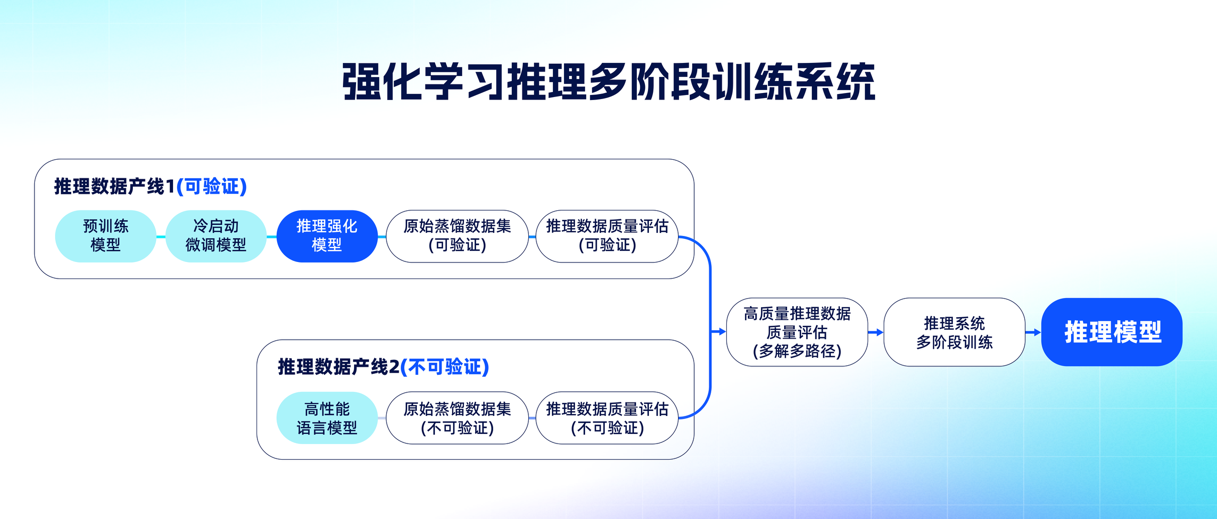
Core Insights - The current pain point for health large models is insufficient accuracy, as stated by Quark Health's product head [1] - Quark Health's large model has become the first in China to pass the written assessment for chief physicians, following its earlier success with deputy chief physician exams [1] - The global AI in healthcare market is projected to grow from $11 billion in 2021 to $194 billion by 2028, with a compound annual growth rate (CAGR) exceeding 41% [1] Group 1: Challenges and Developments - Health large models face challenges related to the accuracy of consumer-selected prompts and the development of multimodal capabilities, which affect the output of model responses [2] - A significant breakthrough for Quark Health's large model is the development of "slow thinking ability," which integrates chain reasoning and multi-stage clinical reasoning to address complex medical issues [2] Group 2: Training and Commercialization - To build slow thinking ability, high-quality reasoning training data is essential, with Quark categorizing medical data into "verifiable" and "non-verifiable" types for different tasks [5] - Quark Health's large model has a professional annotation team of over 1,000, including more than 400 senior medical experts, highlighting the importance of clinical data and human input for model development [5] - Currently, Quark Health is not considering commercialization, but potential future directions may include health record management and diagnostic service transformations [5]
国内首个“主任级AI医生”诞生,夸克健康大模型通过12门主任医师考试
Guan Cha Zhe Wang· 2025-07-23 06:32
Core Insights - Quark Health's large model has successfully passed the written assessment for chief physician in 12 core medical disciplines in China, becoming the first large model to achieve this milestone [1] - This achievement follows the model's earlier success in passing the associate chief physician examination in May, indicating significant advancements in complex medical reasoning tasks [1] - The model's capabilities are now fully integrated into Quark's AI search, allowing users to access "chief-level AI doctor" capabilities for health inquiries [1] Model Development - Quark Health's algorithm head, Xu Jian, stated that the model is based on Tongyi Qianwen and follows a deep engineering route aimed at vertical scenarios, focusing on training the AI to understand medical thinking rather than just answering medical questions [1][2] - A key breakthrough of the model is the development of "slow thinking ability," which combines chain reasoning and multi-stage clinical deduction modeling, enabling the model to derive answers through phased and in-depth reasoning for complex medical issues [1][2] Engineering System - To build the slow thinking capability, Quark employed a "dual data production line + dual reward mechanism" engineering system, categorizing medical data into "verifiable" and "non-verifiable" types for diagnostic and health advice tasks respectively [2] - The training methodology includes a "process reward model" and a "result reward model" to evaluate the reasoning chain's validity and the accuracy of final conclusions, enhancing clinical interpretability and reasoning consistency [2] User Engagement - Quark Health's large model is supported by a professional annotation team of over 1,000 physicians, with more than 400 being associate chief physicians or higher, ensuring high-quality data input [2] - The Quark AI search platform has attracted a significant user base among medical students and doctors, with monthly active users exceeding 2 million among medical students, representing over half of the demographic [2]
