
战略性全球化

Search documents
纯电动汽车销量登顶全球榜首!比亚迪重构全球新能源汽车格局
Chang Sha Wan Bao· 2026-02-05 09:54
Core Insights - In 2025, BYD surpassed Tesla with a total of 2.257 million pure electric vehicle sales, marking a historic shift in the global electric vehicle industry [1] - This achievement reflects the systematic innovation and strategic globalization of Chinese automotive brands, establishing a leading position in the core track of the global automotive industry [1] Group 1: Technological Advancements - BYD's success is built on a robust full-industry chain technology moat, with key innovations such as the "Tian Shen Eye" driver assistance system and "Super e-platform Mega Flash Charging" [1] - The vertical integration of its supply chain ensures rapid iteration of technology and products, providing a competitive edge in global markets [1] Group 2: Market Performance - In Europe, BYD transitioned from a single product approach to a systematic breakthrough, achieving over 50,000 sales in the UK, a 485% year-on-year increase [3] - In traditional automotive strongholds like Germany, Spain, and Italy, annual sales exceeded 20,000 units [3] - In emerging markets like Turkey and Thailand, annual sales reached 45,000 and 41,000 units respectively, with local production significantly enhancing market dominance [3] Group 3: Global Expansion Strategy - BYD's dual strategy of "going global" and "localization" has led to its presence in 119 countries and regions, with overseas sales surpassing one million units in 2025 [4] - The establishment of production facilities in Thailand, Brazil, Uzbekistan, and the upcoming factory in Hungary reflects a commitment to localize operations, shorten delivery times, and meet market demands [4] - BYD's ascent signifies a new phase in global automotive competition, demonstrating the capability of the Chinese automotive industry to lead in technology-intensive high-end manufacturing [4]


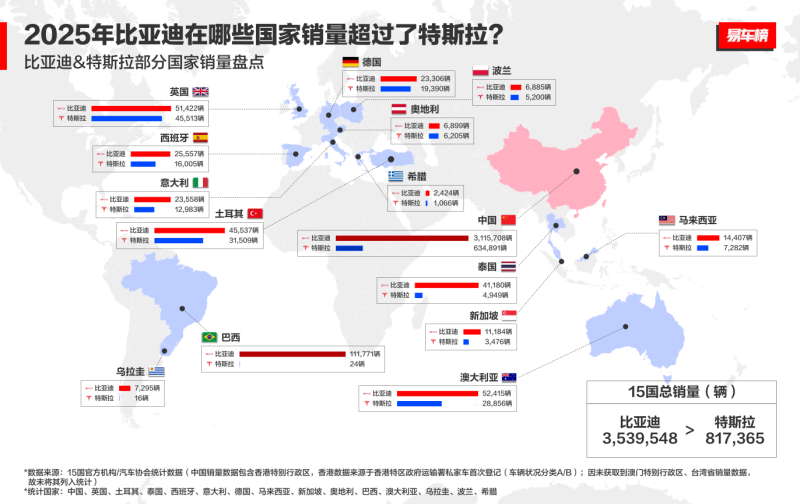
多国销量超越特斯拉!比亚迪登顶全球纯电销量冠军,重构新能源汽车格局
Xin Lang Cai Jing· 2026-02-04 01:56
Core Insights - In 2025, BYD achieved a historic milestone by surpassing Tesla with annual sales of 2.257 million pure electric vehicles, becoming the global leader in the electric vehicle market [1][4] - This achievement is attributed to BYD's systematic innovation and strategic globalization, positioning Chinese automotive brands at the forefront of the global automotive industry [1][4] Group 1: Technological Advancements - BYD's success is built on a robust technological moat established over the years, featuring innovations like the "Heavenly Eye" driver assistance system and the "Super e-platform" for rapid charging [1][4] - The company's vertically integrated supply chain model ensures rapid iteration of technology and products, creating a competitive edge that is difficult to replicate [1][4] Group 2: Market Performance - In Europe, BYD transitioned from a single product focus to a comprehensive breakthrough, with sales in the UK exceeding 50,000 units, a staggering increase of 485% year-on-year [2][5] - In traditional automotive markets like Germany, Spain, and Italy, annual sales surpassed 20,000 units, reflecting the recognition of product quality and the effectiveness of localized sales and service networks [2][5] - In the Asia-Pacific region, BYD's dominance is evident, with annual sales reaching 45,000 units in Turkey and 41,000 units in Thailand, bolstered by the establishment of local manufacturing facilities [2][5] Group 3: Global Expansion Strategy - BYD's dual strategy of "going global" and "localization" has been pivotal, with its electric vehicles now present in 119 countries and regions, achieving overseas sales exceeding one million units in 2025 [3][6] - The company is expanding its production footprint internationally, with factories in Thailand, Brazil, and Uzbekistan already operational, and a facility in Hungary set to commence operations soon [3][6] - This localization strategy not only addresses complex external environments but also shortens delivery times and aligns with market demands, marking a significant shift from "product trade" to "industry rootedness" [3][6]