比亚迪新能源汽车

Search documents
1月德国销量激增超10倍 比亚迪上演“客场逆袭”
Di Yi Cai Jing· 2026-02-09 07:17
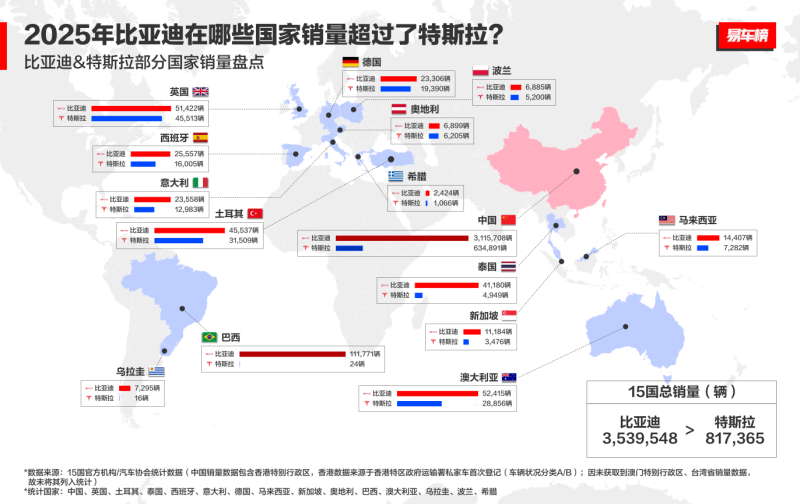
Core Insights - BYD has achieved over 4.6 million units in annual sales, maintaining its position as the world's leading electric vehicle manufacturer for the fourth consecutive year, with significant growth in overseas markets [1] Group 1: Market Performance - In Germany, BYD sold 2,629 new vehicles in January 2026, a remarkable increase of approximately 10.18 times compared to 235 units in January 2025, indicating strong market penetration [2] - For the entire year of 2025, BYD's passenger car registrations in Germany reached 23,306 units, representing an increase of over 7 times from 2024 [2] - In the UK, BYD registered 4,021 new energy vehicles in January 2026, a substantial year-on-year growth of 149.13%, reinforcing its influence in the European market [2] Group 2: Overseas Business Growth - The breakthrough in traditional automotive markets like Germany and the UK marks a significant phase in BYD's global strategy, driving high-speed development [3] - BYD's overseas sales surpassed 1 million units for the first time in 2025, with a year-on-year growth of over 140%, establishing it as a key representative of Chinese automotive exports [6] - In January 2026, BYD's overseas sales reached 100,500 units, reflecting a year-on-year increase of over 43% [6] Group 3: Globalization of Sales Structure - The share of overseas sales in BYD's total sales has significantly increased, from 1.87% in 2020 to 22.81% in 2025, meaning that approximately 2 out of every 9 vehicles sold are exported [7] - In January 2026, overseas sales accounted for 47.84% of total sales, nearing half of the overall sales volume [7] Group 4: Competitive Positioning - In 2025, BYD's pure electric vehicle sales reached 2.257 million units, surpassing Tesla for the first time and leading the global automotive industry [9] - Analysts suggest that BYD's rapid overseas market performance validates its global product strength and supply chain resilience, marking a transition to a dual-driven development model [10] Group 5: Strategic Initiatives - To support expanding overseas demand, BYD is accelerating its localization efforts, with factories in Thailand, Uzbekistan, and Brazil already operational, and a European factory in Hungary expected to start production in Q2 2026 [11] - BYD has also established a fleet of 8 roll-on/roll-off ships to enhance logistics stability and efficiency, crucial for its rapid overseas expansion [13] - The company aims for overseas sales of 1.3 million units in 2026, leveraging its product strength and global strategy to reshape the competitive landscape of the automotive industry [13]


十论广货③丨“广货行天下”需瞄准三大市场
Sou Hu Cai Jing· 2026-02-06 00:18
Core Viewpoint - The development of service consumption is crucial for China's economic growth, with a significant gap compared to developed countries, where service consumption accounts for over 60% of total consumption, while China is projected to reach 46.1% by 2025 [2] Group 1: Service Consumption Trends - There is a consensus among provinces to boost service consumption to fill the consumption gap, with predictions indicating that service consumption will exceed 50% of total consumption during the 14th Five-Year Plan period [2] - The relationship between service consumption and goods consumption is interdependent, with both sectors necessary for driving domestic demand [3] Group 2: Market Opportunities for "Guangdong Goods" - The overseas market presents new opportunities for "Guangdong goods," transitioning from low-margin manufacturing to high-quality brand exports, with increasing demand in Southeast Asia, Europe, and Latin America [4] - The Guangdong-Hong Kong-Macau Greater Bay Area, with over 80 million residents, serves as a testing ground for product optimization and service enhancement, catering to both high-end and cost-effective consumer demands [4] Group 3: Untapped Markets - There is significant potential in lower-tier markets, particularly in rural areas, where consumers prioritize value for money, aligning with the traditional strengths of "Guangdong goods" [5] - The evolution of "Guangdong goods" must focus on creating trends and markets, with future consumption expected to lean towards smart, green, differentiated, and emotional products [5] Group 4: Regional Economic Development - The initiative "Guangdong Goods Go Global" symbolizes a broader trend among provinces to cultivate regional products as economic drivers, with Guangdong aiming to maintain its leadership in consumption and contribute to national economic growth [6]
“广货行天下”需瞄准三大市场
2 1 Shi Ji Jing Ji Bao Dao· 2026-02-05 22:23
Core Viewpoint - The development of service consumption is crucial for China's economic growth, with a significant gap compared to developed countries, indicating a vast potential for growth in this sector [2][3] Group 1: Service Consumption Trends - By 2025, the proportion of per capita service consumption expenditure in China is expected to reach 46.1%, while developed countries typically exceed 60%, with some even over 70% [2] - It is predicted that during the 14th Five-Year Plan period, service consumption will account for over 50% of total consumption, marking an irreversible trend [2] Group 2: Relationship Between Service and Goods Consumption - Both service and goods consumption are essential for expanding domestic demand, with service consumption focusing on growth and goods consumption on quality improvement [3] - The tourism sector exemplifies this relationship, with over 6.5 billion domestic tourist trips expected by 2025, highlighting the interconnectedness of service and goods consumption [3] Group 3: Market Opportunities for "Guangdong Goods" - The overseas market presents new opportunities for Guangdong goods, transitioning from low-margin exports to high-quality brand exports, particularly in emerging markets like Southeast Asia and Europe [4] - The Guangdong-Hong Kong-Macao Greater Bay Area, with over 80 million residents, serves as a significant market for both high-end and cost-effective products, providing a testing ground for product optimization [4] - The untapped potential in lower-tier markets, particularly in rural areas, offers significant opportunities for Guangdong goods, focusing on quality-price ratios rather than premium pricing [4] Group 4: Future Directions for Guangdong Goods - Future consumption trends are expected to lean towards intelligence, sustainability, differentiation, and emotional connection, where Guangdong has competitive advantages [5] - Guangdong's digital economy and advancements in AI and IoT are leading to innovative products, while the focus on green products aligns with global consumption trends [5] - The integration of local cultural elements into products enhances emotional value, appealing to younger consumers [5]
比亚迪2月5日全情报分析报告:「2025比亚迪新能源汽车表现亮眼」对股价有积极影响
36氪· 2026-02-05 14:10
Core Viewpoint - BYD has demonstrated significant leadership in the Chinese electric vehicle market, achieving a sales volume of 4.602 million units in 2025, which positions it at the top of the industry rankings [6][10]. Sales Performance - BYD's stock price increased by 1.09% to 90.11, with a trading volume of 258,400 hands and a turnover rate of 1.02% [5][6]. - The company experienced a 3-day decline of 1.93% and a 5-day decline of 4.50%, with a total market capitalization of 821.6 billion [6][10]. Market Sentiment - As of February 5, the total online sentiment regarding BYD was 46,641 pieces of information, with 32,868 positive mentions (70.5%), 479 negative mentions (1.0%), and 13,294 neutral mentions (28.5%), indicating a strong positive sentiment [7][10]. Competitive Advantages - BYD's leadership in sales is attributed to its comprehensive industry chain layout and technological advantages, including the blade battery technology, which enhances its product offerings [10][11]. - The diverse product matrix covers high, medium, and low-end markets, catering to various consumer needs and increasing market share [10][11]. International Expansion - BYD's overseas sales surpassed 1 million units for the first time, reflecting its capability for global market expansion and contributing positively to its revenue [10][11]. Technological Development - The company is advancing in smart driving technology, collaborating with partners like Changan and Leap Motor, which positions BYD favorably in future automotive technology competition [10][11]. Long-term Outlook - The combination of sales leadership, technological innovation, global market expansion, and smart driving technology development is expected to support BYD's stock price and long-term growth [11].

纯电动汽车销量登顶全球榜首!比亚迪重构全球新能源汽车格局
Chang Sha Wan Bao· 2026-02-05 09:54
Core Insights - In 2025, BYD surpassed Tesla with a total of 2.257 million pure electric vehicle sales, marking a historic shift in the global electric vehicle industry [1] - This achievement reflects the systematic innovation and strategic globalization of Chinese automotive brands, establishing a leading position in the core track of the global automotive industry [1] Group 1: Technological Advancements - BYD's success is built on a robust full-industry chain technology moat, with key innovations such as the "Tian Shen Eye" driver assistance system and "Super e-platform Mega Flash Charging" [1] - The vertical integration of its supply chain ensures rapid iteration of technology and products, providing a competitive edge in global markets [1] Group 2: Market Performance - In Europe, BYD transitioned from a single product approach to a systematic breakthrough, achieving over 50,000 sales in the UK, a 485% year-on-year increase [3] - In traditional automotive strongholds like Germany, Spain, and Italy, annual sales exceeded 20,000 units [3] - In emerging markets like Turkey and Thailand, annual sales reached 45,000 and 41,000 units respectively, with local production significantly enhancing market dominance [3] Group 3: Global Expansion Strategy - BYD's dual strategy of "going global" and "localization" has led to its presence in 119 countries and regions, with overseas sales surpassing one million units in 2025 [4] - The establishment of production facilities in Thailand, Brazil, Uzbekistan, and the upcoming factory in Hungary reflects a commitment to localize operations, shorten delivery times, and meet market demands [4] - BYD's ascent signifies a new phase in global automotive competition, demonstrating the capability of the Chinese automotive industry to lead in technology-intensive high-end manufacturing [4]
谁是“中国汽车第一城”?
Jing Ji Guan Cha Bao· 2026-01-19 10:19
Group 1: Automotive Industry Landscape in China - The competition for the title of "China's Automotive Capital" has evolved from mere production volume to a comprehensive contest of development models and industrial ecosystems by 2025 [1][2] - Chongqing has secured the title of "China's Automotive Capital" for 2025 with an annual production of approximately 2.788 million vehicles, marking a 9.7% increase, and a significant growth in new energy vehicle (NEV) production [2][3] - The Chengdu region, while not leading in production, has achieved rapid growth through collaborations with major companies like FAW and Volkswagen, indicating a strategic shift towards leveraging existing industrial bases [2][4] Group 2: Regional Developments in the Automotive Sector - The Yangtze River Delta, particularly Hefei, has emerged as a strong player in the NEV sector, achieving the highest NEV production in the country by November 2025, with a total of 1.246 million units produced [7][8] - Hefei's growth is attributed to its "investment-driven" model, which has attracted significant projects from major automotive players, enhancing its position in the NEV market [8][9] - The Greater Bay Area, particularly Guangzhou and Shenzhen, has seen a shift in automotive production dynamics, with Shenzhen overtaking Guangzhou in 2024, while Guangzhou faces challenges in transitioning from traditional fuel vehicles to electric and smart vehicles [11][12] Group 3: Strategic Collaborations and Innovations - The collaboration between local companies like Seres and tech giants such as Huawei has been pivotal for Chongqing's automotive growth, leading to significant sales and product price increases [3][4] - Chengdu's strategy of forming partnerships with established brands like Volkswagen to create new local brands, such as the New Jetta, reflects a pragmatic approach to industrial development [4][5] - The Long Triangle region has initiated a collaborative framework to enhance the global competitiveness of its NEV sector, indicating a shift towards cooperative strategies among cities [10] Group 4: Challenges and Future Outlook - The automotive industry in China faces challenges such as the sustainability of Seres' high-end market position and the successful transition of the New Jetta brand to electric vehicles [6] - The competitive landscape is evolving, with cities needing to adapt to the changing dynamics of the automotive market, including the need for innovation and collaboration to maintain relevance [9][14] - Guangzhou's automotive sector is under pressure to balance the transition from traditional vehicles to new energy models while addressing the mismatch in its supply chain [12][14]

“中国汽车第一城”争夺战
Jing Ji Guan Cha Wang· 2026-01-18 09:53
Group 1 - The competition for "China's Automotive Capital" has evolved from a focus on production volume to a comprehensive contest of development models and industrial ecosystems by 2025 [2] - Chongqing has secured the title of "China's Automotive Capital" with an annual production of nearly 2.8 million vehicles, driven by the success of Seres and the steady growth of Changan Automobile [3][4] - Chengdu, while not in the top tier, has achieved rapid automotive industry growth through collaborations with FAW and industrial synergies with Chongqing [2][3] Group 2 - Hefei has emerged as a significant player in the new energy vehicle sector, achieving the highest production of new energy vehicles in China by November 2025, with a production of 1.25 million units [2][10] - The automotive industry in the Yangtze River Delta is becoming more diversified, with Anhui's automotive production reaching 2.76 million vehicles, indicating a shift from Shanghai's dominance [8][9] - The collaboration between Chengdu and Chongqing aims to enhance regional cooperation in the automotive industry, with a focus on breaking the previous competitive mindset [6][7] Group 3 - The Seres brand, in partnership with Huawei, has significantly contributed to Chongqing's automotive growth, with over 420,000 vehicles delivered in 2025 [4][5] - Chengdu's automotive production reached 820,000 units by November 2025, with a remarkable 198.3% increase in new energy vehicle production [5] - The new Jetta brand in Chengdu aims to become a leading enterprise in the province's automotive industry, focusing on electric vehicle transformation [6] Group 4 - The automotive industry in Guangdong has faced challenges, with Guangzhou's production declining significantly, while Shenzhen has taken the lead in both overall and new energy vehicle production [12][14] - BYD, based in Shenzhen, achieved a new energy vehicle production of 4.54 million units in 2025, becoming the global leader in this sector [12][13] - Guangzhou's automotive industry is under pressure to transform, with a focus on integrating traditional manufacturing with new technologies and exploring innovative areas like flying cars [14][15]
2025资本市场年度人物盘点:老将承压,新生代突围
Nan Fang Du Shi Bao· 2026-01-07 04:17
Group 1 - The core trend in the 2025 Chinese capital market indicates a shift from scale expansion to value return, emphasizing hard-core strength over conceptual speculation [2] - The experiences of industry veterans and new generation entrepreneurs reflect the necessity of risk awareness, essence adherence, and innovation embrace to navigate market changes [2] Group 2 - The resignation of Vanke's former CEO, Zhu Jiusheng, marks a significant event in the real estate sector, highlighting the vulnerabilities of high-leverage models amid industry downturns [4] - Xiaomi's CEO Lei Jun faces challenges in the automotive sector, where safety concerns and brand reputation are critical as consumer expectations evolve from mere production to quality [6] - BYD's Wang Chuanfu celebrates record sales of 4.6024 million electric vehicles globally, yet faces declining domestic revenue and profit, indicating the need for technological depth and operational excellence [8] Group 3 - The emergence of new entrepreneurs like Liu Jingkang, who launched a drone brand to compete with DJI, illustrates the survival imperative of differentiation in a competitive landscape [11] - Peng Zhihui's transition from Huawei employee to entrepreneur showcases the capital market's recognition of technical talent, but the challenge remains in converting technical prowess into sustainable profits [13] - Wang Xingxing's company, Yushutech, aims for an IPO, representing the maturation of the embodied intelligence sector, where commercialization and market expectations will dictate future success [15] Group 4 - Bubble Mart's founder Wang Ning experiences a volatile year, with significant revenue growth followed by a sharp decline in stock price, emphasizing the need to shift from reliance on hit products to ecosystem building [20] - Cambricon's Chen Tian Shi sees a turnaround with consecutive profitable quarters, driven by AI computing demand, highlighting the importance of technological barriers and ecosystem development in hard tech [22] - Liang Wenfeng's low-profile yet impactful contributions in AI through DeepSeek demonstrate that sustained innovation is crucial for success in the artificial intelligence era [24][25]

全球车企市值“大洗牌”
财联社· 2026-01-05 14:08
Core Viewpoint - The update of global automotive companies' market capitalization rankings reflects the competitive landscape and industry status of both Chinese and foreign automakers, indicating a significant transformation in the automotive industry [1] Group 1: Global Market Capitalization Rankings - As of December 31, 2025, the top four companies in the global automotive market capitalization are Tesla, Toyota, Xiaomi, and BYD, with their rankings unchanged from the previous year but with increased market values [1] - The rankings from fifth to tenth place have seen significant changes, with BMW, Mercedes-Benz, and Volkswagen improving their positions, while Porsche dropped out of the top ten, replaced by Maruti Suzuki from India [1][2] - The market capitalization of Tesla reached $149.569 billion, an increase of $19.934 billion from 2024, while BYD's market capitalization was $130.23 billion, up by $22.38 billion [2] Group 2: Performance of Key Companies - Xiaomi's market capitalization rose to $131.49 billion, reflecting a growth of $19.48 billion, and the company aims to deliver 550,000 vehicles in 2026, having delivered over 410,000 vehicles in 2025 [2][3] - BYD's market capitalization of $130.23 billion places it fourth globally, significantly ahead of General Motors, Mercedes-Benz, and BMW, with a total of 4.602 million new energy vehicles sold in 2025, marking a 7.73% year-on-year increase [3][4] - The performance of Xiaomi and BYD highlights a divergence in market perception, with Xiaomi benefiting from its "ecosystem premium" compared to BYD's traditional manufacturing focus [4] Group 3: Chinese Automotive Market Landscape - As of December 31, 2025, 19 Chinese companies made it into the global top 50 automotive market capitalization rankings, a decrease of two from 2024, including traditional automakers like Great Wall and new entrants like Xpeng and Li Auto [5] - The rise of companies like Seres, which moved up to 18th place, is attributed to strong product performance and successful market strategies [4][5] - The outlook for 2026 suggests that advancements in L3 automation will become a new benchmark for evaluating the market capitalization of Chinese automakers, with several companies already making progress in this area [6]

目标完成!比亚迪年销460万辆
Xin Lang Cai Jing· 2026-01-04 01:19
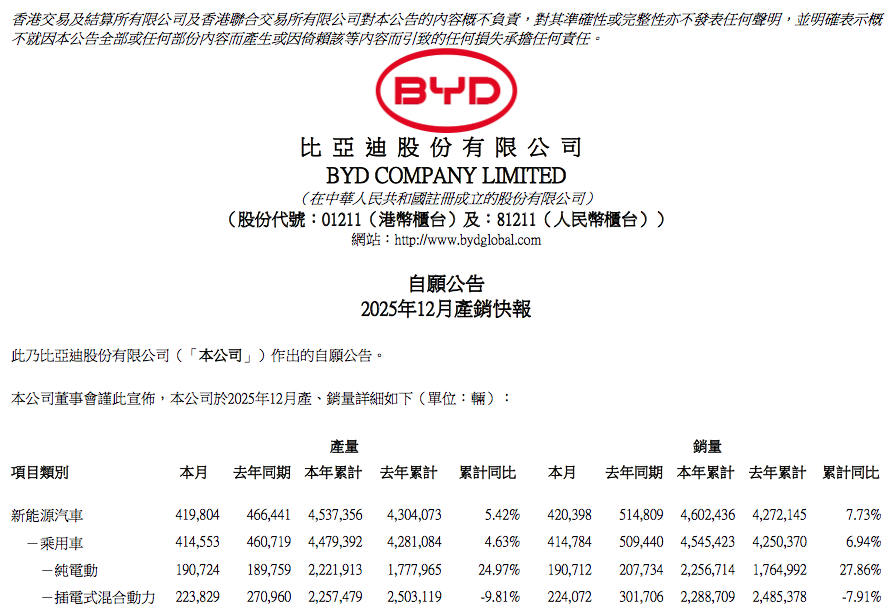
Core Viewpoint - BYD reported its December 2025 and full-year sales data, showing a total of 420,400 electric vehicles sold in December, with a total annual sales of 4,602,436 units, reflecting a year-on-year growth of 7.73% [1][9]. Sales Data Summary - In December 2025, BYD's total sales of new energy vehicles reached 420,400 units, including 414,800 passenger cars, 190,700 pure electric vehicles, and 223,800 plug-in hybrid vehicles [1][2]. - For the entire year of 2025, BYD's cumulative sales of new energy vehicles amounted to 4,602,436 units, with passenger car sales at 4,545,423 units, pure electric vehicle sales at 2,256,714 units (up 27.86%), and plug-in hybrid vehicle sales at 2,288,709 units (down 7.91%) [1][2][12]. Brand Performance - The Dynasty and Ocean networks contributed significantly to sales, with December sales of 344,900 units, including 155,436 units from the Dynasty network and 188,838 units from the Ocean network [3][13]. - The Dynasty network's annual cumulative sales reached 1,885,203 units, while the Ocean network's annual sales totaled 2,220,008 units [4][14]. Export Performance - In December, BYD exported 133,200 new energy vehicles, with total overseas sales for 2025 exceeding 1 million units, marking a 145% year-on-year increase [10][19]. - The company is enhancing its competitiveness in overseas markets through localized production and self-shipping strategies to mitigate high tariffs in regions like Europe and the US [19]. Milestones - BYD announced the production of its 15 millionth new energy vehicle on December 18, 2025, highlighting a significant milestone for the Chinese automotive industry [10][19].