房企亏损

Search documents
上市房企,批量亏损!
Sou Hu Cai Jing· 2026-01-20 11:20
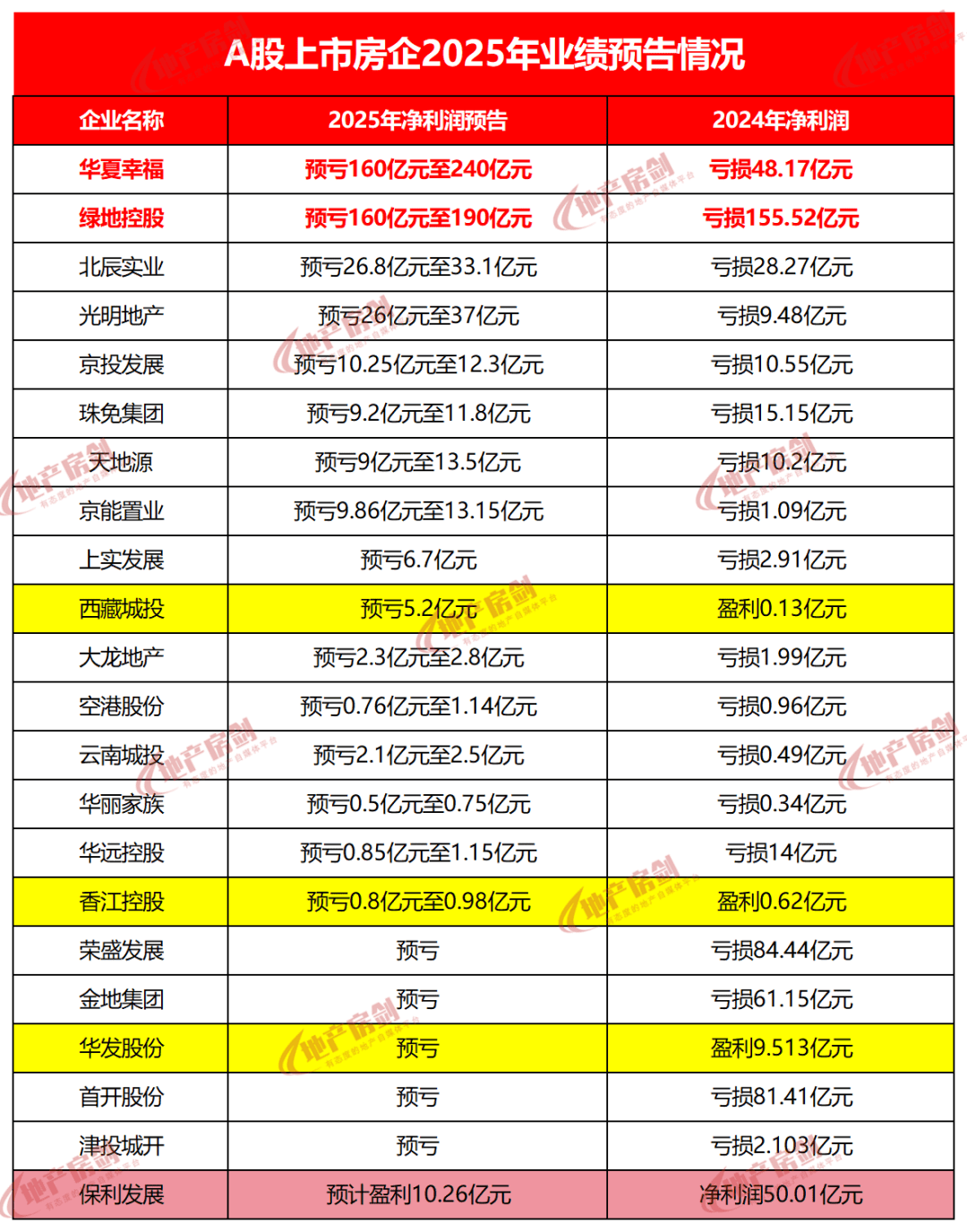
Core Viewpoint - The photovoltaic and real estate industries are experiencing significant losses, with the real estate sector facing even more severe challenges as many companies, including state-owned enterprises, are projected to report substantial losses in 2025 [1][5]. Summary by Sections Photovoltaic Industry Losses - Tongwei Co. is expected to report a loss of 9 to 10 billion yuan, TCL Zhonghuan is projected to lose 9.2 to 9.6 billion yuan, LONGi Green Energy is expected to lose 6 to 6.5 billion yuan, and JA Solar is projected to lose 4.5 to 4.8 billion yuan in 2025 [1]. Real Estate Industry Losses - As of January 19, 2026, 22 A-share listed real estate companies have released their 2025 performance forecasts, with only Poly Development expected to be profitable, while the other 21 companies are projected to incur losses [1][3]. - Poly Development anticipates a net profit of 1.026 billion yuan in 2025, a significant decrease of 79.49% compared to 2024, despite a slight revenue decline of 1.09% [4]. Major Losses Among Real Estate Companies - China Fortune Land Development and Greenland Holdings are expected to report losses exceeding 10 billion yuan, with China Fortune Land Development projected to lose between 16 to 24 billion yuan and Greenland Holdings expected to lose between 16 to 19 billion yuan [6][7]. - Other companies such as Beichen Industrial, Guangming Real Estate, and Jingtou Development are also expected to report losses exceeding 1 billion yuan [7]. Shift from Profit to Loss - Companies like Huafa Holdings and Tibet Urban Investment, which were profitable in 2024, are projected to report losses in 2025, marking a significant shift in their financial performance [8]. - The overall trend indicates that many companies are facing unprecedented challenges, with some experiencing their first losses in decades [1][8]. Market Conditions and Profitability - The decline in profitability across the real estate sector is attributed to a prolonged downturn in housing prices, leading to asset impairment and reduced profit margins [15][16]. - The average gross margin for major real estate companies has decreased significantly, with some companies reporting net profit margins as low as 2.27% [16]. Broader Implications - The losses are not confined to private enterprises; state-owned and central enterprises are also affected, indicating a systemic issue within the real estate market [17]. - The perception of the real estate industry as a high-profit sector is changing, as many companies are now struggling to maintain profitability amid challenging market conditions [16][17].


房企再现大面积亏损
第一财经· 2026-01-20 10:53
Core Viewpoint - The real estate sector is facing widespread losses, with most A-share listed real estate companies reporting varying degrees of losses for 2025, except for the leading company, Poly Developments [3][4]. Group 1: Financial Performance of Real Estate Companies - As of January 20, 2026, 27 real estate companies have released their 2025 performance forecasts, with total losses estimated between 47.546 billion and 62.464 billion yuan [5]. - Poly Developments reported a net profit of approximately 1.026 billion yuan for 2025, a decrease of 79.49% year-on-year, with revenue around 308.261 billion yuan, down 1.09% [5][6]. - Other companies, such as China Fortune Land Development, are expected to incur losses between 16 billion and 24 billion yuan for 2025, with net assets potentially declining by 10 billion to 15 billion yuan [6][7]. Group 2: Reasons for Losses - The significant losses are attributed to factors such as reduced project turnover, high debt levels, increased financial costs, and asset impairment losses [6][9]. - Companies like Greenland Holdings are also facing substantial losses, with projections of net losses between 16 billion and 19 billion yuan for 2025, reflecting a cumulative loss exceeding 40 billion yuan from 2023 to 2025 [7][8]. Group 3: Market Conditions and Future Outlook - The real estate market has been in a state of decline since 2022, with a projected 12.6% decrease in new residential sales in 2025 [10][11]. - The market is still in a "de-stocking" phase, with a total unsold housing area of 766 million square meters, up 1.6% year-on-year [10][11]. - Analysts suggest that the recovery of the real estate market is crucial for improving company performance, with potential for profit recovery if market activity increases in key cities [11]. Group 4: Risks of Delisting - Companies facing continuous large losses may encounter delisting risks, particularly if they fail to meet financial performance criteria or regulatory requirements [11][12]. - Specific delisting categories include trading-related, financial-related, and regulatory-related delistings, which could impact companies like China Fortune Land Development [12].

中指研究:截至2025年8月20家出险房企债务重组、重整获批 化债超1.2万亿元
智通财经网· 2025-08-21 08:14
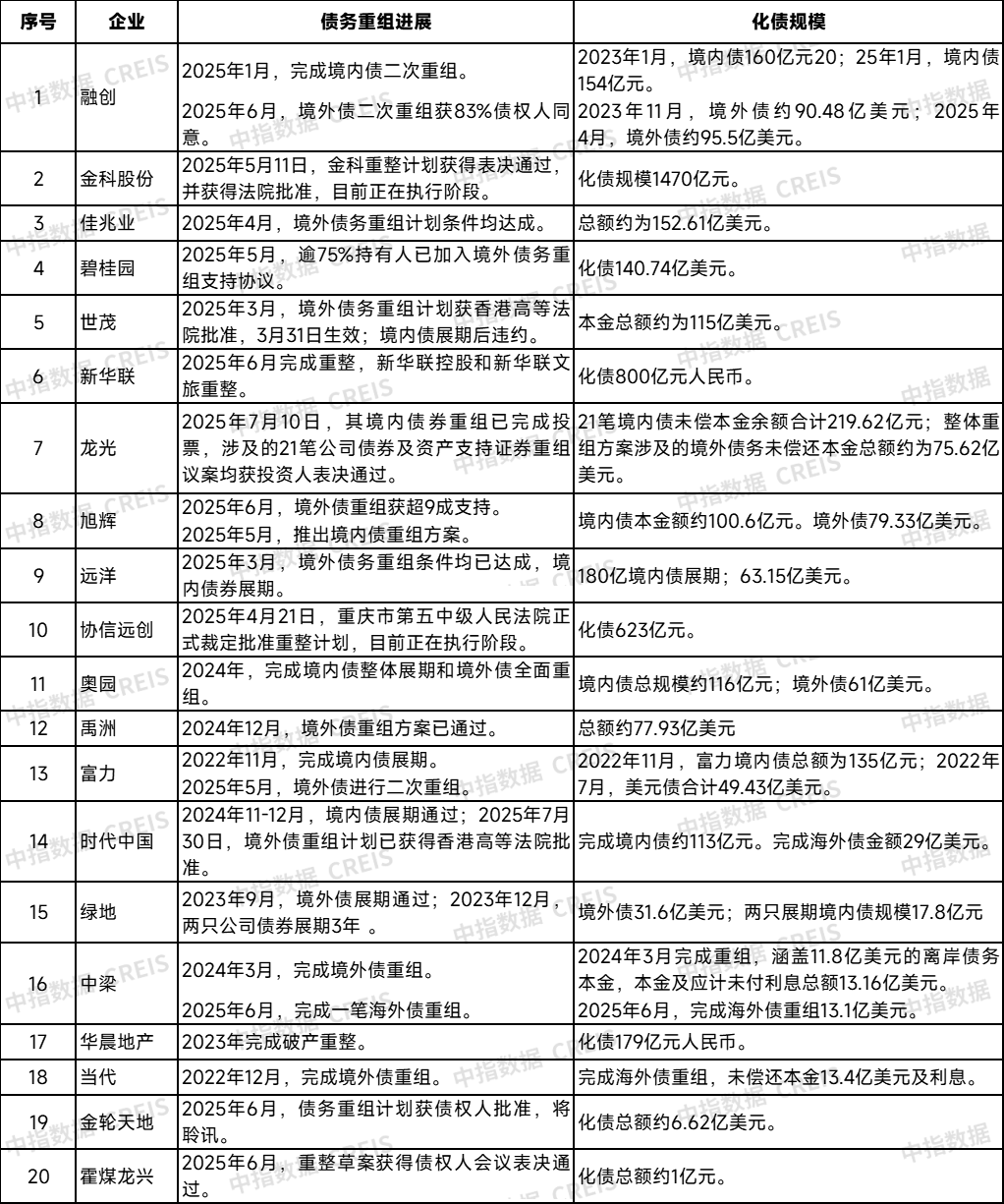
Group 1 - As of August 2025, 20 distressed real estate companies have received approval for debt restructuring and reorganization, with a total debt resolution scale exceeding 1.2 trillion RMB [1][2] - The companies that completed domestic and overseas debt restructuring include Sunac, R&F, Aoyuan, and others, with significant amounts of debt involved [2][4] - The restructuring efforts are a response to the deep market impact and operational challenges faced by real estate companies since 2022, leading to 27 listed companies being passively delisted [6] Group 2 - From 2020 to 2025, over 70 real estate companies experienced debt defaults, with 44 defaults occurring in 2022 alone, indicating a severe industry crisis [6] - The majority of listed real estate companies are facing significant financial difficulties, with 63.4% of 71 companies reporting losses in the first half of 2025, an increase from the previous year [9] - Many companies are divesting from real estate development to transition to lighter asset models, driven by both proactive transformation and the need to protect their market positions [6]