
房企退市潮

Search documents
房企“退市潮”或将持续2-3年
3 6 Ke· 2025-11-05 02:22
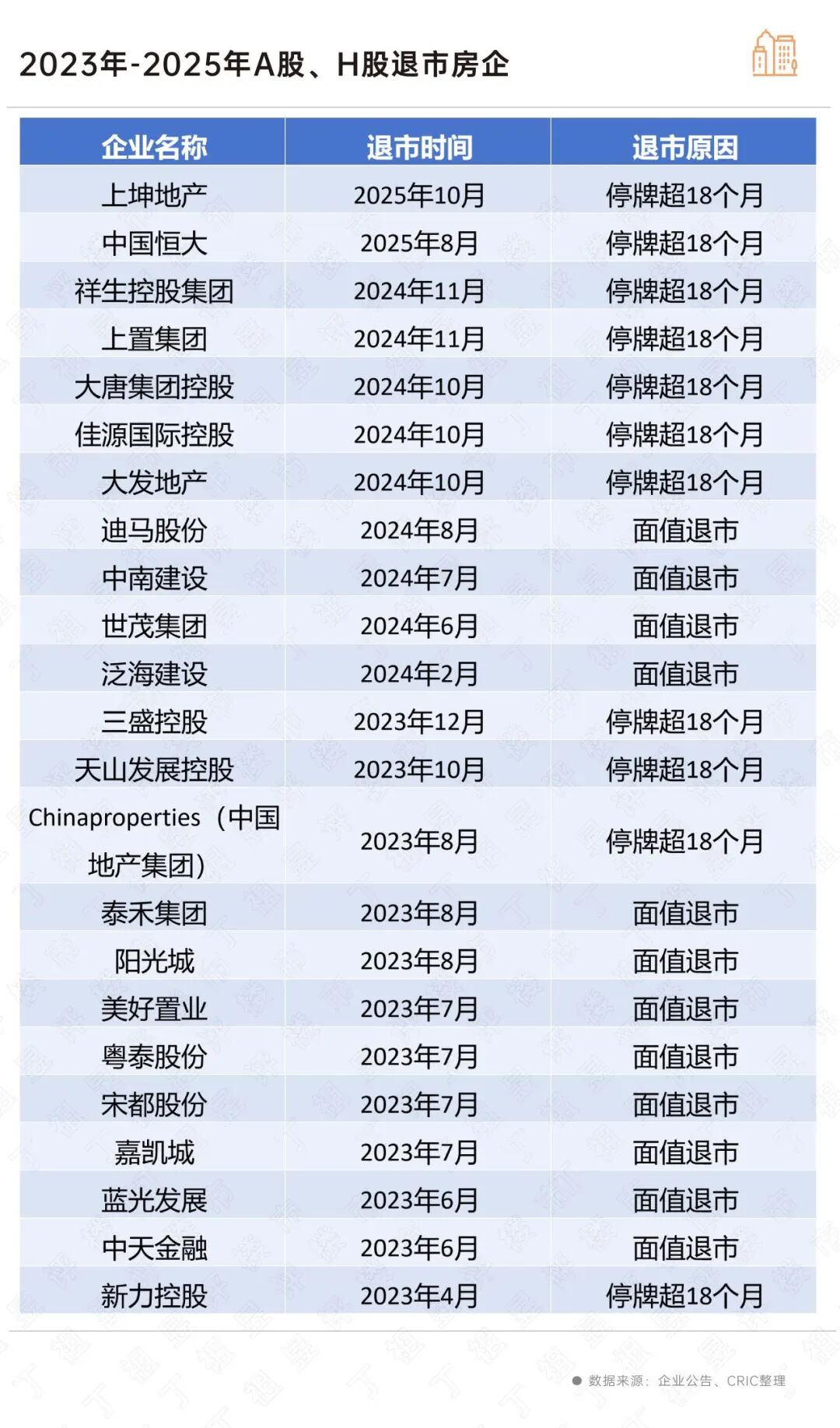
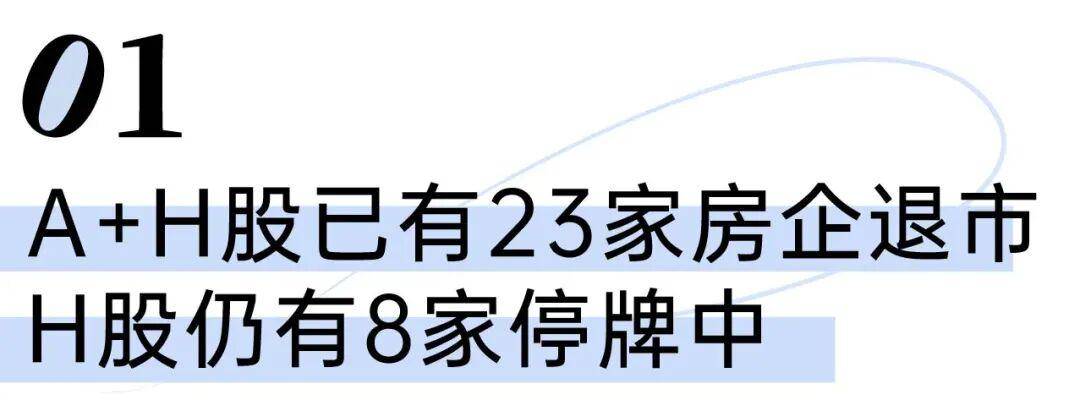
Core Insights - The article highlights the ongoing trend of listed real estate companies in China exiting the capital market, with both passive and active delistings becoming more prevalent [2][12]. Group 1: Delisting Trends - In October 2023, two listed real estate companies, Winking Real Estate and Upkun Real Estate, announced their exit from the capital market [1]. - Since the beginning of 2023, nearly 23 listed real estate companies have delisted from A+H shares, with 7 opting for privatization since 2021 [2][6]. - The delisting trend is characterized by a significant number of companies facing forced delisting due to prolonged trading suspensions, with Upkun Real Estate being the latest to be mandated to delist by the Hong Kong Stock Exchange [3][4]. Group 2: Reasons for Delisting - The primary reasons for delisting include liquidity crises, continuous performance declines, and failure to meet reporting requirements, leading to long-term trading suspensions [5][14]. - The article notes that as of October 27, 2025, 12 A-share real estate companies have been delisted, with 8 of them occurring in 2023 due to stock prices falling below the 1 yuan threshold for 20 consecutive trading days [7]. Group 3: Privatization as a Strategy - The number of companies choosing to privatize has increased, indicating a strategic shift in response to market pressures and operational challenges [12]. - Companies like Winking Real Estate and Dayue City Real Estate are considering privatization as a means to enhance operational flexibility and reduce regulatory burdens [15]. - The article emphasizes that privatization is not merely a reaction to current challenges but a strategic move for long-term restructuring and value reconstruction in a deeply adjusted industry [16].

近30家上市房企退市,“退市潮”或将持续2-3年
Sou Hu Cai Jing· 2025-11-05 02:07
Core Viewpoint - The recent trend of listed real estate companies exiting the capital market is characterized by a predominance of passive delistings and an increase in active privatization delistings, indicating a significant restructuring and reshuffling within the industry over the next 2-3 years [1][11]. Summary by Sections Delisting Trends - In October 2023, two listed real estate companies, Winking Property and the previously high-performing Shankun Property, announced their exit from the capital market [1]. - Since the first delisting of New Power Holdings in 2023, nearly 23 listed real estate companies have exited the A+H share market within three years, with 7 companies opting for privatization since 2021 [1][2]. Reasons for Delisting - The delisting of companies like Shankun Property and Evergrande reflects a broader trend of performance decline among listed real estate firms due to liquidity crises and ongoing industry adjustments [2]. - Companies listed on the Hong Kong Stock Exchange face mandatory delisting if they remain suspended for 18 months, while A-share companies often trigger delisting due to stock prices falling below 1 yuan for 20 consecutive trading days [2][3]. Privatization Movement - The number of companies choosing to privatize has notably increased, with several firms, including Winking Property and Dayue City, considering privatization as a strategic response to market pressures [7][9]. - The reasons for privatization include ongoing market and operational pressures, the need for strategic adjustments, and the desire to enhance operational efficiency [9][10]. Financial Performance - Winking Property has reported continuous losses since 2022, with a significant loss of 3.26 billion yuan in 2024, highlighting the financial pressures driving privatization decisions [9]. - The sales revenue of Winking Property has drastically decreased from 26 billion yuan in 2021 to 7.02 billion yuan in 2024, further emphasizing the challenges faced by the company [9]. Future Outlook - The combination of passive delistings and active privatizations illustrates the current phase of "clearing" and "restructuring" within the industry, suggesting that this trend will continue in the coming years [11].
评司论企|上坤退市、五矿私有化,房企退市潮何时休?
克而瑞地产研究· 2025-10-29 09:26
Core Viewpoint - The article discusses the ongoing trend of delisting among real estate companies in Hong Kong and A-shares, highlighting the reasons behind privatization and delisting, as well as the potential future of this trend in the industry [2][9]. Group 1: Delisting Trends - On October 22, it was announced that Shangkun Real Estate would officially delist on October 27 due to failure to meet resumption guidelines, marking another case of a real estate company being forced to delist after Evergrande's delisting on August 25 [2]. - Since April 2023, a total of 11 H-share real estate companies have been mandated to delist, including major players like China Evergrande [4]. - As of September 2025, there are still 8 H-share real estate companies under suspension, with potential delisting risks if they do not resume trading [5]. Group 2: A-share vs H-share Delisting - A-share companies face delisting primarily due to stock prices falling below RMB 1 per share for 20 consecutive trading days, while H-share companies are more affected by liquidity crises and inability to publish annual reports [6]. - Following the favorable policies introduced in 2024, A-share real estate companies have seen a recovery in confidence, distancing themselves from the delisting risk associated with low stock prices [6]. Group 3: Reasons for Privatization and Delisting - The main reasons for privatization and delisting among real estate companies include insufficient stock liquidity, loss of financing capabilities, and continuous losses leading to debt crises [11]. - Privatization allows companies to implement long-term strategies and enhance operational flexibility, reducing regulatory burdens and costs associated with being a public company [11]. - The challenging market environment, characterized by declining sales and low valuations, further drives companies towards privatization to avoid valuation discounts [12]. Group 4: Future Outlook - The trend of passive delisting and privatization is seen as a necessary outcome during the deep adjustment period of the real estate industry, with expectations that this trend will continue for the next 2-3 years [12]. - Companies are urged to adapt to market changes through strategic adjustments and operational optimizations to address the challenges posed by declining valuations and potential delisting risks [12].

两大知名房企,宣布退市
3 6 Ke· 2025-10-29 03:03
Group 1 - The trend of delisting in the real estate sector continues, with two Hong Kong-listed companies, Upkun Properties and WISCO Properties, announcing their delisting within a week [1][3] - Upkun Properties will have its listing status officially canceled on October 27, 2025, due to failure to publish its annual report and a cross-default on its 13.5% senior notes [1][2] - WISCO Properties has announced a voluntary privatization plan, with a share cancellation price of HKD 1, representing a premium of approximately 104.08% over the last trading day [3] Group 2 - Upkun Properties faced significant management and financial staff turnover, which severely impacted the preparation and auditing of financial statements [2] - WISCO Properties has reported three consecutive years of losses since 2022, with its chairman emphasizing the need to ensure the company's survival and improve its financial health [3] - Several other listed real estate companies have also delisted from the Hong Kong stock market, indicating a broader trend in the industry [4]
强制退市与私有化并行,港股上市房企暗淡离场
Xin Lang Cai Jing· 2025-10-28 03:00
Core Viewpoint - China Minmetals Corporation's real estate platform, Minmetals Land, has announced its privatization and delisting from the Hong Kong Stock Exchange, reflecting a broader trend of real estate companies exiting the market amid industry adjustments and capital restructuring [1][3][5]. Company Summary - Minmetals Land is being privatized by June Glory International Limited, a subsidiary of China Minmetals, with a proposed cash offer of HKD 1 per share, representing a premium of approximately 185.71% over the unaffected share price and 104.08% over the last trading day [2][3]. - The company has issued 3.347 billion shares, with June Glory holding 2.071 billion shares (approximately 61.88%) and other shareholders holding 1.276 billion shares (approximately 38.12%) [2]. - Minmetals Land has faced limited capital raising capabilities and has lost the advantages of being a listed company, with average daily trading volume of only 440,000 shares, representing about 0.03% of the total shares [3][4]. Industry Summary - The Hong Kong Stock Exchange was once the preferred financing platform for mainland real estate companies, but many have announced their delisting this year due to performance pressures and the loss of financing value [5][6]. - The real estate sector is undergoing a deep adjustment, with companies facing low liquidity and the loss of capital market value, leading to a trend of privatization and delisting [7][8]. - The current market environment has resulted in many companies experiencing continuous losses and a lack of new land reserves, prompting strategic contractions and resource consolidation opportunities for parent companies [4][5][8].