
房地产行业深度调整

Search documents
龙湖集团:房地产经历五年深度调整,今年有望止跌回稳
Di Yi Cai Jing· 2026-03-27 07:25
Core Viewpoint - The real estate market is showing signs of recovery, particularly in the second-hand housing sector, which is expected to gradually boost demand for new housing replacements [1][2]. Group 1: Market Conditions - The real estate industry has undergone significant adjustments over the past five years, with notable declines in both construction and transaction volumes [1]. - The current adjustment in the real estate sector is substantial, but ongoing policy support is anticipated to stabilize the market, leading to a significant reduction in overall market declines this year [1]. - In the first quarter of this year, transaction volumes for second-hand homes in key cities have stabilized, and high-end new properties in prime locations are experiencing strong sales [1]. Group 2: Company Performance - In 2025, the company reported total revenue of 97.31 billion yuan, with real estate development contributing 70.54 billion yuan, operational business 14.19 billion yuan, and service business 12.58 billion yuan [2]. - The company's contract sales in the traditional development sector reached 63.16 billion yuan, with a total sales area of 5.186 million square meters and an average selling price of 12,179 yuan per square meter [2]. - The company’s operational business, which includes commercial investments and asset management, generated 14.19 billion yuan in revenue, reflecting a 1.6% increase from the previous year [2]. Group 3: Financial Health - The company’s service business achieved revenue of 12.58 billion yuan, with its smart living segment generating 11.23 billion yuan and managing approximately 360 million square meters [3]. - As of the end of 2025, the company’s total borrowings amounted to 152.81 billion yuan, a decrease of 23.51 billion yuan from the previous year, with an average financing cost of 3.51% [3]. - The company has successfully optimized its debt structure, with nearly 90% of interest-bearing debt sourced from bank financing, and has maintained positive operating cash flow for three consecutive years after capital expenditures [3].

招商蛇口(001979) - 招商蛇口2025年度业绩说明会暨投资者交流会活动记录表
2026-03-24 07:36
Group 1: Company Performance and Financial Overview - In 2025, the company reported a revenue of CNY 154.7 billion, a decrease of CNY 24.2 billion year-on-year, with a gross profit decline of CNY 4.8 billion [8][9] - The company recorded a provision for impairment losses of over CNY 4 billion in 2025 [9] - Depreciation for investment properties and fixed assets amounted to over CNY 3 billion in 2025 [9] Group 2: Strategic Advantages - The company benefits from the strong support of China Merchants Group, a state-owned enterprise with over 150 years of history, providing significant strategic resources [2] - The company has established a robust financial management system, maintaining a risk control framework that includes investment, cash flow, and debt structure [4] - The company has a comprehensive development capability across the entire industry chain, integrating development, operation, and service [5] Group 3: Market Conditions and Responses - The real estate market has experienced a significant downturn, with national new housing sales dropping from CNY 18 trillion in 2021 to around CNY 8 trillion in 2025, a decline of over 50% [10] - Recent policy adjustments, such as the easing of purchase and loan restrictions in core cities, have positively impacted market confidence, leading to a recovery in sales and visits [7] - The company plans to focus investments on core first-tier and strong second-tier cities, with 100% of investments in 30 key cities and nearly 90% in core ten cities by 2025 [7] Group 4: Future Strategies and Goals - The company aims to enhance its asset management capabilities, with a focus on commercial properties, apartments, and industrial parks, targeting a management revenue of CNY 7.63 billion in 2025 [21] - The company will continue to implement a "six good" investment system to ensure effective resource allocation and maintain financial stability [13] - The company anticipates a gradual recovery in the real estate market, with a focus on sustainable growth and profitability during the "14th Five-Year Plan" period [10] Group 5: Product Development and Customer Focus - The company emphasizes the importance of customer research to understand the evolving needs for improved housing, aiming to enhance product quality and service [25][26] - The company is committed to integrating technology into housing solutions, focusing on smart and sustainable living environments [26] - The company has established a team of chief designers and product managers to ensure high-quality product development and management [26]

深度调整,动态筑底 2025年房地产行业数据解读
Zhong Guo Jing Ji Wang· 2026-01-20 08:37
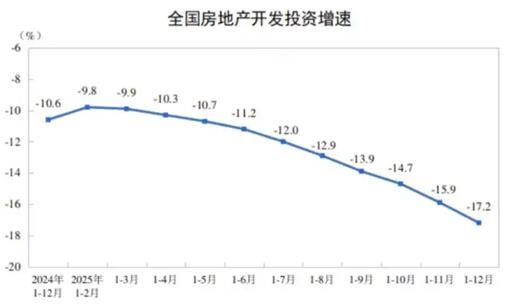
Core Insights - The real estate industry in China is undergoing a deep adjustment, with significant declines in investment and sales metrics for 2025 [1][3][5] Group 1: Investment and Sales Data - Real estate development investment reached 82,788 billion yuan in 2025, a year-on-year decrease of 17.2% [1] - The sales area of new commercial housing was 88,101 million square meters, down 8.7% year-on-year, while the sales amount was 83,937 billion yuan, reflecting a 12.6% decline [1] - The total construction area for real estate enterprises was 659,890 million square meters, a decrease of 10.0% year-on-year, with residential construction down 10.3% [3] Group 2: Market Dynamics - The new housing starts area was 58,770 million square meters, down 20.4%, indicating a continued downward trend in new construction [3] - The completion area of houses was 60,348 million square meters, down 18.1%, with residential completions declining by 20.2% [3] - The market is still in a "de-inventory" phase, influenced by declining new home sales and reduced land transactions over the past two years [3] Group 3: Company Performance - In 2025, ten real estate companies achieved sales exceeding 100 billion yuan, with four surpassing 200 billion yuan, including major players like Poly Development and China Overseas Land [5] - The top ten companies by investment are primarily state-owned enterprises, with significant contributions from China Overseas, China Resources, and Poly Development, which together account for over 30% of total investment [5] - These leading companies are leveraging core city demand to maintain operational resilience, while many private firms are still seeking opportunities to rebuild their core value [5] Group 4: Market Trends and Future Outlook - December 2025 showed signs of improvement, with new housing sales area increasing by 39.87% month-on-month and sales amount rising by 44.07% [7] - The price of new residential properties in first-tier cities saw a slight decrease of 0.3%, indicating a narrowing decline compared to previous months [7] - The second-hand housing market is gaining traction, with an increasing proportion of transactions occurring in this segment, as buyers often turn to second-hand homes to meet their housing needs [8]

私有化退市后,何剑波辞任五矿地产董事会主席
Xin Lang Cai Jing· 2025-11-14 01:38
Group 1 - The core point of the news is the resignation of He Jianbo as the executive director and chairman of Minmetals Land, effective November 13, 2025, due to personnel rotation and succession planning by China Minmetals Corporation [1] - Dai Pengyu has been appointed as the acting chairman and will assume multiple roles within the board until a new chairman is officially appointed [1] - Dai Pengyu has extensive experience in real estate management and has been with Minmetals Land since 2007, holding various senior management positions [1] Group 2 - Minmetals Land announced plans for privatization and delisting, with a maximum cash consideration of approximately HKD 1.276 billion, citing limited capital raising ability and loss of listing platform advantages [2] - The company has not raised funds through public markets since 2009, and the privatization is expected to enhance business flexibility and streamline corporate structure [2] - Minmetals Land is a key subsidiary of China Minmetals, which has a diverse portfolio of over 80 real estate projects across more than 20 cities in China [2] Group 3 - Minmetals Land has reported consecutive years of losses, with revenues of HKD 10.065 billion, HKD 12.631 billion, and HKD 9.883 billion from 2022 to 2024, and a significant loss of HKD 3.621 billion in the first half of 2024 [3] - The company previously set ambitious sales targets but has struggled to achieve them due to market adjustments [3] - Industry experts suggest that the delisting reflects a strategic contraction in the real estate sector, with many companies facing prolonged losses and a lack of new land reserves [3]
又一房企从港交所退市
Xin Lang Cai Jing· 2025-10-28 05:56
Core Viewpoint - China Minmetals Corporation's real estate platform, Minmetals Land, has announced its privatization and delisting from the Hong Kong Stock Exchange, reflecting a broader trend of real estate companies exiting the market amid industry adjustments and capital restructuring [2][3][4]. Company Summary - Minmetals Land is being privatized by June Glory International Limited, a subsidiary of China Minmetals, with a proposed cash offer of HKD 1 per share, representing a premium of approximately 185.71% over the last unaffected trading price [3]. - The company has issued 3.347 billion shares, with June Glory holding 2.071 billion shares (approximately 61.88%) and other shareholders holding 1.276 billion shares (approximately 38.12%) [3]. - Minmetals Land's trading volume has been low, averaging about 440,000 shares per day, which is only 0.03% of the total shares held by non-related shareholders [5]. - The company has faced significant financial challenges, reporting revenues of HKD 100.65 billion, HKD 126.31 billion, and HKD 98.83 billion for the years 2022 to 2024, with shareholder losses of HKD 13.62 billion, HKD 10.16 billion, and HKD 35.21 billion respectively [6]. Industry Summary - A number of real estate companies have announced their delisting from the Hong Kong Stock Exchange this year, categorized into voluntary privatization and involuntary delisting due to prolonged trading suspension [7][11]. - The Hong Kong Stock Exchange was previously a preferred platform for real estate financing, but the current market conditions have led to a loss of value and functionality for many listed companies [8][9]. - The ongoing deep adjustment in the real estate market has prompted companies to accelerate their exit from the capital market, as they face liquidity issues and diminished financing capabilities [10][11]. - The trend of delisting is expected to continue as companies seek to improve operational efficiency and reduce costs in a challenging market environment [11].
强制退市与私有化并行,港股上市房企暗淡离场
Xin Lang Cai Jing· 2025-10-28 03:00
Core Viewpoint - China Minmetals Corporation's real estate platform, Minmetals Land, has announced its privatization and delisting from the Hong Kong Stock Exchange, reflecting a broader trend of real estate companies exiting the market amid industry adjustments and capital restructuring [1][3][5]. Company Summary - Minmetals Land is being privatized by June Glory International Limited, a subsidiary of China Minmetals, with a proposed cash offer of HKD 1 per share, representing a premium of approximately 185.71% over the unaffected share price and 104.08% over the last trading day [2][3]. - The company has issued 3.347 billion shares, with June Glory holding 2.071 billion shares (approximately 61.88%) and other shareholders holding 1.276 billion shares (approximately 38.12%) [2]. - Minmetals Land has faced limited capital raising capabilities and has lost the advantages of being a listed company, with average daily trading volume of only 440,000 shares, representing about 0.03% of the total shares [3][4]. Industry Summary - The Hong Kong Stock Exchange was once the preferred financing platform for mainland real estate companies, but many have announced their delisting this year due to performance pressures and the loss of financing value [5][6]. - The real estate sector is undergoing a deep adjustment, with companies facing low liquidity and the loss of capital market value, leading to a trend of privatization and delisting [7][8]. - The current market environment has resulted in many companies experiencing continuous losses and a lack of new land reserves, prompting strategic contractions and resource consolidation opportunities for parent companies [4][5][8].
从“最年轻上市房企”到退市,上坤地产这五年
Bei Ke Cai Jing· 2025-10-25 11:22
Core Viewpoint - The company, formerly known as the "youngest listed real estate company," is set to have its listing status officially canceled on October 27, 2025, marking a rapid decline from its initial public offering in November 2020 to delisting in less than five years [2][4]. Company Summary - The company failed to disclose financial performance on time, leading to its delisting [3]. - The company was unable to resume trading by October 1, 2025, triggering the cancellation of its listing status due to non-compliance with listing rules [5]. - The company has faced significant management turnover, with only two board members remaining as of now [7][10]. - The stock price plummeted to 0.013 HKD per share before suspension, with a total market value of only 26.95 million HKD, down from over 4.5 billion HKD at its peak [11]. Financial Performance - The company experienced a drastic decline in revenue, with 2022 revenue reported at 3.034 billion CNY, a 63.61% decrease year-on-year, and a net loss of 1.937 billion CNY [17]. - As of mid-2023, the company had a debt-to-asset ratio of 88.88%, with total outstanding borrowings of approximately 10.348 billion CNY [18][19]. - The company attempted various self-rescue measures, including asset sales and strategic upgrades, but these efforts did not reverse its declining fortunes [21][22]. Industry Context - The company's trajectory reflects the broader challenges facing the real estate industry, particularly for small to medium-sized firms amid market adjustments [24]. - The case serves as a warning for the industry regarding the sustainability of high-leverage, high-turnover business models, emphasizing the need for a balance between scale, profit, and risk management [25].
三大地产央企中报比拼:保利发展失速,华润反超中海夺“利润王”
Bei Jing Shang Bao· 2025-09-07 07:09
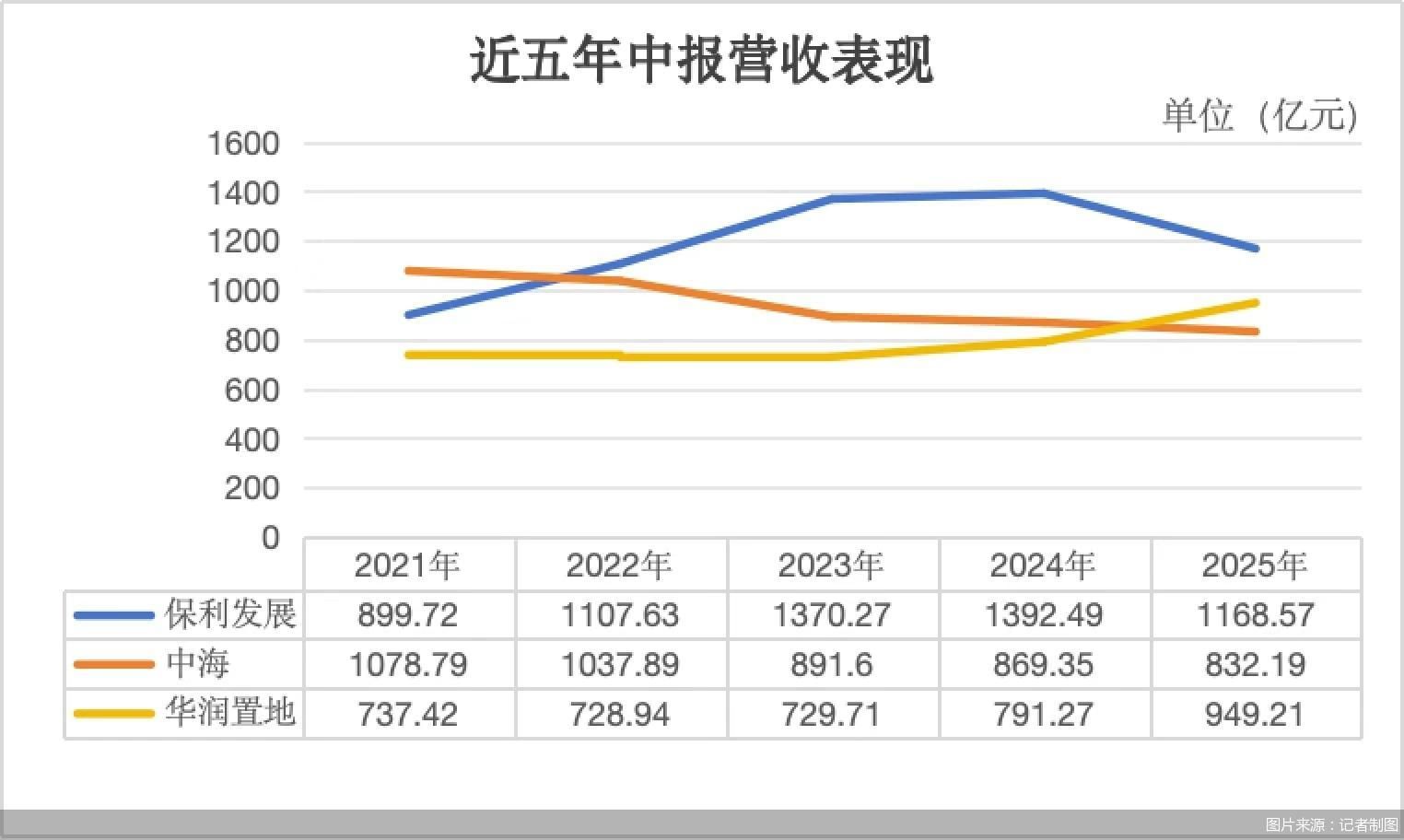
Core Viewpoint - In the first half of 2025, the performance of three leading state-owned real estate companies, Poly Developments, China Overseas Development (CO), and China Resources Land, showed significant differentiation, with China Resources Land emerging as the strongest performer, achieving revenue growth and surpassing CO in net profit [1][4][5]. Revenue and Profit Performance - China Resources Land reported revenue of 949.21 billion yuan, a year-on-year increase of 19.96%, and a net profit of 118.8 billion yuan, up 15.87%, marking two consecutive years of growth [4][5]. - CO's revenue decreased by 4.27% to 832.19 billion yuan, with a net profit decline of 16.63% to 85.99 billion yuan [4][5]. - Poly Developments, despite leading in revenue at 1168.57 billion yuan, experienced a 16.08% decline in revenue and a 63.46% drop in net profit to 27.11 billion yuan, marking its first revenue decline in five years [5][10]. Growth in Operational Real Estate - China Resources Land's operational real estate revenue reached 121.1 billion yuan, growing by 5.5%, contributing significantly to its profit performance [7]. - CO's operational real estate revenue was 35.4 billion yuan, accounting for less than 5% of total revenue, while Poly Developments reported only 25.4 billion yuan in operational real estate revenue, indicating a clear gap compared to China Resources Land [8][10]. Land Acquisition and Market Confidence - All three companies increased their land acquisition efforts, focusing on first-tier cities, with Poly Developments leading with 509 billion yuan in land costs for 26 new projects [11][12]. - CO and China Resources Land also significantly increased their land acquisition, indicating strong confidence in the market's recovery [11][12]. - The strategy of focusing on core first and second-tier cities is seen as a way to leverage traditional advantages in development and ensure quicker capital turnover [12][13]. Strategic Recommendations - To balance core development and new growth points, companies are advised to adopt four core principles: match investment with sales, align production with sales capacity, adjust marketing strategies based on market demand, and respect market and policy dynamics [13].



上半年净亏37亿元!金地集团同比亏损进一步扩大
Nan Fang Du Shi Bao· 2025-08-29 22:33
Core Viewpoint - The financial report of the company reflects the severe challenges faced by the Chinese real estate industry during a deep adjustment period, with significant declines in revenue and profit metrics [2][3]. Financial Performance - In the first half of 2025, the company achieved operating revenue of 15.678 billion yuan, a year-on-year decrease of 25.8% [2][3]. - The company's net profit attributable to shareholders was -3.701 billion yuan, a decline of 10.13% year-on-year, indicating continued pressure on performance [2][3]. - The net profit margin was -27.28%, down 29.66% year-on-year, while the gross profit margin increased by 19.27% to 13.17% [2][3]. Cash Flow and Operational Challenges - The company reported a net cash flow from operating activities of -1.258 billion yuan, a significant decline of 127.40%, marking the first cash outflow from operations in nearly four years [4]. - The decline in sales was cited as the primary reason for the negative cash flow [4]. Strategic Adjustments - The company is focusing on enhancing its core business through product improvement and resource optimization to restore operational momentum [4][5]. - As of the reporting period, the total land reserve was approximately 27.01 million square meters, with equity land reserves of about 11.62 million square meters, and 79% located in first and second-tier cities [5]. Organizational Changes - The company underwent significant management changes, described as the largest management overhaul in its history, with the founder's team completely stepping down [6][7]. - The organizational structure was adjusted from a three-tier to a 2.5-tier management model, aiming to streamline operations and enhance decision-making efficiency [6][7]. - The company reported a reduction in both sales and management expenses, with sales expenses at 524.5 million yuan (down 24.23%) and management expenses at 1.079 billion yuan (down 17.95%) [7].

半年报观察︱董事长杨扬上任两年 金融街净亏损终于同比收窄
Mei Ri Jing Ji Xin Wen· 2025-08-20 16:53
Core Viewpoint - Financial Street reported a significant decline in revenue and a net loss for the first half of the year, raising concerns about its future profitability and strategic direction [1][3]. Financial Performance - The company achieved an operating income of 4.655 billion yuan, a year-on-year decrease of 51.79% [1]. - The net profit attributable to shareholders was a loss of 1.008 billion yuan, which represents a reduction in losses by 49.20% compared to the previous year [1]. - Cash flow from investment activities was 519 million yuan, up from 151 million yuan in the same period last year [1]. Asset Transactions - Financial Street completed the sale of two core hotel assets, receiving a total transaction amount of 527 million yuan for the sale of Tianjin Regent Hotel and Huizhou Sheraton Hotel [2]. - The sale of Tianjin Regent Hotel involved transferring 100% equity and all debts to a related party for a total of 527 million yuan, with the equity transfer valued at 235 million yuan and the debt at 292 million yuan [2]. - The final sale price for Huizhou Sheraton Hotel was approximately 275 million yuan, significantly lower than its previous listing price of 760 million yuan [2]. Leadership and Strategic Direction - Under the leadership of Chairman Yang Yang, who took office in September 2023, the company has faced substantial losses, totaling over 14 billion yuan in the past two years [3]. - Yang Yang has a long history with the company, having joined in 1992, and is expected to navigate the firm through the current downturn in the real estate sector [3]. - The company plans to enhance its real estate development operations, focusing on sales management and project investment that aligns with its strategic goals [4]. Operational Adjustments - The asset management division will adjust its leasing strategies based on market conditions and improve property management services to stabilize occupancy rates [5]. - There is an emphasis on revitalizing existing projects and enhancing resource integration capabilities to explore new profit avenues [5].
