房地产新模式构建

Search documents
市场周报 | 两会报告定调“着力稳市场”,30城第9周成交环比再降14%(2026.3.2-3.6)
克而瑞地产研究· 2026-03-10 09:29
Core Viewpoint - The article emphasizes the Chinese government's commitment to stabilizing the real estate market, with a focus on tailored policies for different cities to control supply, reduce inventory, and optimize housing supply, indicating a shift towards ensuring housing security and high-quality development in the sector [1]. Group 1: Central Government Policies - The government work report from the two sessions highlights the need to stabilize the real estate market, reiterating the importance of city-specific policies to control supply, reduce inventory, and optimize housing supply [1]. - The "14th Five-Year Plan" draft emphasizes promoting high-quality development in real estate, positioning it as a key area for public welfare rather than merely a risk mitigation strategy [1]. - The report calls for enhanced housing security for newly married and childbearing families, linking housing policy with population development strategies [1]. Group 2: Local Government Initiatives - Shenzhen has introduced new regulations that exempt certain urban renewal projects from mandatory affordable housing requirements [2]. - Zhengzhou is promoting the development of prefabricated housing, allowing for a 20% increase in housing provident fund loan limits for these properties [2]. - Nanchong has implemented new policies to support first-time marriages, providing a one-time interest subsidy based on 1% of the loan amount [2]. Group 3: Market Performance - In the 9th week of 2026, the transaction volume of new residential properties in 30 major cities decreased by 14% compared to the previous week and by 58% year-on-year, indicating a continued low absolute volume [5][7]. - First-tier cities are experiencing the largest declines in transaction volume, while second-tier cities have shown a quicker recovery post-holiday, with a 15% decrease compared to the average for the year [6][7].


9月房价数据出炉!同比降幅继续收窄
Zhong Guo Zheng Quan Bao· 2025-10-20 04:47
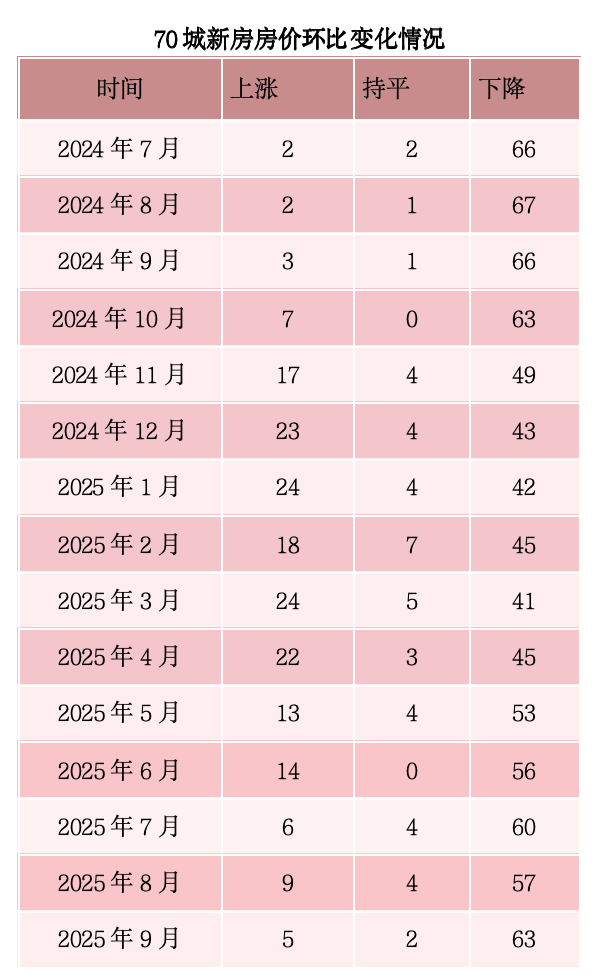
Core Insights - In September, the sales prices of new residential properties in 70 large and medium-sized cities showed a month-on-month decline, with the rate of decline narrowing year-on-year [1][7] Group 1: New Residential Property Prices - In first-tier cities, new residential property prices decreased by 0.3% month-on-month, with Beijing and Shanghai experiencing slight increases of 0.2% and 0.3%, while Guangzhou and Shenzhen saw declines of 0.6% and 1.0% respectively [1] - Second-tier cities experienced a month-on-month decline of 0.4% in new residential property prices, while third-tier cities also saw a 0.4% decline [1] - Year-on-year, first-tier cities' new residential property prices fell by 0.7%, with Shanghai increasing by 5.6% and Beijing, Guangzhou, and Shenzhen decreasing by 2.6%, 4.1%, and 1.8% respectively [7] Group 2: Second-hand Residential Property Prices - In September, second-hand residential property prices in first-tier cities decreased by 1.0% month-on-month, with declines in Beijing, Shanghai, Guangzhou, and Shenzhen of 0.9%, 1.0%, 0.8%, and 1.0% respectively [1] - Second and third-tier cities saw month-on-month declines of 0.7% and 0.6% in second-hand residential property prices [1] - Year-on-year, first-tier cities' second-hand residential property prices fell by 3.2%, with Beijing, Shanghai, Guangzhou, and Shenzhen experiencing declines of 2.7%, 2.4%, 6.0%, and 1.7% respectively [7] Group 3: Market Outlook - The research center expects that in the fourth quarter, relevant departments will continue to focus on high-quality urban development and the construction of new real estate models [8] - Policies will likely be implemented to support affordable housing and urban renewal projects, aiming to accelerate inventory reduction and the establishment of new models in the industry [8]