执源治理

Search documents
省高院发布司法改革研究成果“贵法智库丛书”
Xin Lang Cai Jing· 2026-01-31 22:37
Core Insights - The Guizhou Provincial High Court has launched the "Guizhou Law Think Tank Series" to present research outcomes from judicial reform practices and theoretical studies in the court system [1][2] Group 1: Publication Overview - The "Guizhou Law Think Tank Series" was initiated in 2024, involving collaboration with the People's Court Publishing House and extensive research on key judicial issues over two years [1] - The series consists of three main sections: "Practice and Exploration of Source Governance," "Practice and Outlook of Digital Court Construction," and "Guidelines for Common Case Trial Elements in Guizhou Courts" [1] Group 2: Focus Areas - "Practice and Exploration of Source Governance" addresses the effective resolution of execution difficulties and highlights Guizhou's pioneering institutional innovations in source governance [1] - "Practice and Outlook of Digital Court Construction" discusses the application of new technologies such as big data and artificial intelligence in the judicial field, summarizing innovative practices like the "single set" electronic file system and collaborative case handling [1] - The "Guidelines for Common Case Trial Elements" focuses on common crimes and case types, with 20 items expected to be completed by 2025 and published in batches over three years to provide practical guidance for frontline judges [1] Group 3: Performance Metrics - The Guizhou court system emphasizes "justice and efficiency" throughout its operations, implementing a comprehensive strategy that has led to consistent achievement of trial quality indicators for two consecutive years [2] - The rate of resolving disputes after judgment remains high at 98.55%, reflecting the effectiveness of the court's initiatives [2]
法院多措并举解决执行难
Xin Lang Cai Jing· 2026-01-28 19:57
Core Insights - The Jilin Provincial High Court aims to maintain its leading position in execution work quality by implementing comprehensive cross-execution efforts and enhancing preemptive governance measures, achieving an execution rate of 98.6% in 2022, ranking first nationally for three consecutive years [1][2] Group 1: Execution Work - In 2022, Jilin courts accepted 147,600 execution cases and concluded 145,500 cases, maintaining a high execution rate of 98.6% [1] - The court focuses on three categories of key cases: those with strong correlations, concentrated public complaints, and long-standing unresolved cases, utilizing systematic screening and feedback mechanisms to ensure efficient execution [1] Group 2: Governance and Resource Management - The Jilin court emphasizes preemptive governance by enhancing property preservation efforts and establishing a mediation mechanism that integrates successful mediation with execution [1] - The court is managing the termination of execution procedures by concentrating judicial resources on cases with assets, thereby improving efficiency in handling execution cases [2] Group 3: Market Dynamics and Corporate Restructuring - The Jilin court is actively addressing execution backlog while facilitating the exit of non-viable market entities through efficient bankruptcy liquidation processes, effectively clearing a significant number of "zombie companies" [2] - For viable companies, the court employs bankruptcy reorganization and settlement strategies to help them overcome crises, particularly in complex cases involving multiple creditors and unfinished housing projects [2]
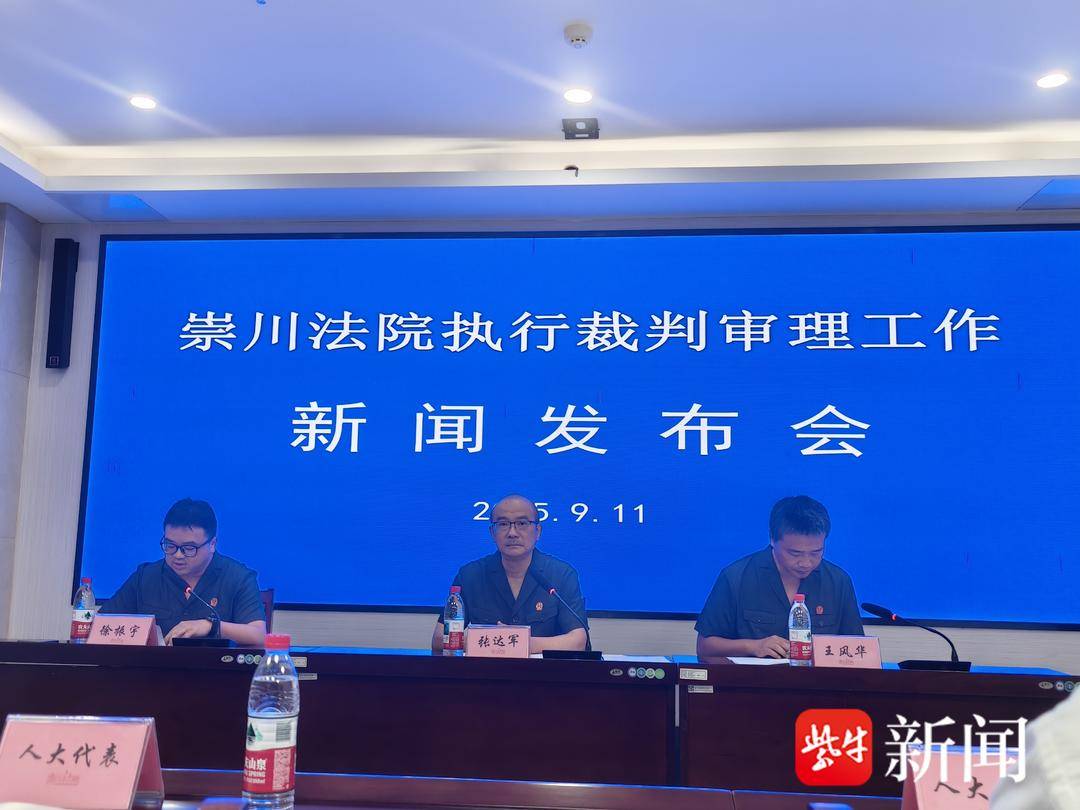
崇川法院:多维发力破解执行裁判难题 “执”写司法为民答卷
Yang Zi Wan Bao Wang· 2025-09-11 11:04
Core Viewpoint - The execution process in judicial cases is crucial for achieving fairness and justice, and the execution tribunal plays a key role in resolving disputes and protecting the legal rights of the public [1] Group 1: Execution Case Statistics - From 2022 to the first half of 2025, the Chongchuan Court accepted a total of 817 execution objection cases and 210 execution objection lawsuits, with 822 execution objection cases and 182 execution objection lawsuits concluded [3] - The annual case acceptance numbers show an overall declining trend, indicating the effectiveness of the court's governance work [3] Group 2: Case Structure and Challenges - Disputes in cases are primarily concentrated on issues such as "discrepancy between name and reality" of property rights and conflicts of multiple rights, with the highest proportion of cases involving third parties claiming ownership to exclude execution [3] - New types of objections, such as residential rights and leasing rights, are gradually emerging [3] Group 3: Innovative Mechanisms - To address challenges in execution adjudication, the Chongchuan Court has implemented innovative mechanisms, including the responsibility system and case review mechanism, enhancing business learning to improve the quality and efficiency of execution adjudication [3] - The court has established a pre-examination mechanism for execution disputes to promote substantive resolution of objections and prevent abuse of objections through a warning mechanism [3] Group 4: Judicial Principles and Case Examples - The execution adjudication work emphasizes the principle of good faith and civilized execution, prioritizing the review of cases involving survival rights and promptly lifting improper execution measures [4] - A typical case involved the court supporting the rental rights of two employees living in a property seized during execution, highlighting the need to respect historical welfare housing rights [4] Group 5: Future Directions - The Chongchuan Court plans to continue deepening reforms in execution adjudication mechanisms to address execution difficulties and contribute to the protection of legal rights and the optimization of the legal business environment [4]