技术栈

Search documents
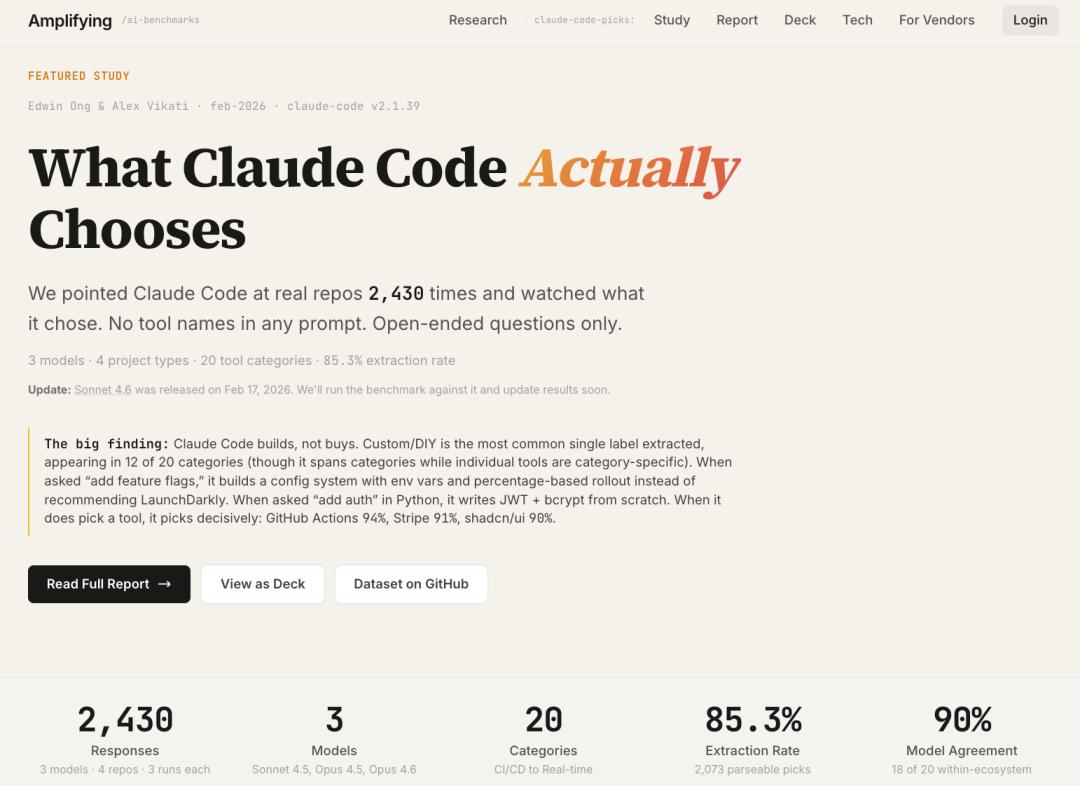
Claude Code“隐形技术栈”被扒出来了,2430次测试揭秘工具偏好清单
3 6 Ke· 2026-02-27 09:27
Core Insights - The study conducted by Amplifying.ai reveals Claude Code's preference for building custom solutions over recommending third-party tools, with 12% of all major selections being self-built solutions [5][27] - A default technology stack has emerged, with Claude Code favoring specific third-party tools such as Vercel, PostgreSQL, and Stripe [6][30] - Certain tool categories have become dominated by single tools, with GitHub Actions, Stripe, and shadcn/ui capturing 94%, 91%, and 90% of their respective categories [7][31] - Consistency in tool selection is high among different models within the same technology ecosystem, with 90% agreement on preferred tools across 20 categories [8][49] Experiment Setup - The research covered three models and involved 4 project types and 20 tool categories, analyzing a total of 2,430 tool selection behaviors [2][11] - Open-ended prompts were used throughout the experiment, ensuring no specific tool names were mentioned [4][13] - The study included a clean code environment for each test run to ensure unbiased results [11] Key Findings - Claude Code shows a strong inclination towards self-built solutions, particularly in feature flags and authentication, where it frequently opts for custom implementations [27][28] - The study identified a high extraction rate of 85.3%, indicating a strong ability to identify primary tool recommendations from responses [19] - The models demonstrated varying preferences, with Opus 4.6 showing a tendency to recommend newer tools and custom solutions compared to its predecessors [56] Tool Selection Preferences - GitHub Actions, Stripe, and shadcn/ui are the most frequently recommended tools, dominating their respective categories with high selection rates [30][31] - The study highlights that project context significantly influences tool selection, with different models showing consistent preferences within the same technology ecosystem [9][62] - The research indicates a trend towards custom solutions, particularly in areas like feature flags and authentication, where models prefer building from scratch rather than using established services [47][39] Model Comparison - The three models (Sonnet 4.5, Opus 4.5, Opus 4.6) showed high agreement on tool preferences, with only a few categories exhibiting real divergence [49][50] - The study emphasizes that the choice of tools is heavily influenced by the specific programming ecosystem, with distinct preferences emerging for JavaScript and Python projects [61][62] - The models' recommendations reflect a shift towards a new technology stack shaped by AI-assisted development, indicating a potential change in industry standards [62]

“陪伴”不是好赛道,但是个至关重要的“技术栈”
Hu Xiu· 2025-08-18 09:08
Group 1 - The core idea is that while the demand for "companionship" exists, it is not a strong enough need to support a standalone market, as users often turn to cheaper alternatives for alleviating loneliness [2][3][4] - The concept of "effective proactivity" is highlighted as a crucial capability in the AI era, allowing products to build a more interactive relationship with users by remembering preferences and anticipating needs [12][13] - The comparison is made between the "companionship" market and the early GPS products, which failed as standalone offerings but became essential infrastructure in mobile internet applications [10][11] Group 2 - The article suggests that "companionship" should not be overestimated as a market but should be recognized as an important technological stack that can enhance existing products [5][14] - Companies should be cautious not to package a foundational capability like "companionship" as an independent demand, but rather integrate it into products that solve real user problems [14] - The relationship formed through proactive engagement can significantly enhance user lifetime value (LTV) and create a competitive moat for companies [13][14]
没有防御性编程,Rust服务稳定到不需要维护,然后老板说不需要我们了...
菜鸟教程· 2025-06-05 12:05
Core Insights - The article illustrates the paradox of success in technology, where a highly efficient system can lead to the perception that fewer developers are needed, ultimately jeopardizing the use of that technology [1][29]. Group 1: Technical Debt - The company had a traditional tech stack and needed to develop a real-time service to support 100,000 concurrent users, displaying user activity information [2]. - The initial choice of Ruby was deemed inadequate, prompting discussions on technology selection [3]. Group 2: Technology Selection Battle - The development team proposed using Rust, but management was cautious and requested comparisons with other languages [4][5]. - Concept validation versions were created using Elixir, Rust, Ruby, and Node.js, with Rust being developed by a novice [5][6]. Group 3: Performance Results - The performance results showed Rust as the fastest and most memory-efficient option, followed by Elixir, Node.js, and Ruby [8][10]. - The final decision favored Rust not only for its performance but also for its versatility in future applications [10]. Group 4: Rapid Development - Due to time constraints, a single developer with Rust experience was tasked to lead the project, collaborating closely with the team [11][13]. - The architecture was designed to handle 100,000 connections efficiently, utilizing a WebSocket-based API and in-memory data storage [14]. Group 5: Performance Challenges - The service performed stably under the expected load, but management later decided to shift it to maintenance mode, leading to a lack of oversight [16]. - The service was initially successful, but as the company expanded, management questioned the need for Rust developers due to the service's stability [19][20]. Group 6: Management Decisions - The new director's perspective led to the departure of experienced Rust developers, as they were deemed unnecessary due to the service's lack of issues [22]. - The decision to abandon Rust in favor of more mainstream technologies raised concerns about the existing Rust service's future [23]. Group 7: Node.js Rewrite Attempt - The attempt to rewrite the service in Node.js failed due to its single-threaded nature, which could not handle the required load [24][25]. - The company resorted to using a third-party service, which also proved inadequate [26]. Group 8: Lessons Learned - The Rust service continued to operate effectively but without a dedicated maintenance team, highlighting the risks of having a highly efficient system [28][29]. - The article concludes that sometimes, a less-than-perfect system may be perceived as safer, emphasizing the impact of management changes on technical decisions [29].